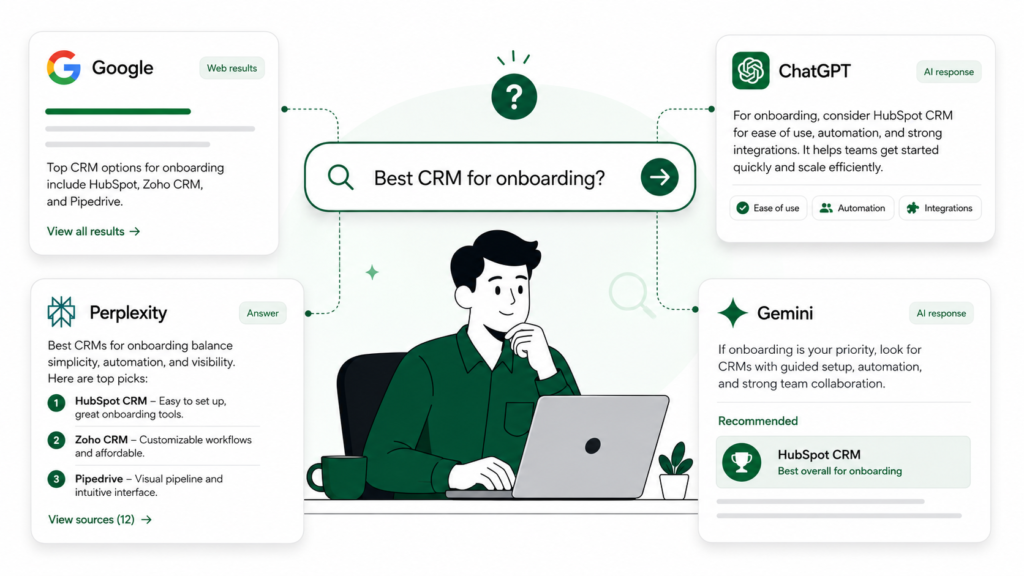
AEO content is content built to answer buyer questions in a clear, direct, and structured way.
For SaaS brands, AEO content helps blog posts, feature pages, comparison pages, glossary pages, and help-center articles get understood by Google AI Overviews, ChatGPT, Perplexity, Gemini, and traditional search engines.
SaaS buyers no longer follow 1 search path.
They search on Google. They ask ChatGPT for tool lists. They compare vendors in Perplexity. They use Gemini for quick research. They still check product pages, review sites, and social proof before they book a demo.
As a B2B SaaS content writer, I see AEO content as a structure problem first. Your page needs a clear answer, a clear topic, SaaS examples, entity signals, internal links, and enough depth to earn trust.
Not longer content.
Clearer content.
Table of Contents
What Is AEO Content?
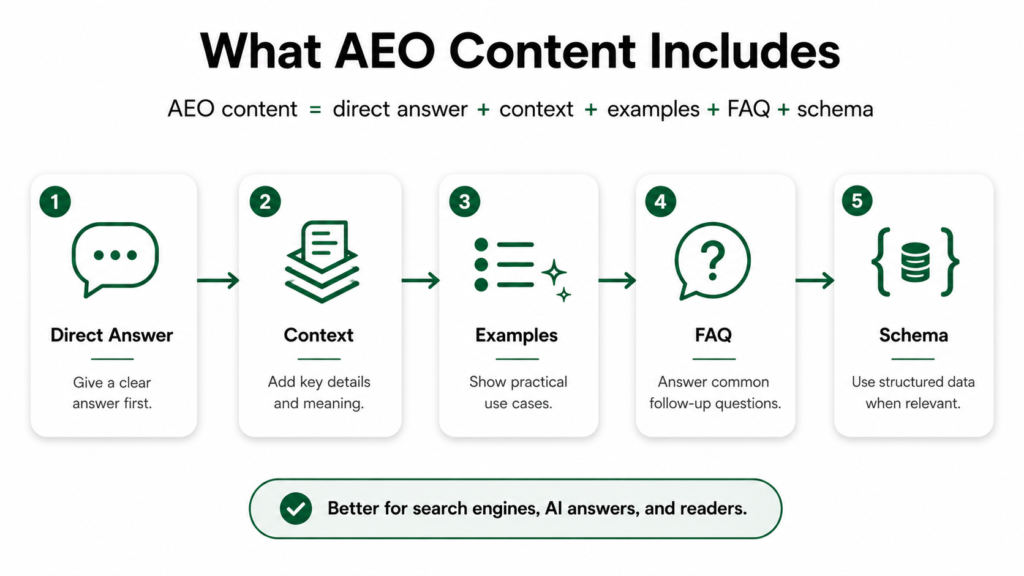
AEO content is SaaS content structured to answer a specific buyer question clearly.
It helps search engines and AI tools like Google AI Overviews, ChatGPT, Perplexity, and Gemini understand the page, extract the answer, and present the brand in direct search results.
AEO stands for answer engine optimization.
AEO content is content written for answer-based search. It gives a direct answer first, then adds context, examples, steps, comparisons, and FAQs.
For SaaS brands, AEO content often answers questions like:
- What is customer onboarding software?
- How does churn prediction work?
- CRM vs marketing automation: what is the difference?
- What is AEO content for SaaS?
- How do SaaS brands improve AI search visibility?
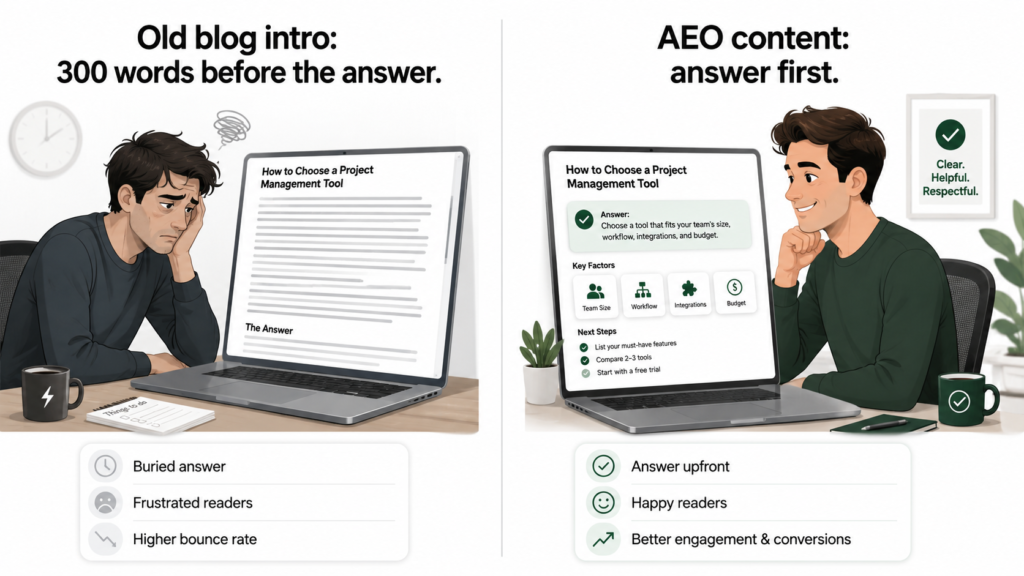
Traditional blog content often starts with a long intro. AEO content starts with the answer. Then it proves the answer with clear sections and useful context.
My recommendation: do not write AEO content as “content for AI.” Write it for a busy SaaS buyer who wants the answer now.
That structure also helps AI tools understand the page.
Why AEO Content Matters for SaaS Brands
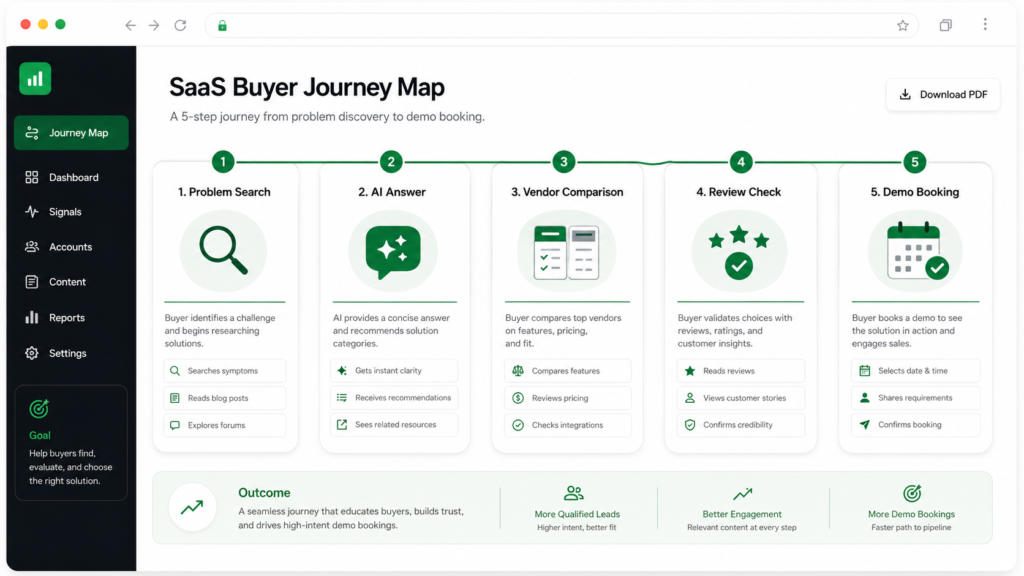
AEO content matters for SaaS brands because buyers now ask AI tools and search engines for software comparisons, workflow advice, and product recommendations.
Clear answer-first content gives SaaS brands a better chance to appear during early research, not only after buyers search for a brand name.
SaaS buying journeys start long before a pricing page visit.
A buyer often starts with a problem:
- “How do I reduce customer churn?”
- “What is the best CRM for a small sales team?”
- “How does onboarding software help activation?”
- “What is the difference between HubSpot and Salesforce?”
- “Which email automation tool fits a creator business?”
These searches show problem awareness, product research, and comparison intent.
AEO content helps your SaaS brand show up in those moments.
This matters because AI search gives users fewer answers at the top. If your page fails to give a clean answer, another brand gets that visibility.
SaaS readers skim. They want the answer, the context, the proof, and the next step. They do not want a long intro before the main point.
My experience: SaaS brands lose content opportunities because the answer exists on the page, but it sits too far down or sounds too vague.
AEO fixes that.
AEO Content vs SEO Content: What’s the Difference?
SEO content helps SaaS pages rank in search results. AEO content helps those pages become clear answers for search engines and AI tools.
The best SaaS content uses both: SEO for visibility and AEO for direct, structured answers that match buyer questions.
SEO and AEO do not fight each other.
SEO helps search engines find, crawl, index, and rank your page. It covers keywords, search intent, internal links, backlinks, site structure, metadata, and technical health.
AEO helps search engines and AI tools understand the answer inside the page.
That answer matters for featured snippets, Google AI Overviews, ChatGPT responses, Perplexity summaries, Gemini answers, and other answer-led search results.
| Area | SEO content | AEO content |
|---|---|---|
| Main goal | Rank in search results | Appear in direct answers |
| Structure | Keyword-led sections | Question-led sections |
| First section | Context and hook | Direct answer |
| Best formats | Blogs, landing pages, guides | FAQs, definitions, steps, comparisons |
| SaaS use case | Rank for “CRM automation software” | Answer “what is CRM automation?” |
| Success signal | Rankings, clicks, traffic | Snippets, AI mentions, cited answers |
A SaaS article still needs a primary keyword, search intent match, internal links, metadata, and a clean outline.
But AEO adds 1 more test:
Does each section stand alone as a useful answer?
A weak section says, “Many companies look for better ways to manage customers.”
A stronger AEO section says, “CRM automation helps SaaS teams reduce manual sales tasks by automating lead routing, follow-ups, lifecycle emails, and pipeline updates.”
The second sentence gives the topic, audience, action, and use case.
That is the standard I use for SaaS AEO writing.
What Makes SaaS AEO Content Effective?
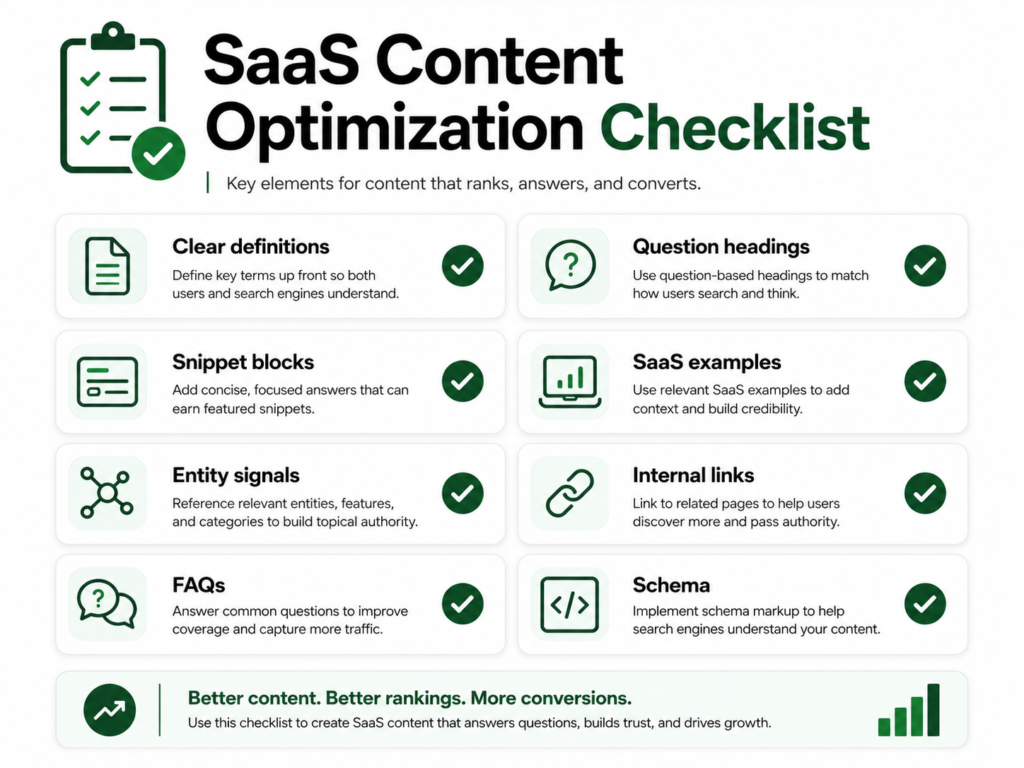
Effective SaaS AEO content includes clear definitions, question-based headings, short answer blocks, product-led examples, entity signals, internal links, FAQs, and schema markup.
These elements help both buyers and answer engines understand what the page explains and why it matters.
AEO content needs more than a FAQ section at the bottom.
The full page needs answer-first structure.
Start with clear definitions.
Use this structure:
“[Concept] is [simple definition] that helps [specific SaaS audience] do [specific job].”
Example:
“Customer onboarding software is a tool that helps SaaS teams guide new users from signup to product activation.”
Then add short answer blocks under major H2s. Aim for 40–60 words. These blocks help with featured snippets, AI Overviews, and plain user experience.
Use question-based headings that match real SaaS buyer questions:
- What is AEO content?
- How does AEO content work?
- Why does AEO matter for SaaS brands?
- How do you optimize SaaS content for AI answers?
- What schema should SaaS AEO content use?
Add product-led examples too.
A CRM article should mention sales pipelines, lead scoring, HubSpot, Salesforce, lifecycle emails, and sales team workflows.
A project management article should mention tasks, timelines, boards, Notion, Asana, ClickUp, and remote teams.
Entity signals also matter.
For this article, useful entities include Google AI Overviews, ChatGPT, Perplexity, Gemini, HubSpot, Salesforce, Notion, Asana, Mailchimp, featured snippets, structured data, FAQPage schema, Article schema, and search intent.
Use entities where they help explain the topic. Do not force them.
For a deeper example of answer-first structure, read why SaaS blogs answer too late.
For schema, use Article schema for the main article.
Add FAQPage schema when the article has strong FAQs.
Use HowTo schema only for a clear step-by-step process.
How to Create AEO Content for SaaS
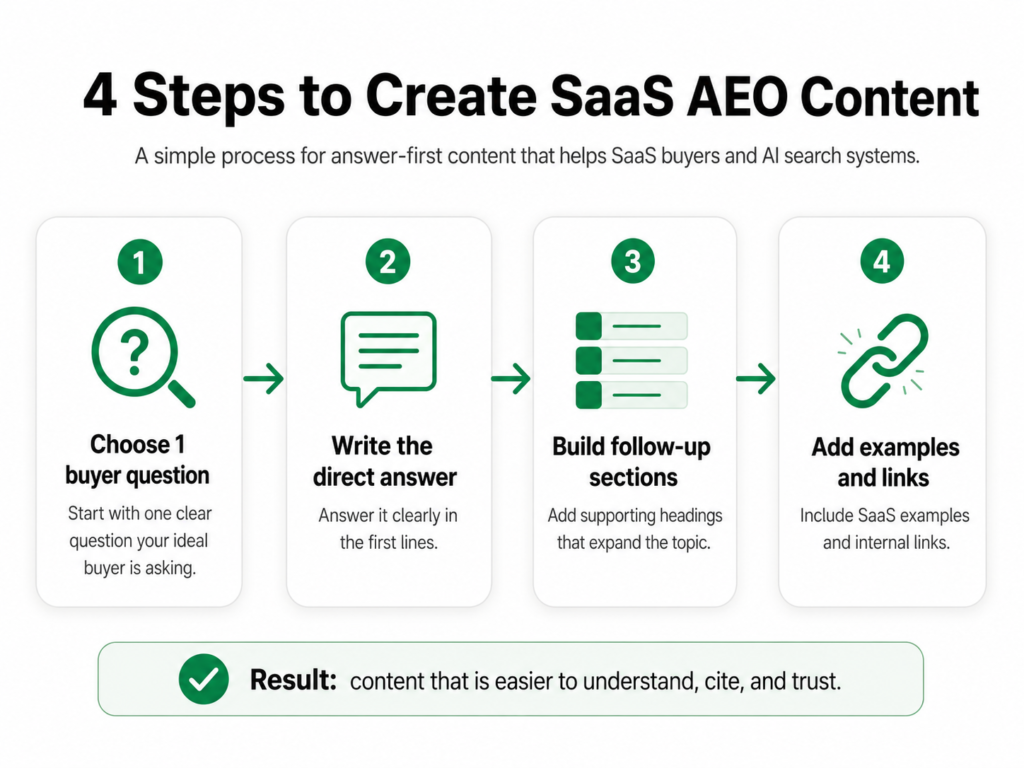
To create AEO content for SaaS, choose 1 buyer question, answer it in 40–60 words, expand with SaaS context, add examples, include related questions, link to relevant pages, and add Article or FAQPage schema.
AEO content works best when the page has a clear job from the start.
Step 1: Choose 1 buyer question
Do not start with a broad topic like “automation.”
Start with a question like:
“What is sales automation software?”
For this article, the target question is “What is AEO content?”
The audience is a SaaS content marketing manager. They know SEO basics. They need help with answer engines, content structure, AI search visibility, and conversions.
Step 2: Write the direct answer first
Write the answer before the intro.
Use this formula:
“[Main keyword] is [definition]. For SaaS brands, it helps [specific result] by [specific method].”
Example:
“AEO content is SaaS content structured to answer buyer questions clearly. It helps search engines and AI tools understand the page, extract the answer, and present the brand in direct search results.”
That answer belongs near the top of the article.
Step 3: Build sections around follow-up questions
After the first answer, write the questions the reader asks next.
For this topic, those questions are:
- What is AEO content?
- Why does it matter for SaaS?
- How is AEO different from SEO?
- What makes AEO content effective?
- How do you create AEO content?
- What are SaaS examples?
- How do you measure performance?
This structure matches informational search intent.
Step 4: Add SaaS examples and internal links
Examples make the advice useful.
Use examples from CRM platforms, onboarding software, project management tools, email automation tools, product analytics tools, and help desk software.
Mention real tools where relevant, such as HubSpot, Salesforce, Notion, Asana, and Mailchimp.
Internal links should help the reader take the next step.
If you want this structure handled for your brand, explore my SaaS SEO and AEO content services.
Examples of AEO Content for SaaS Pages
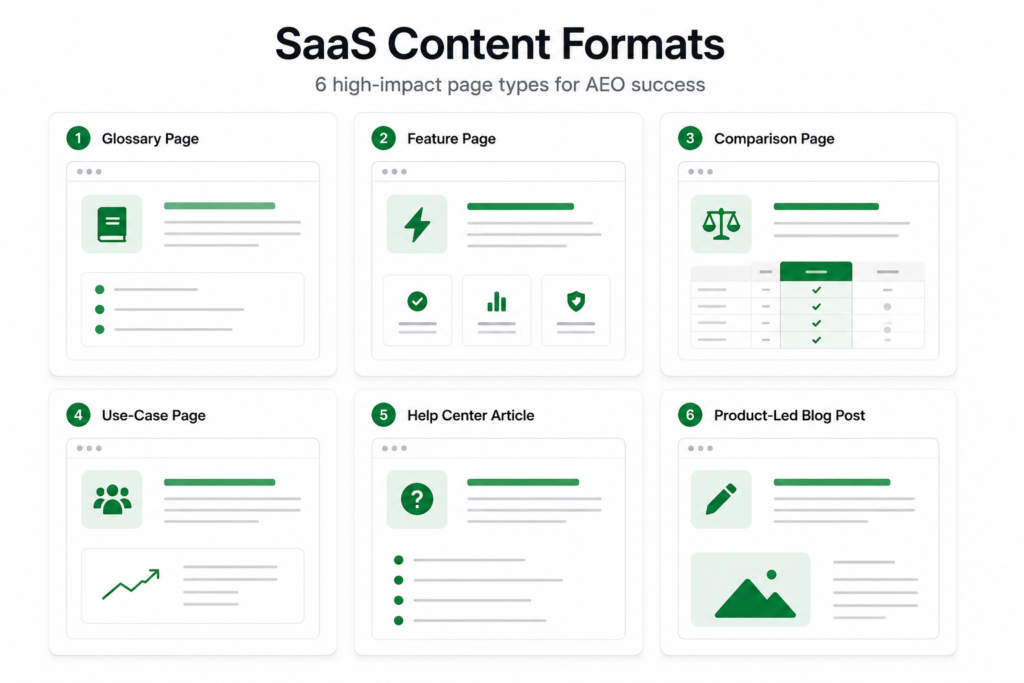
The best SaaS AEO content formats are glossary pages, feature explainers, comparison pages, use-case pages, help-center articles, and product-led blog posts.
These pages work because they answer specific buyer questions before a demo request or sales call.
AEO content fits many SaaS page types.
Glossary pages answer category and concept questions.
Example: “What is customer onboarding software?”
Feature pages explain how a product capability works.
Example: “How does churn prediction work?”
Comparison pages help buyers choose between categories or tools.
Example: “CRM vs marketing automation: what is the difference?”
This page should include a table, direct verdict, use cases, and tool examples like HubSpot, Salesforce, and Mailchimp.
Use-case pages connect the product to a specific job.
Example: “Project management software for remote SaaS teams.”
This page should mention task ownership, async updates, timelines, Notion, Asana, and team workflows.
Help-center articles also support AEO.
Example: “How to set up automated renewal reminders.”
These pages answer support questions, reduce friction, and help AI tools understand product workflows.
Product-led blog posts work well for high-intent research.
Example: “Best project management tools for remote teams.”
This page should include criteria, comparison tables, use cases, and direct answers.
For proof of structure, review my SaaS content portfolio.
How to Measure AEO Content Performance
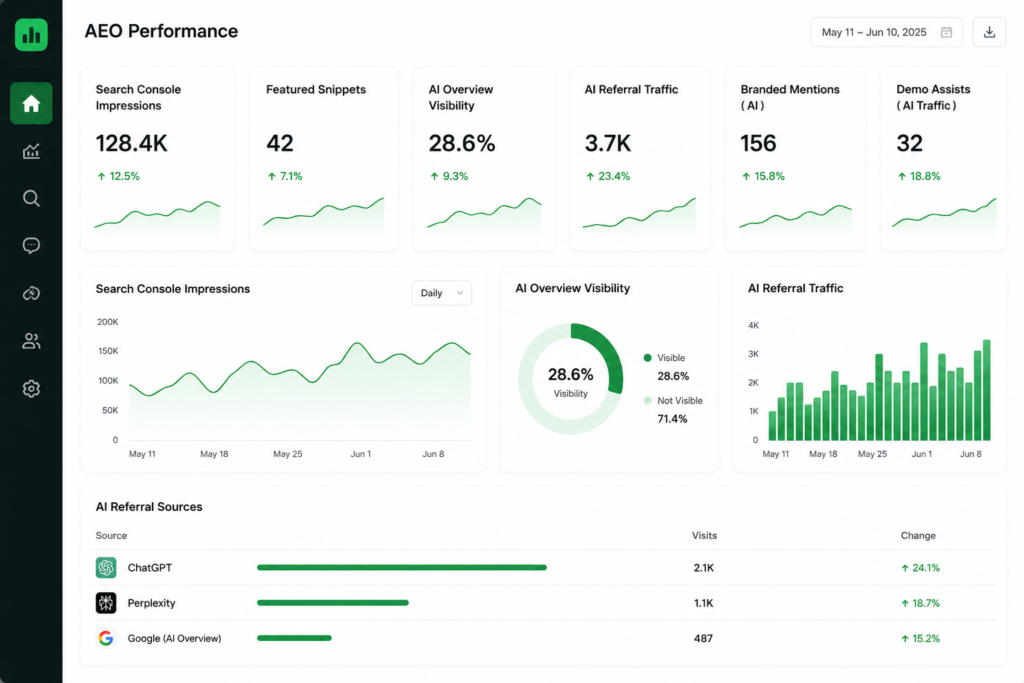
Measure AEO content through Google Search Console impressions, featured snippet wins, AI Overview visibility, branded mentions in ChatGPT, Perplexity, and Gemini, referral traffic from AI tools, branded search growth, and assisted demo or signup conversions.
AEO measurement is not perfect yet.
Still, SaaS teams have useful signals.
Track these metrics:
- Google Search Console impressions
- Organic clicks
- Featured snippet wins
- Google AI Overview appearances
- Branded mentions in ChatGPT, Perplexity, and Gemini
- Referral traffic from AI tools
- Demo assists
- Signup assists
- Branded search growth
- Internal link clicks
- FAQ engagement
Do not judge AEO content only by clicks.
A buyer sees your brand in an AI answer, searches your brand later, reads a comparison page, and books a demo after 3 visits.
That path will not always show as a clean click from the first article.
My experience: AEO content often helps with visibility before attribution tools show the full value.
That is why I track both search metrics and business metrics.
For a related framework, read SEO vs AEO vs GEO for SaaS brands.
My Recommendation for SaaS Brands
SaaS brands should start with 3 AEO content assets: 1 glossary article, 1 comparison page, and 1 product-led blog post. Add direct answers, question-based headings, SaaS examples, FAQs, internal links, and Article or FAQPage schema to each page.
Do not rebuild the whole content strategy at once.
Start with 3 assets:
- 1 glossary article
- 1 comparison page
- 1 product-led blog post
For each page, add:
- 1 direct answer near the top
- Question-based H2s
- 40–60-word snippet blocks
- SaaS-specific examples
- 4–6 FAQs
- Internal links
- Article or FAQPage schema
- Named tools and concepts where relevant
Then measure what changes.
Check if the page gets more impressions, earns snippets, appears in AI Overviews, or gets mentioned by ChatGPT, Perplexity, or Gemini.
This gives you a practical baseline.
My personal view as a SaaS SEO writer: AEO content works best when it sounds human and precise at the same time.
Do not write robotic content for AI tools.
Write for a busy SaaS buyer who wants a clear answer, a real example, and a reason to trust you.
That is also the content AI tools prefer to summarize.
Final Takeaway
AEO content helps SaaS brands answer buyer questions in a format that works for search engines, AI tools, and human readers.
The best AEO content gives the answer early, adds SaaS context, uses real examples, includes entity signals, and links the reader to the next helpful page.
Start with 3 assets: a glossary article, a comparison page, and a product-led blog post.
Make each page clear enough for a SaaS buyer to trust and structured enough for answer engines to understand.
If you want help turning your topic into a structured SaaS article, contact me with your SaaS content topic, keyword, audience, word count, and goal.
FAQ
What is AEO content?
AEO content is content structured to answer specific questions clearly so search engines and AI tools use it in direct answers. For SaaS brands, it helps blog posts, feature pages, comparison pages, and help-center articles appear during buyer research.
How does AEO content work?
AEO content gives answer engines clear signals. It uses direct answers, question-based headings, short paragraphs, SaaS examples, entity mentions, FAQs, internal links, and schema markup so tools like Google AI Overviews, ChatGPT, Perplexity, and Gemini understand the page faster.
Is AEO replacing SEO?
No. AEO does not replace SEO. SEO helps SaaS pages rank in traditional search results. AEO helps those same pages answer buyer questions in formats that search engines and AI tools understand.
Why is AEO important for SaaS companies?
AEO is important for SaaS companies because buyers use search engines and AI tools to compare products, understand problems, and shortlist vendors. AEO content helps your brand appear before the buyer reaches a demo or pricing page.
How is AEO content different from regular blog content?
AEO content is more direct than regular blog content. It gives the answer early, uses question-led sections, adds short snippet blocks, includes SaaS-specific examples, and supports the page with FAQs, entity signals, internal links, and schema.
What schema should SaaS AEO content use?
Most SaaS AEO articles should use Article schema. If the page includes several strong questions and answers, add FAQPage schema. If the page explains a clear step-by-step process, HowTo schema also fits.
Need SaaS content built for SEO and AI visibility?
Work with Manal Ghamir on answer-first SaaS content that supports Google rankings, AI search visibility, buyer education, and product clarity.
View Services View Portfolio Contact Manal