This before/after proof asset shows how I turn a broad SaaS blog opening into a clearer, answer-first intro.
The goal is to improve search intent match, buyer clarity, AEO readiness, and AI visibility without changing the core topic.
For this example, I analyzed a SaaS blog intro about failed payments in subscription businesses and rewrote it for founders, finance leads, RevOps managers, and operations teams.
Project details table
| Item | Detail |
|---|---|
| Content type | SaaS blog intro refresh |
| Topic | Failed payments in subscription businesses |
| Target reader | Founder, finance lead, RevOps manager, or operations lead |
| Main buyer question | How do failed payments hurt recurring revenue, and what should we fix first? |
| Main improvement | Turning a generic intro into an answer-first opening |
| Focus | SaaS SEO, AEO, buyer clarity, AI visibility, intro optimization |
| Section | Strategy & Audits |
Overview
This before/after proof asset shows how I turn a broad SaaS blog opening into a clearer, answer-first intro. The goal is to improve search intent match, buyer clarity, and AI visibility without changing the core topic.
For this example, I analyzed a SaaS blog intro about failed payments in subscription businesses and rewrote it to speak more directly to founders, finance leads, RevOps managers, and operations teams.
Strategy Snapshot
| Item | Detail |
|---|---|
| Content type | SaaS blog intro refresh |
| Topic | Failed payments in subscription businesses |
| Target reader | Founder, finance lead, RevOps manager, or operations lead |
| Main buyer question | How do failed payments hurt recurring revenue, and what should we fix first? |
| Main improvement | Turning a generic intro into an answer-first opening |
The original problem
The original intro introduced the topic clearly, but it delayed the useful answer.
A SaaS buyer searching this topic is likely not just asking whether failed payments happen. They want to understand how failed payments affect MRR, churn, customer experience, billing operations, and revenue recovery.
The opportunity was to make the opening more specific, more useful, and easier for both readers and AI systems to understand.
Before and After
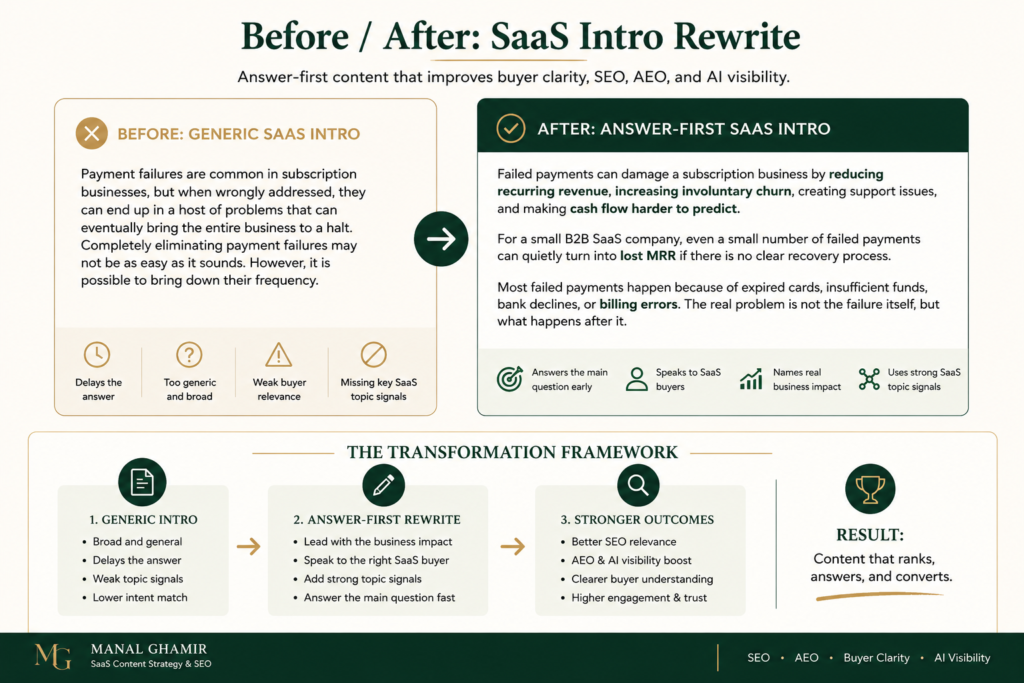
Before: Generic SaaS intro
Payment failures are common in subscription businesses, but when wrongly addressed, they can end up in a host of problems that can eventually bring the entire business to a halt. Completely eliminating payment failures may not be as easy as it sounds, however, it is possible to bring down its frequency.
Why This Opening Could Perform Better
- It introduces the topic, but does not answer the main question early enough.
- It says failed payments cause problems, but does not name the specific SaaS impact.
- It uses broad phrases like “host of problems” instead of concrete outcomes.
- It does not speak directly to SaaS buyers managing MRR, retention, billing, and payment recovery.
- It misses useful topic signals such as involuntary churn, failed payment recovery, dunning, payment retries, and recurring revenue.
After: Answer-first SaaS intro
Failed payments can damage a subscription business by reducing recurring revenue, increasing involuntary churn, creating support issues, and making cash flow harder to predict.
For a small B2B SaaS company, even a small number of failed payments can quietly turn into lost MRR if there is no clear recovery process.
Most failed payments happen because of expired cards, insufficient funds, bank declines, or billing errors. The real problem is not the failure itself, but what happens after it.
If the customer is not notified, retries are not timed well, or access is interrupted too early, a recoverable payment issue can become a lost account.
Reducing failed payments starts with better subscription billing, smart payment retries, clear dunning emails, and a process for tracking recovery.
This article breaks down the hidden costs of failed payments and how SaaS teams can reduce them before they affect growth.
What changed
| Before | After |
|---|---|
| Opens with a broad warning | Opens with the business impact |
| Says failed payments cause “problems” | Names lost MRR, churn, support issues, and cash flow risk |
| Speaks generally to subscription businesses | Speaks to small B2B SaaS teams |
| Delays the answer | Answers the main question in the first sentence |
| Has weak entity clarity | Adds SaaS-specific topic signals |
Why this version is stronger
The rewritten intro gives the reader the answer first: failed payments hurt recurring revenue, increase involuntary churn, create support issues, and make cash flow harder to predict.
It also gives SaaS buyers a clearer reason to keep reading. Instead of only warning that failed payments are common, the new version explains what actually goes wrong and what the article will help them understand: billing recovery, payment retries, dunning, and retention protection.
Why this matters for SaaS SEO, AEO, and AI visibility
For SaaS SEO, the rewrite improves relevance by using clearer language around subscription billing, failed payment recovery, recurring revenue, MRR, and churn.
For AEO, it answers the main question early instead of making the reader wait.
For AI visibility, it strengthens entity clarity by connecting the article to related concepts like dunning emails, payment retries, involuntary churn, revenue recovery, and subscription operations.
Strategy Takeaway
This is the kind of improvement I focus on in SaaS content refreshes: not just making the writing sound better, but making the content clearer, more useful, and easier to understand for buyers, search engines, and AI systems.
A stronger intro does not need to be longer. It needs to answer faster, use clearer topic signals, and give the reader a reason to keep going.
FAQ
What is an answer-first SaaS intro?
An answer-first SaaS intro gives the reader the main answer immediately, then expands with context, examples, and next steps. It helps SaaS buyers understand the topic faster and makes the content easier for search engines and AI tools to interpret.
Why do SaaS blog intros need to answer faster?
SaaS blog intros need to answer faster because buyers often scan before reading deeply. A clearer intro improves search intent match, reduces confusion, and helps readers decide whether the article is useful within the first few seconds.
How does an intro rewrite improve SaaS SEO?
An intro rewrite can improve SaaS SEO by making the topic, audience, problem, and value clearer from the start. It can also add stronger topic signals, related terms, and buyer-focused language that better matches search intent.
How does answer-first content support AEO?
Answer-first content supports AEO by placing a clear answer near the top of the page. This makes it easier for answer engines, featured snippets, and AI search tools to identify the main point and understand the page structure.
What makes a SaaS content refresh effective?
A SaaS content refresh is effective when it improves clarity, search intent match, buyer relevance, structure, internal links, and topic signals. The goal is not only better writing, but content that is easier for buyers, search engines, and AI systems to understand.
Need SaaS content built for SEO and AI visibility?
Work with Manal Ghamir on answer-first SaaS content that supports Google rankings, AI search visibility, buyer education, and product clarity.
View Services View Portfolio Contact Manal