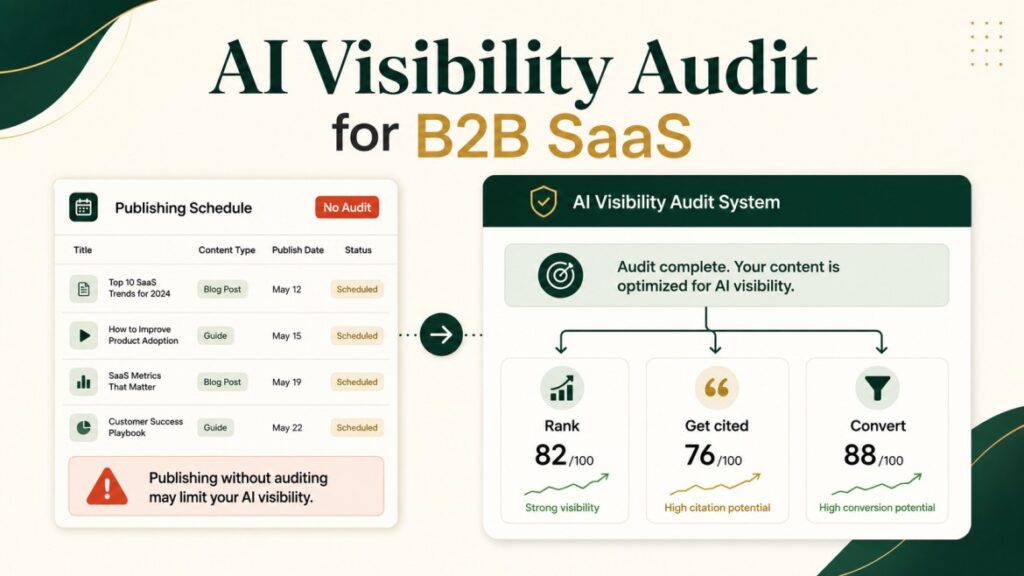
Publishing more content is not always the fix.
For many SaaS teams, the problem is not the size of the content calendar. The problem is what the current website already says, hides, repeats, or fails to prove.
A blog post may rank but send no qualified buyers forward. A feature page may describe the product but skip the pain behind it. A comparison page may avoid the real choice buyers need to make. A help center may explain product steps but stay disconnected from SEO pages.
An AI visibility audit for B2B SaaS helps you find those gaps before your team adds more pages to the same weak system.
Table of Contents
What Is an AI Visibility Audit for B2B SaaS?
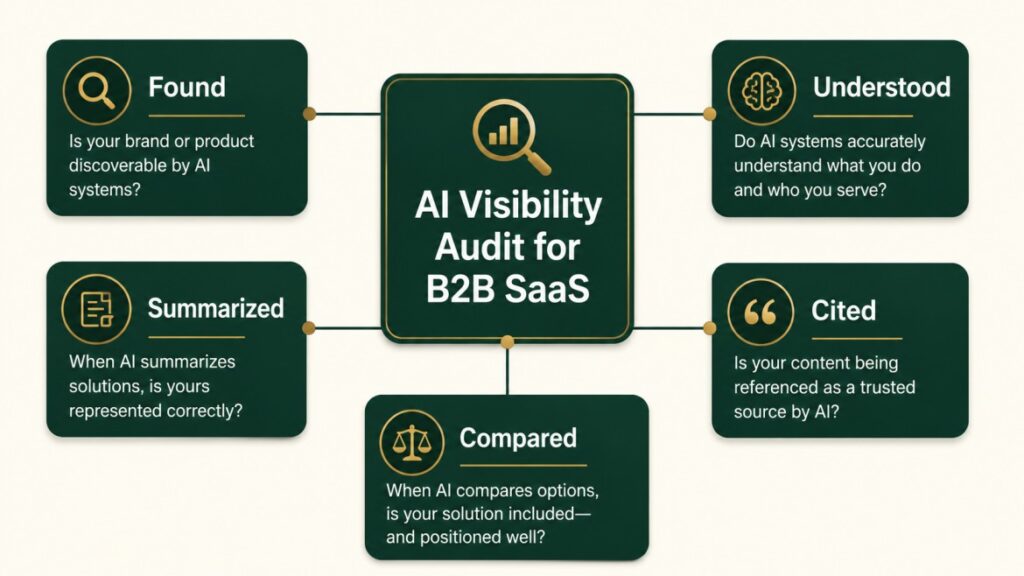
An AI visibility audit for B2B SaaS checks how well your website can be found, understood, summarized, cited, compared, and trusted by search engines, AI answer systems, and buyers.
It reviews content through five layers:
- Search intent.
- Answer clarity.
- Product and entity context.
- Trust and citation readiness.
- Conversion path.
This matters because AI visibility does not start inside an AI tool. It starts with pages that search engines can crawl, index, understand, and use as reliable sources.
Google Search Central says Google’s generative AI search features are rooted in core Search ranking and quality systems, and pages need to be indexed and eligible to appear with a snippet to be shown in generative AI features.
So an AI visibility audit for B2B SaaS should not replace SEO. It should connect SEO, AEO, GEO, product-led content, and buyer intent into one review.
Why Publishing More Content Is Not Always the Fix
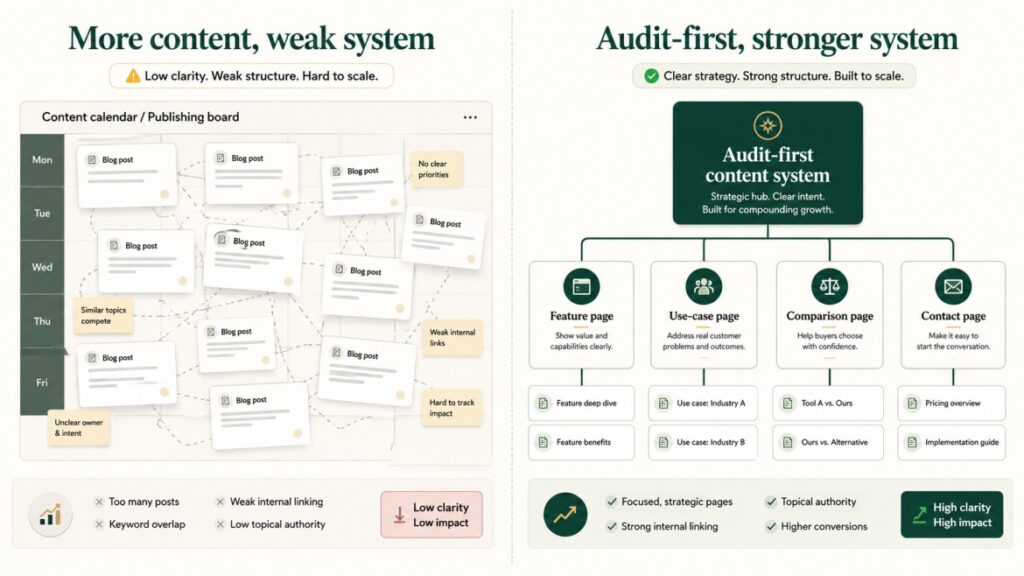
An AI visibility audit for B2B SaaS matters because publishing more content helps only when the current content system is clear.
If your pages answer late, repeat the same search intent, use vague product language, or fail to connect blog traffic to product-led pages, more content can add clutter.
This is why an AI visibility audit for B2B SaaS should happen before a new content push.
The audit shows whether your team needs:
- New pages.
- Better pages.
- Merged pages.
- Stronger internal links.
- Clearer comparison content.
- Updated proof.
- Better conversion paths.
Example:
If ten blog posts explain the same problem but none link to a feature page, your issue is not topic volume. It is content flow.
If your alternatives page lists tools but avoids real comparison points, your issue is not keyword coverage. It is weak decision support.
If your feature pages say “platform” in every section but never name the use case, buyer, workflow, or product category, your issue is unclear product context.
I wrote more about this pattern in why SaaS blogs answer too late.
The 5-Layer SaaS AI Visibility Audit Framework
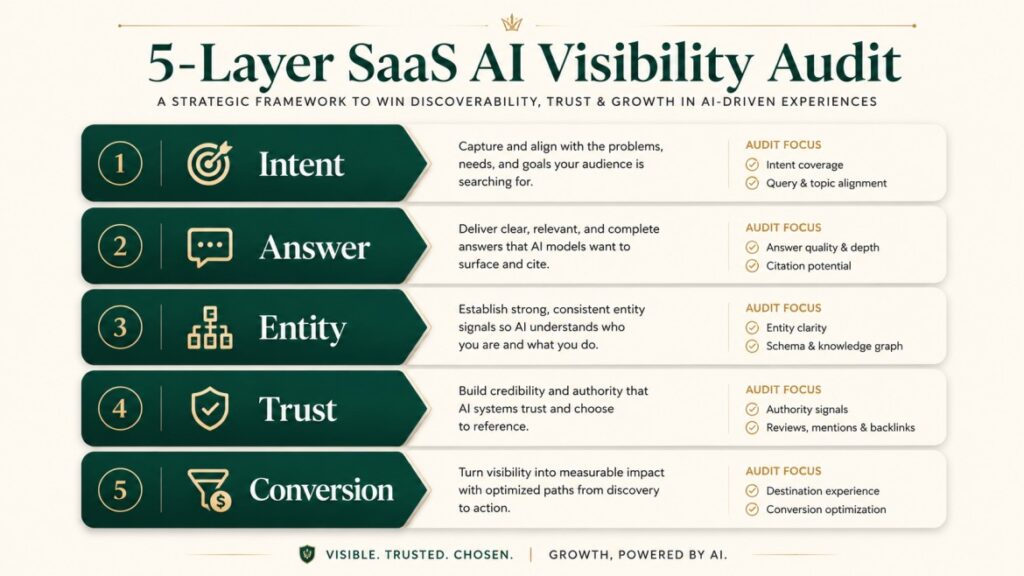
An AI visibility audit for B2B SaaS should give your team a clear framework, not a random list of checks.
Use this 5-layer model inside an AI visibility audit for B2B SaaS.
1. Intent Layer
The intent layer checks if each page matches the buyer’s real question.
Ask:
- Is the query educational, commercial, product-led, or support-led?
- Is the page type right for that query?
- Does the page answer what the buyer came to learn?
- Does the CTA match the reader’s stage?
A blog post should not target a buying query and then give a basic definition. A comparison page should not avoid comparison. A feature page should not ignore buyer pain.
2. Answer Layer
The answer layer checks if the page gives the main answer fast.
This supports SEO, AEO, GEO, featured snippets, AI summaries, and readers.
Ask:
- Does the first 100 words answer the main query?
- Does each H2 start with a direct answer?
- Are definitions short and clear?
- Are steps, lists, and tables easy to extract?
- Does the FAQ answer each question in the first sentence?
For more context, read what is AEO content.
3. Entity Layer
The entity layer checks if search engines and AI systems can understand the product, category, features, buyers, use cases, and competitors.
Ask:
- Is the product category named clearly?
- Are core features explained in plain language?
- Are use cases connected to buyer roles?
- Are competitors and alternatives handled fairly where relevant?
- Is the same language used across homepage, blog, feature pages, and comparison pages?
If your site uses five different terms for the same thing, your brand becomes harder to summarize.
4. Trust Layer
The trust layer checks if the page gives buyers and AI systems enough reason to believe the content.
Ask:
- Is the author named?
- Does the author bio show relevant expertise?
- Are claims supported?
- Are examples specific?
- Are sources linked where needed?
- Is the page updated when the product or market changes?
Author expertise matters in B2B SaaS because buyers are not reading for information only. They are judging whether the brand understands the problem.
5. Conversion Layer
The conversion layer checks if the page moves the right reader to the right next step.
Ask:
- Does the page have a clear CTA?
- Does the CTA match the reader’s intent?
- Does the page link to the right feature, use-case, comparison, or contact page?
- Does the reader know what to do next?
Good SaaS content does not push every reader to buy now. It guides each reader to the next useful step.
AI Visibility Audit for B2B SaaS Checklist
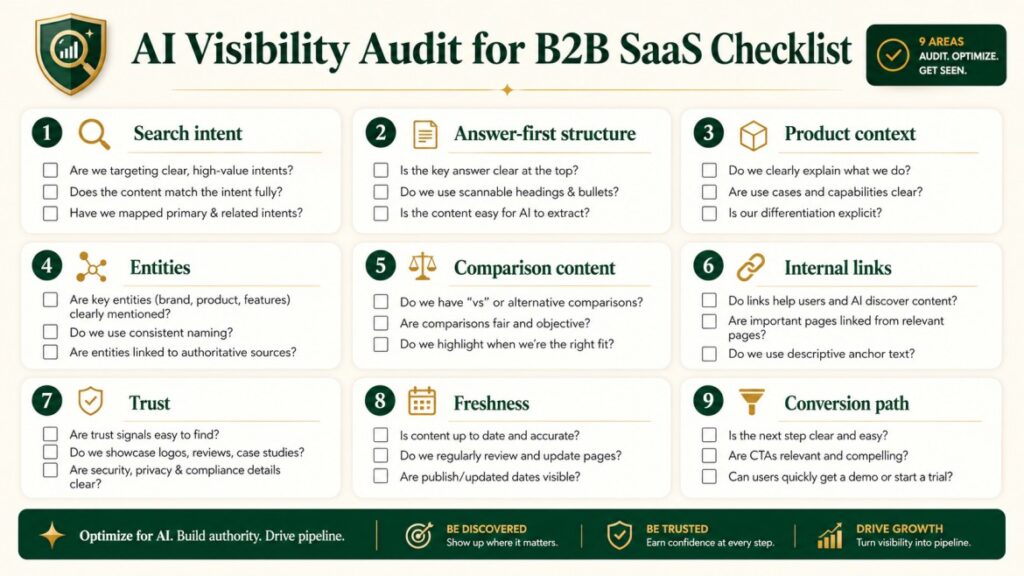
An AI visibility audit for B2B SaaS should review the full buyer and search path, not only blog posts.
Use this checklist inside an AI visibility audit for B2B SaaS before approving another batch of content.
Search Intent
In an AI visibility audit for B2B SaaS, check if each page matches the reason behind the search.
- Informational query: does the page teach clearly?
- Commercial query: does the page help the buyer compare?
- Product-led query: does the page explain the product in context?
- Support query: does the page solve the issue and link to related education?
Answer-First Structure
In an AI visibility audit for B2B SaaS, check if the page answers early.
- Main answer in the first 100 words.
- Clear H2s.
- Short definitions.
- Numbered steps.
- Simple tables.
- FAQ answers that begin with the answer.
Product Context
In an AI visibility audit for B2B SaaS, check if the page explains how the product fits.
- Product category.
- Main features.
- Buyer role.
- Use case.
- Pain point.
- Workflow.
- Integration.
- Next step.
Entity Clarity
In an AI visibility audit for B2B SaaS, check if the page names the right concepts.
- Product type.
- Feature names.
- Competitor names where relevant.
- Category terms.
- Buyer roles.
- Jobs to be done.
- Industry terms.
Comparison Content
In an AI visibility audit for B2B SaaS, check if the page helps buyers choose.
- Who each option fits.
- Main differences.
- Feature gaps.
- Tradeoffs.
- Pricing context when available.
- Migration concerns.
- Clear recommendation.
Internal Links
In an AI visibility audit for B2B SaaS, check if the site guides the buyer.
- Blog to use-case pages.
- Blog to feature pages.
- Feature pages to use cases.
- Comparison pages to proof.
- High-traffic posts to audit, demo, or contact pages.
- Old posts to newer pages.
Trust and Evidence
In an AI visibility audit for B2B SaaS, check if the page deserves to be cited.
- Named author.
- Author bio.
- Updated date.
- Clear examples.
- Source links.
- Product screenshots when useful.
- Customer language.
- No exaggerated claims.
Content Freshness
In an AI visibility audit for B2B SaaS, check if the page still matches the product and market.
- Updated product language.
- Current competitor context.
- Fresh examples.
- Working internal links.
- Current CTA.
- No outdated claims.
Conversion Path
In an AI visibility audit for B2B SaaS, check if the page moves readers forward.
- One clear next step.
- CTA tied to page intent.
- No vague “learn more” button when a stronger action fits.
- Internal links that support the buyer journey.
Technical Checks That Affect AI Visibility
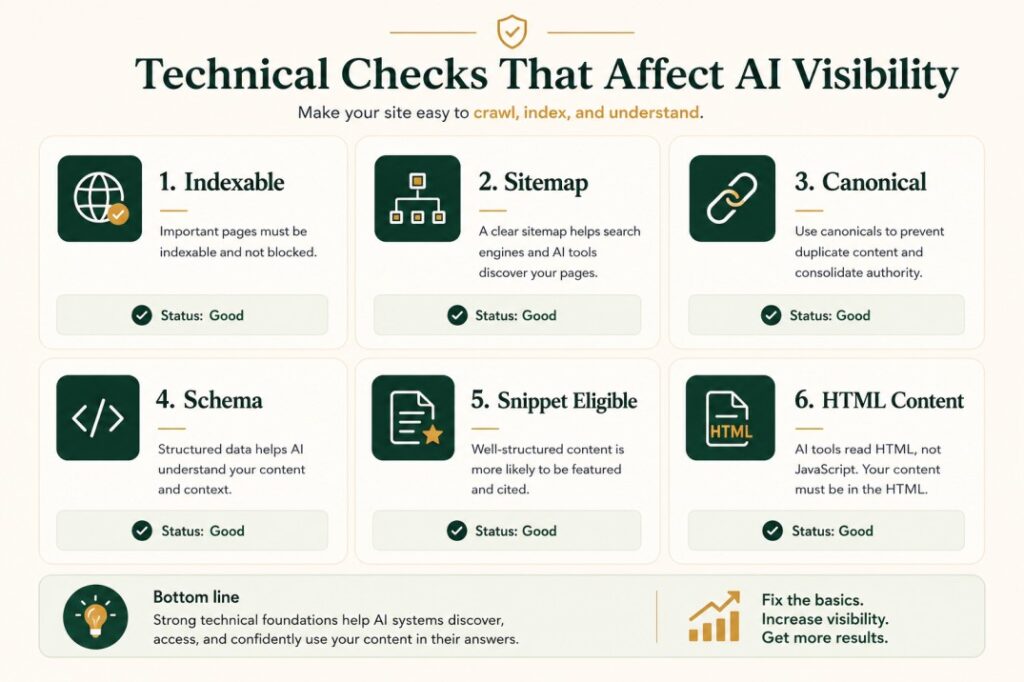
An AI visibility audit for B2B SaaS should include technical checks because AI visibility still depends on search visibility.
Google’s SEO Starter Guide says SEO helps search engines crawl, index, and understand content. That base still matters when your goal includes AI Overviews and other AI search features.
Check:
- Is the page indexable?
- Is the page included in the sitemap?
- Does the page return a 200 status?
- Is the canonical tag correct?
- Is the main content visible in HTML?
- Is the page blocked by robots.txt or noindex?
- Can Google show a snippet for the page?
- Are title tags and meta descriptions clear?
- Are headings structured logically?
- Is schema used where it fits?
Useful schema types for SaaS content may include:
- Article schema.
- FAQPage schema.
- Breadcrumb schema.
- Organization schema.
- Person schema.
- Product schema where accurate.
- SoftwareApplication schema where accurate.
Schema will not fix weak content. But it can help search engines understand page type, page structure, author information, and related entities.
Why SaaS Pages Fail to Get Cited by AI Answers
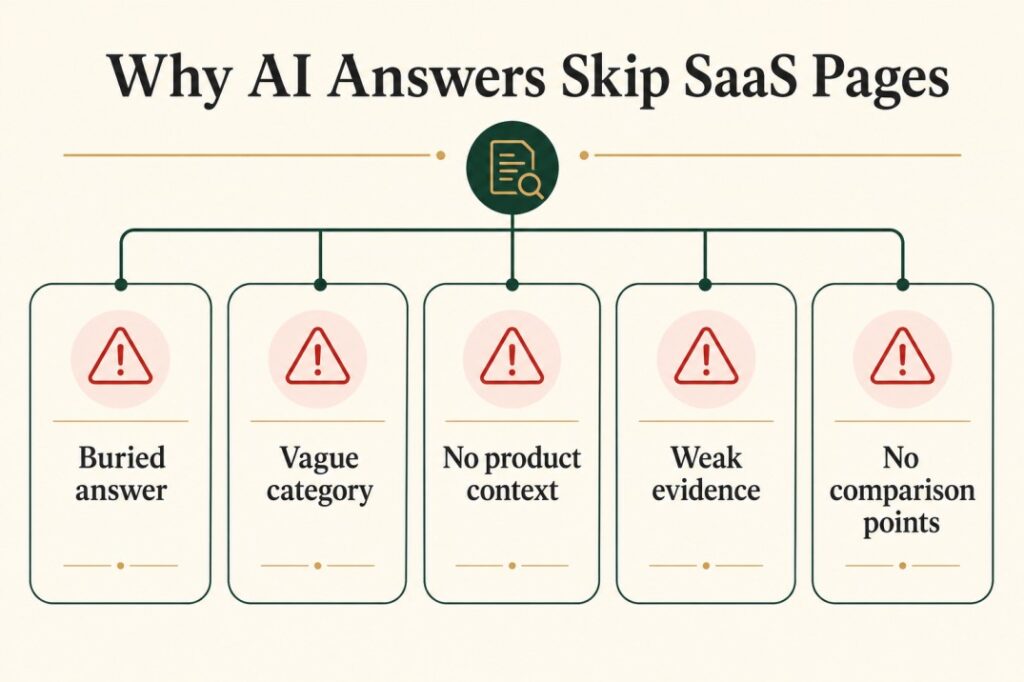
SaaS pages often fail to get cited by AI answers because they are too vague, too slow to answer, too light on product context, or weaker than third-party sources.
An AI visibility audit for B2B SaaS should look for citation blockers.
Common blockers include:
- The answer is buried.
- The page starts with broad filler.
- The product category is unclear.
- The page lacks clear definitions.
- The page does not explain who the product is for.
- Comparison points are missing.
- Claims are not supported.
- The author is not clear.
- The page has no original insight.
- Better third-party pages explain the topic more clearly.
AI systems need pages that can support an answer. If your content sounds like any other SaaS blog, it gives the system little reason to cite you.
A stronger page gives clear, specific, source-worthy statements.
Example:
Weak: “Our software helps teams improve productivity.”
Stronger: “Project management software helps operations teams assign work, track deadlines, manage approvals, and report progress across shared workflows.”
The stronger version gives more entity context. It is also easier to summarize and cite.
Owned Content Is Not the Only AI Visibility Signal
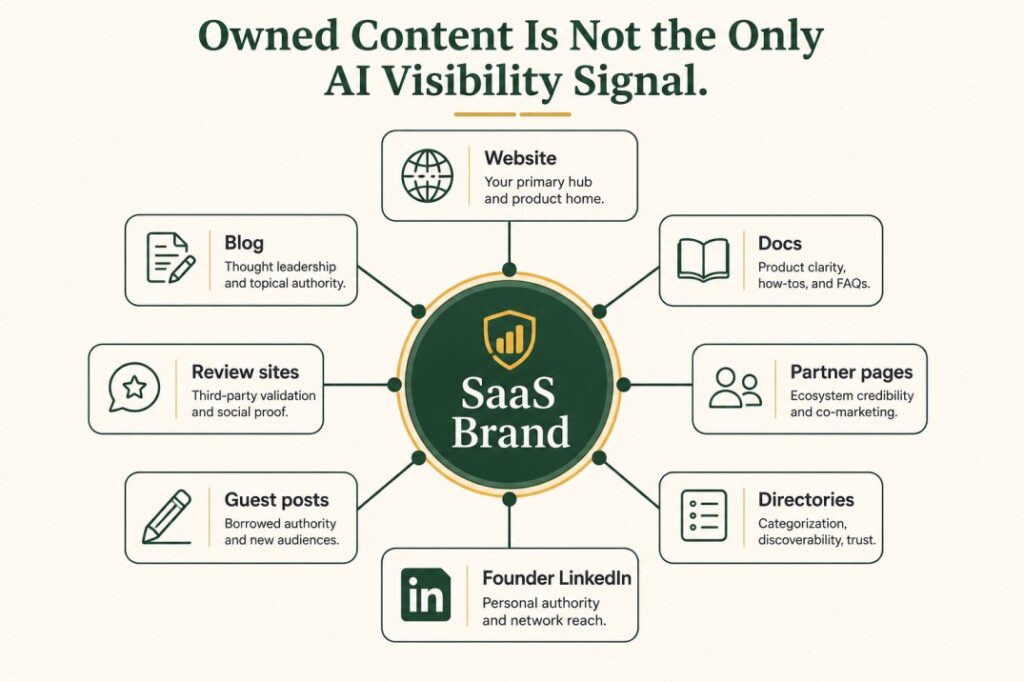
An AI visibility audit for B2B SaaS should review owned content and third-party authority.
Owned content is what you publish on your own website. This includes blog posts, product pages, feature pages, use-case pages, comparison pages, documentation, and case studies.
Third-party authority is what other trusted sources say about your brand or category.
This can include:
- Review sites.
- Partner pages.
- Guest posts.
- Podcast pages.
- SaaS directories.
- Analyst mentions.
- Customer stories.
- Community discussions.
- Founder LinkedIn content.
- Independent comparison pages.
A 2025 GEO research paper found that AI search systems can draw heavily from earned and third-party sources, not only brand-owned pages.
That means your website should be clear, but your brand also needs outside context.
For B2B SaaS, this creates an authority opportunity.
Do not only ask, “What do we say about ourselves?”
Also ask:
- Where does the market mention us?
- Are those mentions clear and current?
- Do third-party pages describe our category correctly?
- Do comparison pages include our brand?
- Do review profiles support our positioning?
- Do founder or expert profiles strengthen trust?
What to Audit by SaaS Page Type
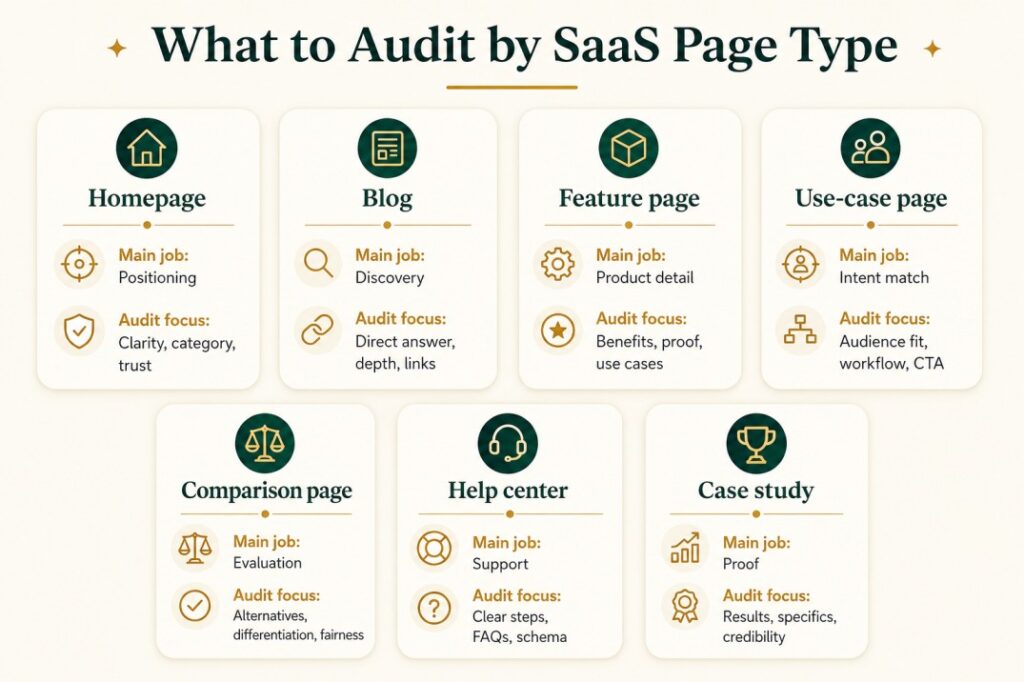
An AI visibility audit for B2B SaaS should not score every page the same way. Each page has a different job.
| Page type | Main job | What to audit |
| Homepage | Explain category, audience, and offer fast | Positioning, proof, CTA, entity clarity |
| Blog post | Answer a problem or question | Answer speed, intent fit, internal links |
| Feature page | Explain what the product does | Buyer pain, workflow, examples |
| Use-case page | Connect product to a real problem | Role fit, use-case clarity, CTA |
| Comparison page | Help buyers choose | Differences, tradeoffs, honest fit |
| Help center | Teach product use | Steps, support intent, related links |
| Case study | Prove value | Specific problem, process, outcome |
| Contact or demo page | Convert demand | Friction, clarity, trust |
Many SaaS teams overbuild the blog and underbuild the pages closest to revenue.
That creates a visibility gap.
AI tools may understand the topic, but not your product. Buyers may read the post, but never see the path to purchase.
SaaS SEO Audit vs SaaS Content Audit vs AI Visibility Audit
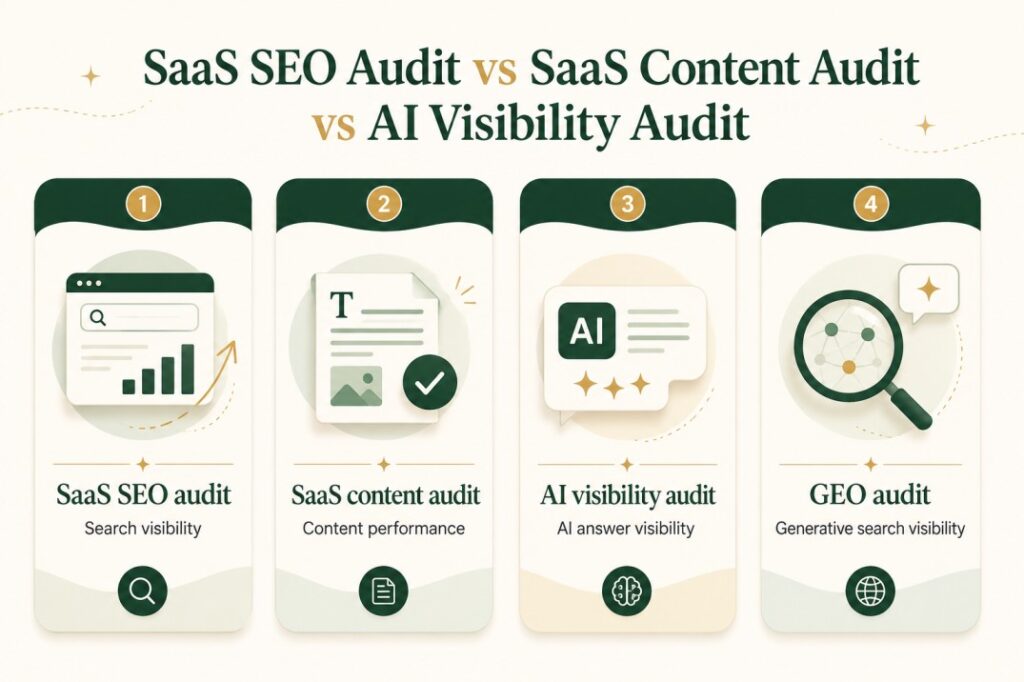
A SaaS SEO audit, SaaS content audit, and AI visibility audit for B2B SaaS overlap, but they do not check the same thing.
| Audit type | What it checks | Best used for |
| SaaS SEO audit | Crawlability, indexing, keywords, rankings, links | Search visibility |
| SaaS content audit | Quality, intent, gaps, decay, conversion | Content performance |
| AI visibility audit | AI mentions, citations, summaries, entities | AI answer visibility |
| GEO audit | Extractability, source fit, third-party authority | Generative search visibility |
The strongest audit connects all four.
A SaaS page can be technically indexable and still be weak for AI answers.
A blog post can rank and still fail to convert.
A comparison page can get traffic and still fail to help buyers choose.
This is why an AI visibility audit for B2B SaaS should look at search, structure, authority, and conversion together.
Internal Links and Buyer Paths
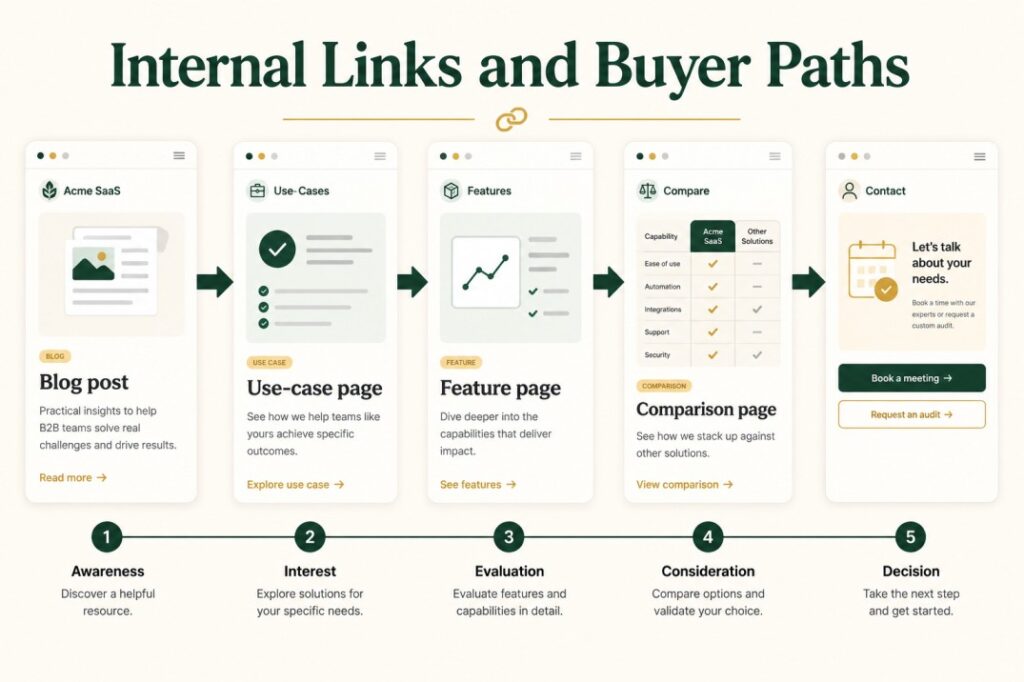
Internal links help search engines understand page relationships, and they help buyers move through the site.
An AI visibility audit for B2B SaaS should check if internal links guide readers from learning to evaluation.
A useful SaaS path may look like this:
- Blog post answers a problem.
- Use-case page shows the product in context.
- Feature page explains the capability.
- Comparison page supports decision-making.
- Contact, demo, audit, or service page gives the next step.
Check:
- Do high-traffic blog posts link to product-led pages?
- Do feature pages link to use cases?
- Do comparison pages link to proof?
- Do old posts link to newer, stronger pages?
- Do several posts compete for the same query?
Internal links should feel useful, not forced.
If you need stronger SaaS content and page strategy support, read my guide to B2B SaaS SEO content writers.
How to Measure SaaS AI Visibility After the Audit
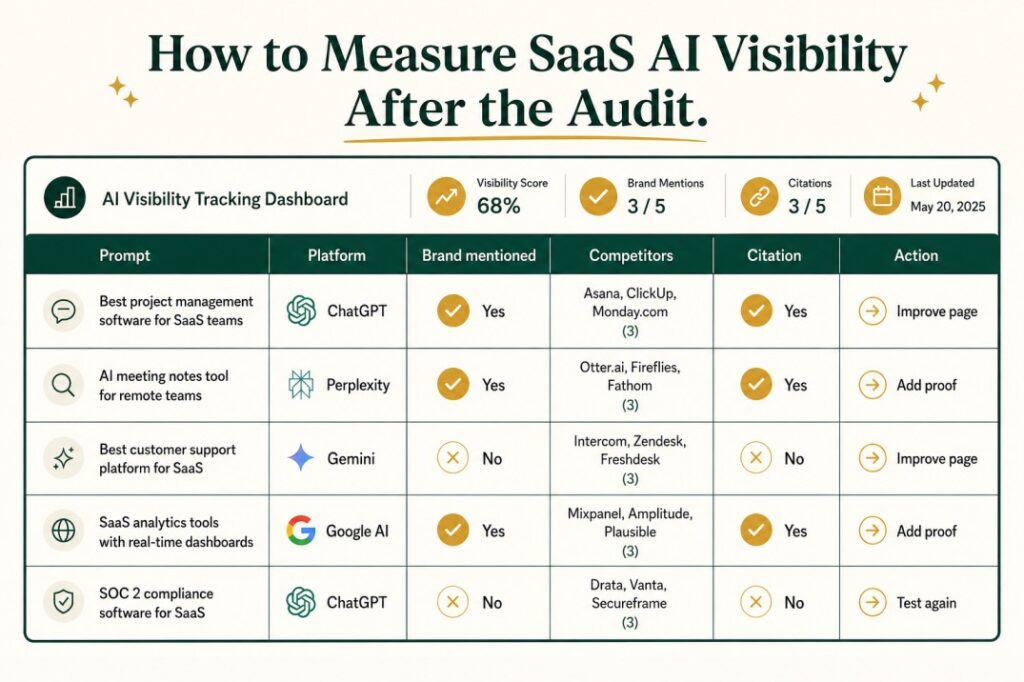
An AI visibility audit for B2B SaaS should include a measurement plan so your team can track progress.
Do not measure AI visibility with one prompt on one day.
AI answers can change by platform, query wording, location, source availability, and timing. A 2026 empirical study of Google Search, Gemini, and AI Overviews found that source sets and AI outputs can differ across systems and query runs.
Track visibility with a simple prompt log.
Create a sheet with:
- Prompt.
- Platform.
- Date.
- Your brand mentioned: yes or no.
- Competitors mentioned.
- Your website cited: yes or no.
- Third-party source cited.
- Citation context.
- Summary accuracy.
- Missing or wrong claims.
- Next content action.
Test prompts such as:
- “Best [category] software for [buyer type].”
- “What is the best way to solve [problem]?”
- “[Your brand] vs [competitor].”
- “Top alternatives to [competitor].”
- “How does [feature] help [use case]?”
- “What tools help [role] do [workflow]?”
Measure the same prompt set every month. Look for patterns, not one-off answers.
What to Fix First
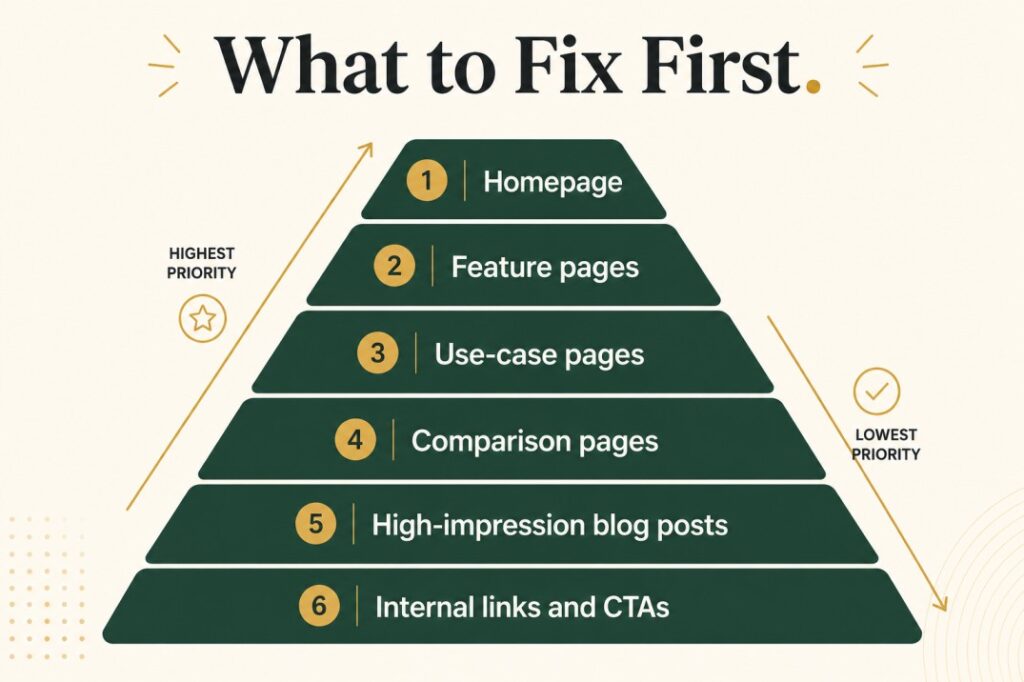
An AI visibility audit for B2B SaaS should end with priorities, not a long list of tasks.
Fix the pages closest to revenue first.
1. Homepage Positioning
Make the product category, audience, problem, and offer clear.
If the homepage is vague, every other page has to work harder.
2. Feature Pages
Connect each feature to a buyer pain, workflow, and use case.
Do not explain features as isolated functions.
3. Use-Case Pages
Build use-case pages around real buyer problems.
Each page should show who the use case is for, what problem it solves, how the product supports it, and what to do next.
4. Comparison Pages
Give buyers direct, fair, specific comparison points.
Avoid vague “we are better” messaging.
5. High-Impression Blog Posts
Improve answer speed, structure, internal links, product context, and CTA.
These posts already have search demand. Make them work harder.
6. Cannibalized Pages
Merge, redirect, or reposition overlapping content.
One strong page usually beats several weak pages targeting the same intent.
7. Outdated Pages
Update definitions, product language, competitor context, examples, links, and CTAs.
8. Weak Conversion Paths
Add relevant next steps for audit, demo, product education, comparison, contact, or sales.
Only publish more after these pages can support search visibility, AI visibility, and buyer movement.
When to Publish More Content After an AI Visibility Audit for B2B SaaS
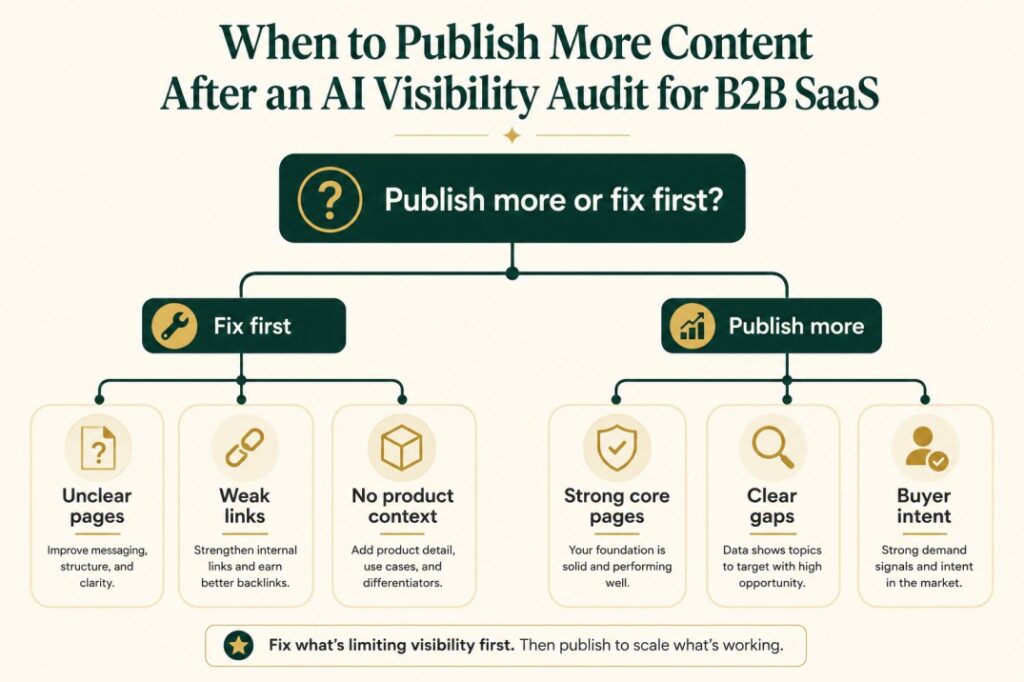
Publish more content when your current content system has a clear base.
That means:
- Core product pages explain the offer clearly.
- Blog posts answer fast and link forward.
- Comparison content helps buyers choose.
- Use-case pages support real buyer problems.
- Internal links connect the journey.
- Trust signals make the brand credible.
- Technical basics are clean.
- CTAs match buyer intent.
At that point, new content can fill real gaps.
An AI visibility audit for B2B SaaS can help your team decide which topics deserve new pages and which topics need a better existing page instead.
Get an AI Visibility Audit or SaaS Content Audit Before Publishing More
Before publishing another batch of SaaS content, audit what your current pages already tell Google, AI answer systems, and buyers.
If your pages are unclear, disconnected, outdated, or hard to cite, more content may not solve the real issue.
I help B2B SaaS teams improve content for SEO, AEO, GEO, AI visibility, and conversion.
You can start with a SaaS content audit, an AI visibility content review, or a focused brand AI visibility teardown.
If you want a practical review before publishing more, contact me.
FAQ
What is an AI visibility audit for B2B SaaS?
An AI visibility audit for B2B SaaS checks how well your SaaS website can be found, understood, cited, summarized, and compared by search engines, AI answer systems, and buyers.
It reviews search intent, answer-first structure, product context, entities, internal links, technical SEO, trust signals, content freshness, and conversion paths.
Why should SaaS teams audit content before publishing more?
SaaS teams should audit content before publishing more because weak existing pages can limit rankings, AI visibility, and conversions.
If current pages answer late, overlap, lack product context, or fail to guide buyers, more content can repeat the same problems.
How does answer-first content help AI visibility?
Answer-first content helps AI visibility by making the main answer easy to extract, summarize, and cite.
It gives direct definitions, clear section headings, short explanations, lists, tables, and FAQ answers that search engines, AI answer systems, and buyers can understand fast.
What pages should a SaaS AI visibility audit review first?
A SaaS AI visibility audit should review the homepage, feature pages, use-case pages, comparison pages, high-impression blog posts, help center content, case studies, and conversion pages first.
These pages shape how buyers and AI systems understand the product.
What is the difference between a SaaS content audit and an AI visibility audit?
A SaaS content audit reviews content quality, search intent, rankings, traffic, internal links, freshness, and conversions.
An AI visibility audit reviews whether the same content can be understood, summarized, cited, compared, and trusted by AI answer systems.
The strongest review combines both.
How often should B2B SaaS teams run an AI visibility audit?
B2B SaaS teams should run an AI visibility audit before major content planning, after major product updates, and when rankings, AI mentions, demo quality, or branded search visibility decline.
For active content programs, a focused audit every quarter can help keep pages fresh and aligned with buyer intent.
Need SaaS content built for SEO and AI visibility?
Work with Manal Ghamir on answer-first SaaS content that supports Google rankings, AI search visibility, buyer education, and product clarity.
View Services View Portfolio Contact Manal