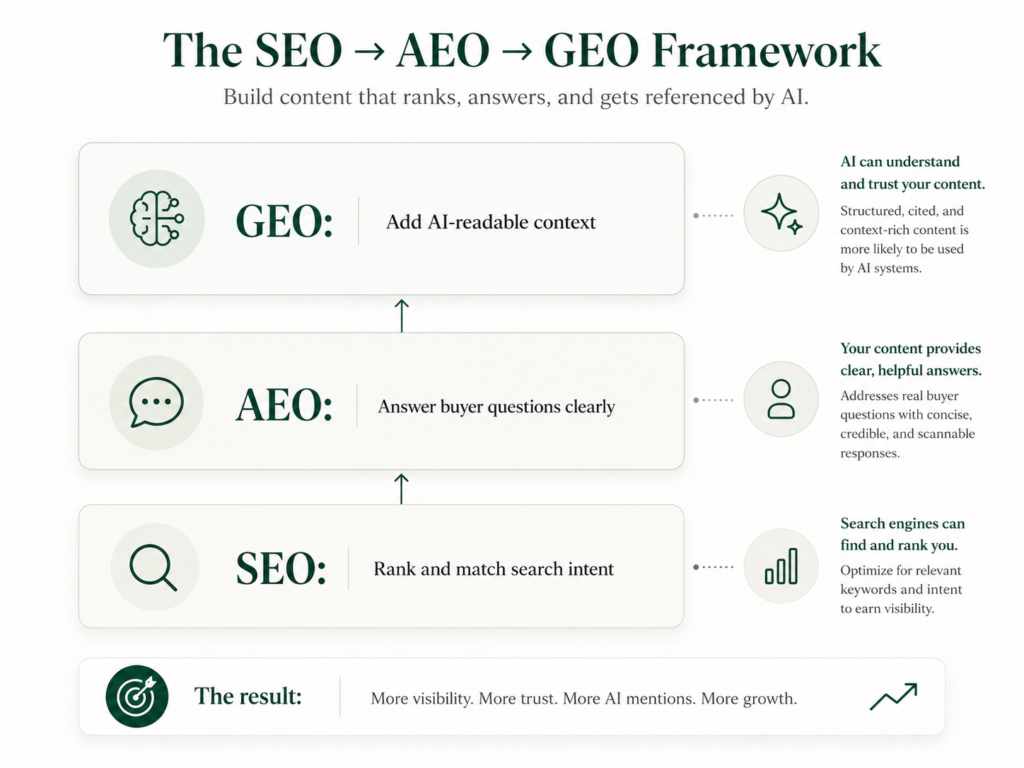
SEO vs AEO vs GEO is not just a search terminology debate for SaaS brands. It explains how your content ranks, answers questions, and gets understood by AI search tools.
SEO helps SaaS brands rank in search engines. AEO helps SaaS content answer buyer questions clearly. GEO helps AI tools understand, summarize, and reference content.
SaaS brands need all three.
Search is more crowded now. Buyers use Google Search, featured snippets, People Also Ask, Google AI Overviews, ChatGPT, Perplexity, Gemini, and other tools to find answers. SEO is not dead.
SaaS content now needs clearer structure, stronger answers, better examples, and more context.
This guide explains SEO vs AEO vs GEO in plain language. It gives SaaS founders, marketing leads, and content teams a practical framework they can use without chasing every new AI search trend.
Table of Contents
SEO vs AEO vs GEO: Quick Comparison
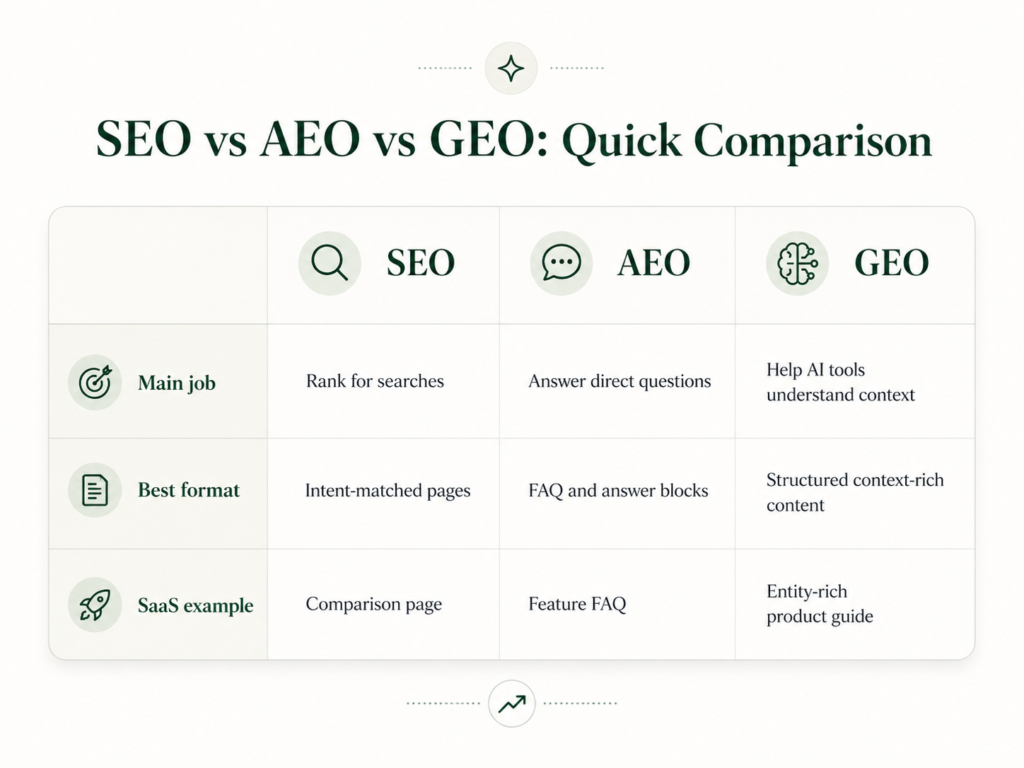
SEO vs AEO vs GEO compares three layers of modern search strategy. SEO helps SaaS brands rank in Google. AEO helps content answer direct questions clearly. GEO helps AI tools understand, summarize, and reference content.
SaaS brands need all three because buyers now search through traditional results, snippets, and AI answers.
| Search layer | Full name | Main job | Best content format | SaaS example |
|---|---|---|---|---|
| SEO | Search engine optimization | Rank for relevant searches | Guides, comparisons, use case pages | “Best CRM automation tools” |
| AEO | Answer engine optimization | Answer direct questions | FAQs, lists, tables, definitions | “How do SaaS teams reduce churn?” |
| GEO | Generative engine optimization | Help AI tools understand context | Structured explainers, entity-rich guides | “What is product usage analytics?” |
Simple breakdown:
- SEO helps buyers find your content.
- AEO helps buyers get the answer faster.
- GEO helps AI tools understand what your content means.
The best way to understand SEO vs AEO vs GEO is to see each one as a layer, not a separate campaign. Use SEO vs AEO vs GEO as a planning lens, not as three separate briefs.
For SaaS brands, the goal is not to chase every new search acronym. The goal is to write useful content that buyers understand and search systems read clearly.
What Is SEO in the SEO vs AEO vs GEO Framework?
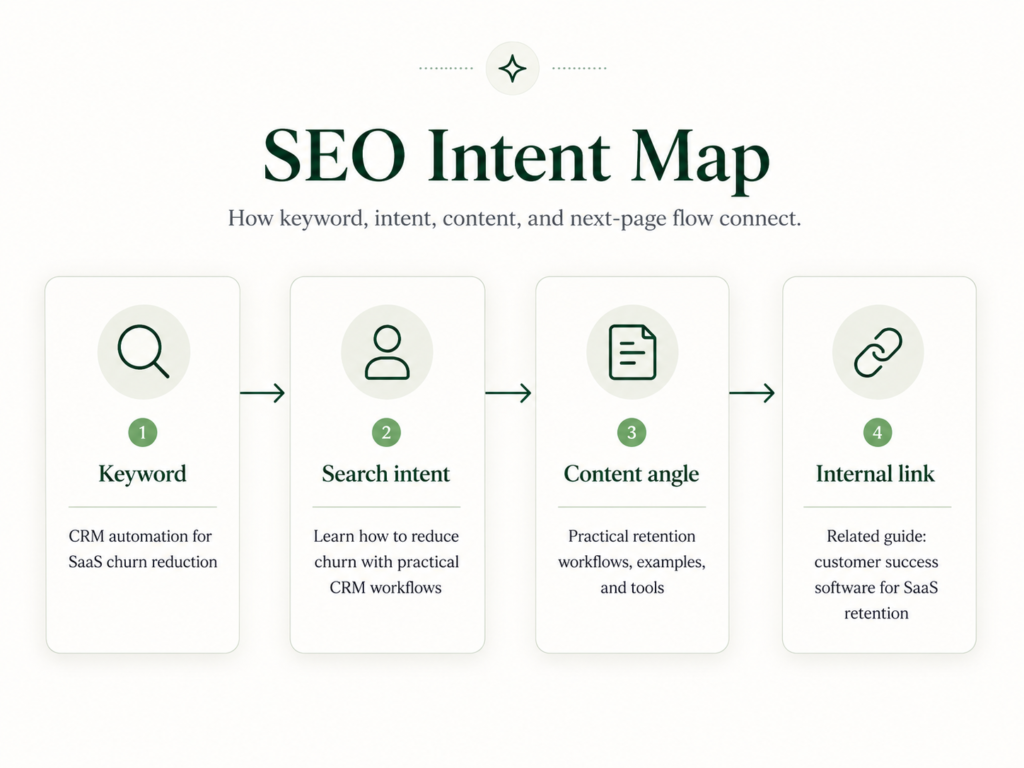
SEO is the base layer of SaaS search visibility. It helps content rank for the right keywords, match search intent, and guide buyers from problem awareness to product research. Strong SEO gives AEO and GEO a better foundation.
SEO stands for search engine optimization. It means improving website content so it ranks better in search engines like Google.
For SaaS brands, SEO supports:
- Blog traffic
- Product education
- Comparison content
- Use case pages
- Buyer guides
- Internal linking
- Long-term demand generation
A CRM SaaS, for example, might target a keyword like CRM automation for SaaS churn reduction.
A strong article would:
- Define CRM automation.
- Explain why churn happens.
- Show SaaS use cases.
- Answer buyer questions.
- Link to related product or service pages.
This type of content does more than rank. It helps the buyer understand the problem, see the options, and decide what to read next.
Good SEO starts with search intent. Search intent means the reason behind a search. A founder searching “how to reduce SaaS churn” wants a clear answer, not a vague product pitch.
In the SEO vs AEO vs GEO framework, SEO gives the page its foundation. It connects the content to the buyer’s search, the topic, and the next useful page.
What Is AEO in the SEO vs AEO vs GEO Framework?
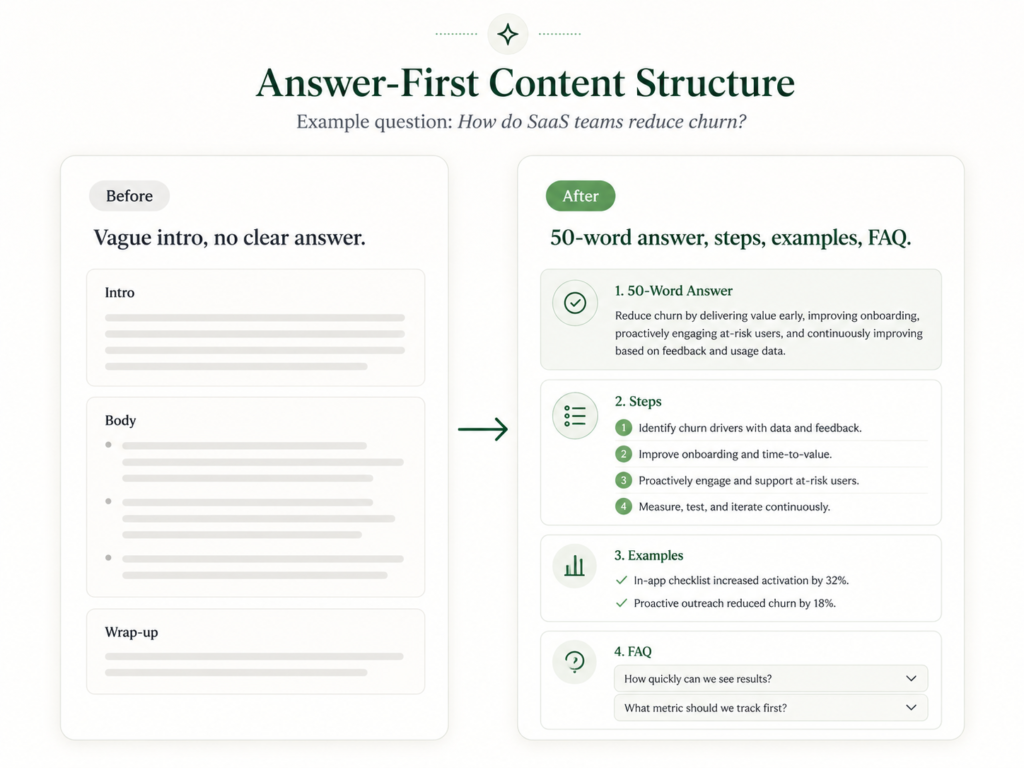
AEO helps SaaS content answer specific buyer questions in a clear, direct way. It supports featured snippets, People Also Ask results, and answer-style search by using question headings, short answers, lists, tables, definitions, and FAQs.
AEO stands for answer engine optimization. It focuses on answer clarity.
AEO matters because SaaS buyers search with direct questions:
- How do SaaS teams reduce churn?
- What is onboarding software?
- What is customer health scoring?
- How does CRM automation work?
- What is the best way to track product adoption?
A strong AEO section gives the answer first. Then it adds detail.
For example, a customer success platform might use this H2:
How do SaaS teams reduce churn?
SaaS teams reduce churn by improving onboarding, tracking customer health, spotting low engagement, and acting before renewal risk grows. The best churn reduction plans connect product usage data, customer success workflows, and clear renewal signals.
Then the article explains:
- Onboarding gaps
- Low product adoption
- Poor customer health tracking
- Renewal risk
- Engagement workflows
This format helps readers and search systems. It also makes the content easier to pull into featured snippets, People Also Ask results, and answer-style search.
In SEO vs AEO vs GEO planning, AEO is the answer layer. This is where SEO vs AEO vs GEO becomes practical for featured snippets and People Also Ask results.
What Is GEO in the SEO vs AEO vs GEO Framework?
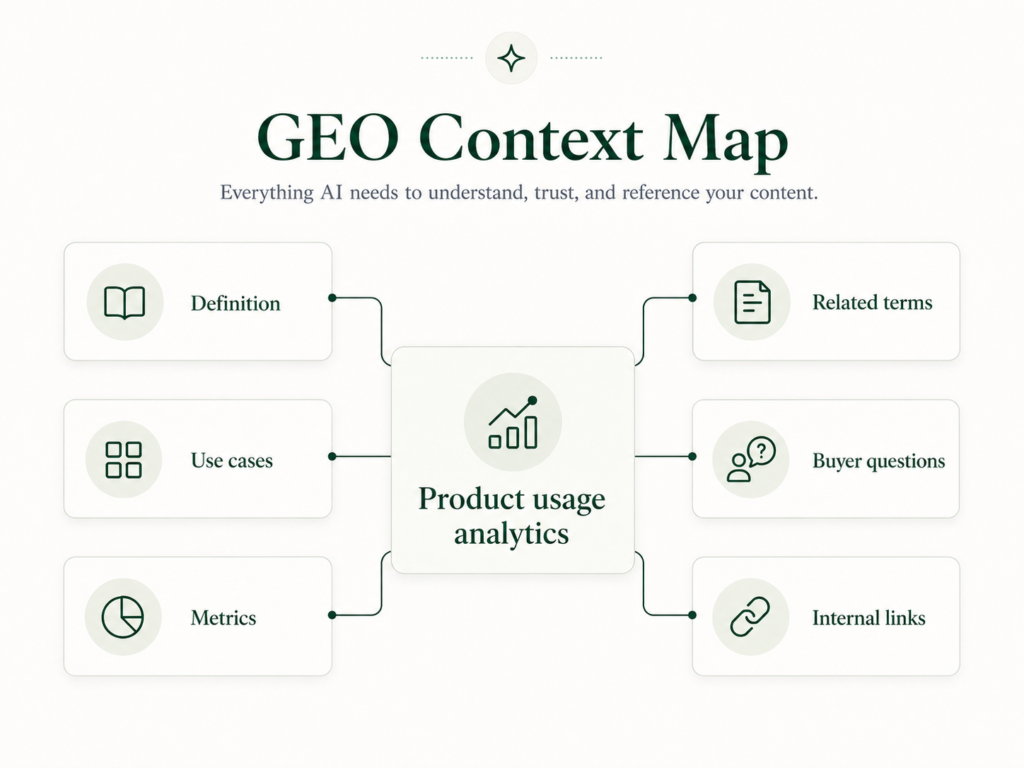
GEO, or generative engine optimization, means making content easier for AI tools to understand, summarize, and reference.
For SaaS brands, GEO means clear definitions, related entities, product context, buyer questions, structured sections, examples, and trust signals. GEO does not guarantee AI citations or rankings.
GEO matters because SaaS buyers use tools like Google AI Overviews, ChatGPT, Perplexity, Gemini, and Bing Copilot to compare options, define terms, and research problems.
A strong GEO section should include:
- A direct answer at the top.
- A clear definition of the main term.
- Related entities and concepts.
- A practical SaaS example.
- A table, checklist, or short workflow.
- Internal links to relevant service, portfolio, or trust pages.
- Honest limits around AI visibility.
For example, a B2B analytics SaaS writing about product usage analytics should define the term, explain related metrics like activation rate and feature adoption, show use cases for product teams, compare it with customer health scoring, and answer buyer questions.
That gives AI tools more context. It also gives buyers a better page.
My honest take: GEO is useful, but it gets messy fast when brands treat it like keyword stuffing for AI. GEO is not “SEO with extra keywords.”
For SaaS content, SEO vs AEO vs GEO turns a basic article into a clearer resource for buyers and AI tools. In the SEO vs AEO vs GEO framework, GEO adds context. It helps the page explain people, products, topics, tools, and relationships clearly.
Does GEO Replace SEO?
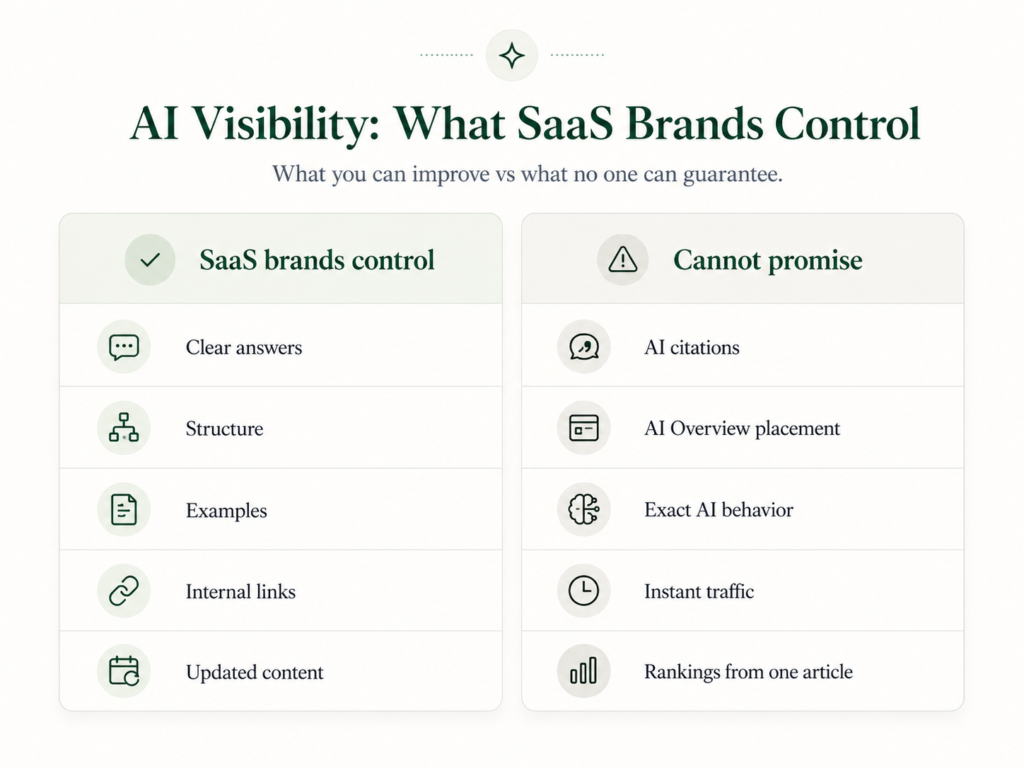
No, GEO does not replace SEO. GEO builds on SEO by making content clearer for AI tools and answer-based search.
SaaS brands still need strong search intent, useful content, crawlable pages, internal links, and authority signals. GEO adds clearer structure, entity coverage, direct answers, examples, and better context.
SaaS teams should not rebuild their whole content strategy around GEO alone.
| Avoid this | Do this instead |
|---|---|
| Treating GEO like a shortcut to AI traffic | Build useful content with clear answers |
| Stuffing pages with random entities | Add relevant terms in context |
| Ignoring search intent | Match the buyer’s real question |
| Promising AI citations | Explain what the brand controls |
| Rewriting every page for AI tools only | Write for buyers first, then structure for search systems |
My honest take: GEO is useful, but it is not a magic switch for AI traffic. Most SaaS brands need clearer answers, stronger structure, better examples, and smarter internal links before another acronym enters the content plan.
The safer approach is simple. Build content that helps buyers first. Then structure it so Google, answer engines, and AI tools understand it.
SEO vs AEO vs GEO works best when SEO remains the base, AEO improves the answer, and GEO adds context.
How to Apply SEO vs AEO vs GEO to SaaS Content
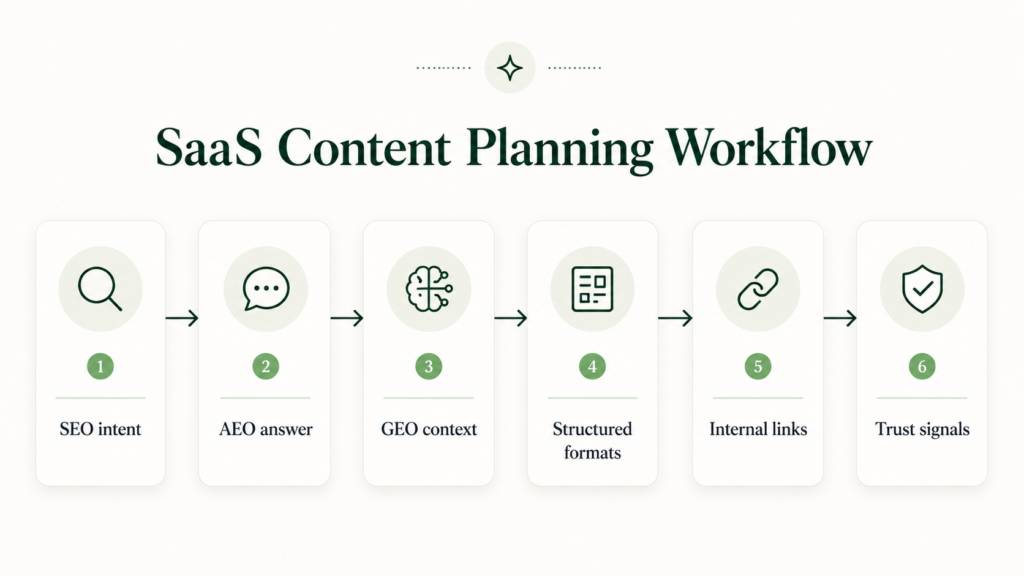
SaaS brands should use SEO, AEO, and GEO as one content workflow. SEO targets the right search intent. AEO gives the reader a direct answer. GEO adds context, entities, examples, and trust signals so AI tools and search systems understand the content.
The real value of SEO vs AEO vs GEO is not choosing one layer. The value is knowing how each layer improves the same SaaS content asset.
Use this workflow:
- Start with SEO intent.
Define what the buyer wants to learn, compare, or solve. - Add an AEO answer.
Place a 40–60 word direct answer under the key H2. - Build GEO context.
Add related entities, definitions, examples, and clear topic relationships. - Use structured formats.
Add a table, checklist, numbered process, or FAQ section. - Connect internal links.
Link to service, portfolio, about, or contact pages where relevant. - Add trust signals.
State what can improve and what cannot be promised.
Example: a customer success SaaS writing about how to reduce SaaS churn should target the keyword, answer the question directly, define churn and customer health, mention onboarding and product adoption, add a checklist, and link to related customer success content or services.
Here is the framework in a simple table:
| Layer | What to add |
|---|---|
| SEO | Target a clear keyword and buyer pain point |
| AEO | Add a direct answer under the H2 |
| GEO | Add definitions, related entities, examples, and internal links |
This is where strategy matters. A SaaS blog should not be a pile of keywords. It should connect search intent, answer intent, product context, and buyer education. You can also view my SaaS content portfolio for examples.
If your team needs help applying this structure, explore my SaaS SEO blog writing services.
Modern Search Checklist for SEO vs AEO vs GEO
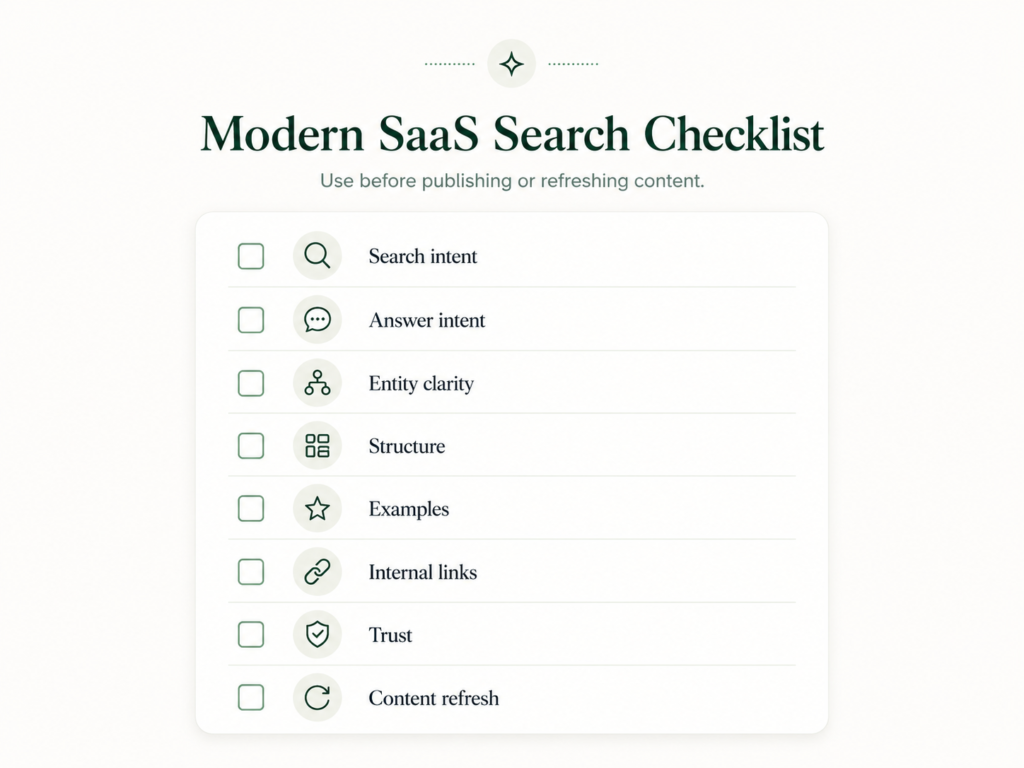
Modern SaaS content should be easy to read, scan, and extract. It should answer the buyer’s question first, then add context, examples, definitions, internal links, and trust signals. The goal is not to trick AI tools. The goal is to make useful content easier to understand.
Before publishing or refreshing a SaaS blog, check:
- Search intent: What does the reader want to solve or understand?
- Answer intent: What direct answer should this section provide?
- Entity clarity: Are key terms, tools, platforms, and concepts explained in context?
- Structure: Are H2s, H3s, lists, tables, and FAQs easy to scan?
- Examples: Does the page include at least one SaaS-specific example?
- Internal links: Does the page connect to relevant service, proof, or contact pages?
- Trust: Does the page avoid unsupported claims and guaranteed AI visibility promises?
- Content refresh: Does older content need updated definitions, examples, or FAQs?
A practical SEO and GEO strategy starts with useful, crawlable content. Then it adds clear definitions, entities, examples, internal links, and answer-first sections.
| Term | Clear definition |
|---|---|
| Search intent | The reason behind the search |
| Answer intent | The direct answer a reader expects from a section |
| Entity clarity | Clear use of related topics, tools, platforms, and concepts |
| Content refresh | Updating an existing page so it better matches current search behavior |
| FAQ schema | Structured data that marks up FAQ questions and answers |
AI visibility notes
AI visibility depends on clarity, structure, context, and trust. SaaS brands should explain concepts in plain language. They should include related entities naturally, like Google AI Overviews, ChatGPT, Perplexity, Gemini, featured snippets, People Also Ask, search intent, answer intent, and structured content.
The point is not to “game” AI tools. The point is to make the page easy to understand.
Here is what SaaS brands control.
| SaaS brands control | SaaS brands cannot promise |
|---|---|
| Clear answers | Guaranteed AI citations |
| Strong structure | Guaranteed AI Overview placement |
| Helpful examples | Exact AI tool behavior |
| Internal links | Instant traffic growth |
| Updated content | Rankings from one article |
A good modern search strategy is not built on fear. It is built on useful content, clear answers, and honest limits.
For a custom SaaS content project, you can contact me here.
FAQ
What is the difference between SEO, AEO, and GEO?
SEO helps content rank, AEO helps content answer, and GEO helps AI tools understand content. SaaS brands need all three because buyers now use Google Search, featured snippets, People Also Ask, AI Overviews, ChatGPT, Perplexity, and Gemini to research products and problems.
Is SEO still important for SaaS brands?
Yes, SEO is still important for SaaS brands. SEO gives AEO and GEO a strong base by matching search intent, improving content structure, supporting internal links, and helping buyers find useful guides, comparison pages, and product-led content.
Does GEO replace SEO?
No, GEO does not replace SEO. GEO adds another layer to SEO by improving clarity, entity coverage, structure, examples, and trust signals for AI-driven search. SaaS brands still need useful content, crawlable pages, search intent, and internal links.
How does AEO help with featured snippets?
AEO helps featured snippets by giving search engines clear answer blocks. It uses question-style headings, 40–60 word answers, numbered steps, comparison tables, definitions, and FAQs so search engines identify the most useful answer faster.
How can SaaS brands improve AI visibility?
SaaS brands improve AI visibility by publishing clear, structured, entity-rich content. They should define key terms, answer buyer questions, mention relevant platforms naturally, add examples, use internal links, and avoid claims about guaranteed AI citations or AI Overview placement.
Need SaaS content built for SEO and AI visibility?
Work with Manal Ghamir on answer-first SaaS content that supports Google rankings, AI search visibility, buyer education, and product clarity.
View Services View Portfolio Contact Manal