A B2B SaaS blog post can be correct, readable, and still fail its main job. It may target the wrong buyer, answer the wrong question, hide the product connection, or give readers no clear next step.
This B2B SaaS blog post checklist helps content managers, founders, writers, and SEO teams review a draft before it goes live. The 25 checks cover buyer intent, SEO, answer-first writing, product positioning, trust, AEO, GEO, AI visibility, conversion, and WordPress publishing.
Use the checklist as a final quality-control system, not as a set of boxes to tick after a weak strategy.
Table of Contents
What Is a B2B SaaS Blog Post Checklist?
A B2B SaaS blog post checklist is a pre-publish review system for content aimed at business software buyers. It checks whether an article matches buyer and search intent, explains the product in useful context, supports its claims, gives direct answers, connects to related pages, and guides the reader toward a logical next step.
A generic blog checklist may confirm that the draft has a keyword, title, links, and images. A SaaS checklist must go further because the reader may need to understand:
- A complex problem
- A software category
- A workflow or use case
- Product features and business outcomes
- Buying criteria
- Risks, limits, and alternatives
- The next step in a longer sales process
Google also advises publishers to create helpful, reliable, people-first content rather than content made mainly to influence rankings. Its guidance asks whether the content gives the intended audience useful, first-hand, or expert value. Read Google’s people-first content guidance.
Why Generic SEO Checklists Fall Short for SaaS
Generic SEO checks help with discoverability, but they do not prove that a SaaS article helps a buyer make progress.
A page can have clean SEO fields while still failing to explain who the product helps, why a feature matters, or what the buyer should do next.
| Generic SEO checklist | B2B SaaS publishing checklist |
|---|---|
| Checks keyword placement | Checks search intent and buyer intent |
| Reviews headings | Reviews the question each section answers |
| Adds internal links | Builds a path to product, use-case, and service pages |
| Mentions the product | Connects product capabilities to buyer outcomes |
| Adds sources | Checks whether each claim needs proof |
| Adds an FAQ | Builds answer-ready sections across the full article |
| Adds a CTA | Matches the CTA to the buyer’s stage |
| Publishes the page | Tracks queries, clicks, internal paths, and conversions |
A SaaS article must work as a search, teaching, product-marketing, and conversion asset.
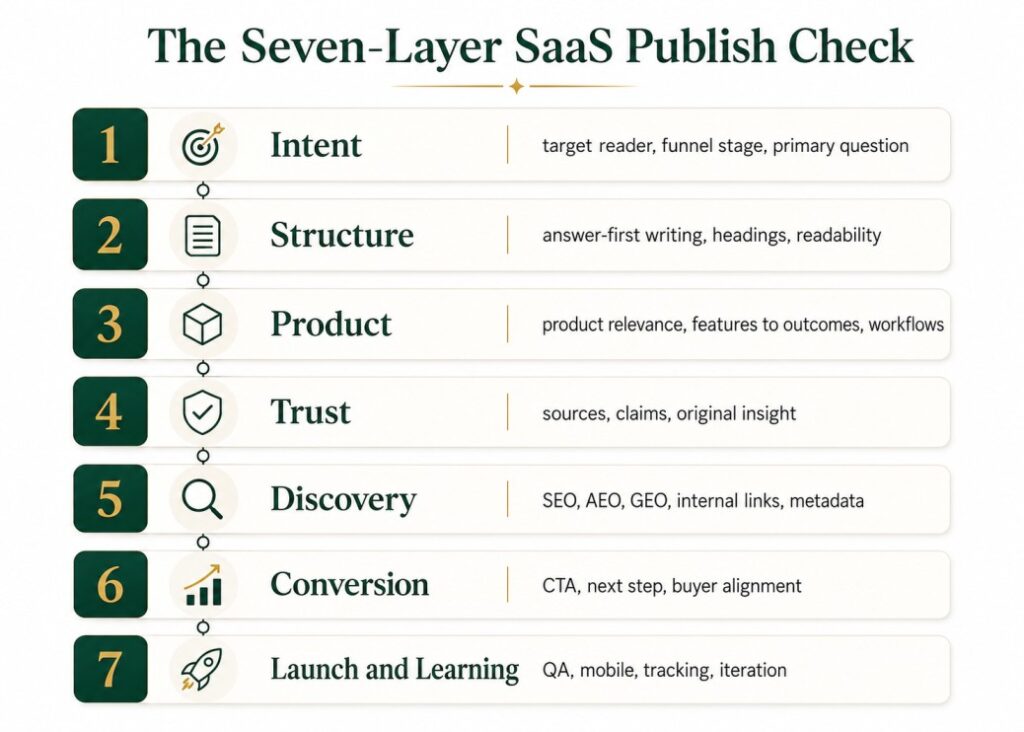
The Seven-Layer SaaS Publish Check
I use seven review layers to keep the process clear:
- Intent: Who is reading, what do they need, and why are they searching?
- Structure: Does the article answer quickly and guide the reader well?
- Product: Does the content explain the software in useful buyer context?
- Trust: Can the reader verify important claims and understand the author’s basis?
- Discovery: Can search engines and answer systems understand and connect the page?
- Conversion: Does the article offer a logical next step?
- Launch and learning: Is the page technically ready, and will the team measure what happens next?
Together, the layers catch problems an SEO plugin score cannot.
Layer 1: Strategy and Buyer-Intent Checks
A SaaS article should begin with a specific reader, buying stage, and question. Without those decisions, the draft often becomes broad, repetitive, and disconnected from the product.
1. Name the Exact Target Reader
Write down the reader’s role before you approve the draft.
“Marketing teams” is too broad. A stronger reader definition would be:
- Head of content at a 50-person SaaS company
- Founder choosing a first CRM
- Customer success manager trying to reduce churn
- SEO manager planning comparison content
- RevOps lead reviewing attribution software
The reader definition affects the language, examples, objections, detail, and CTA.
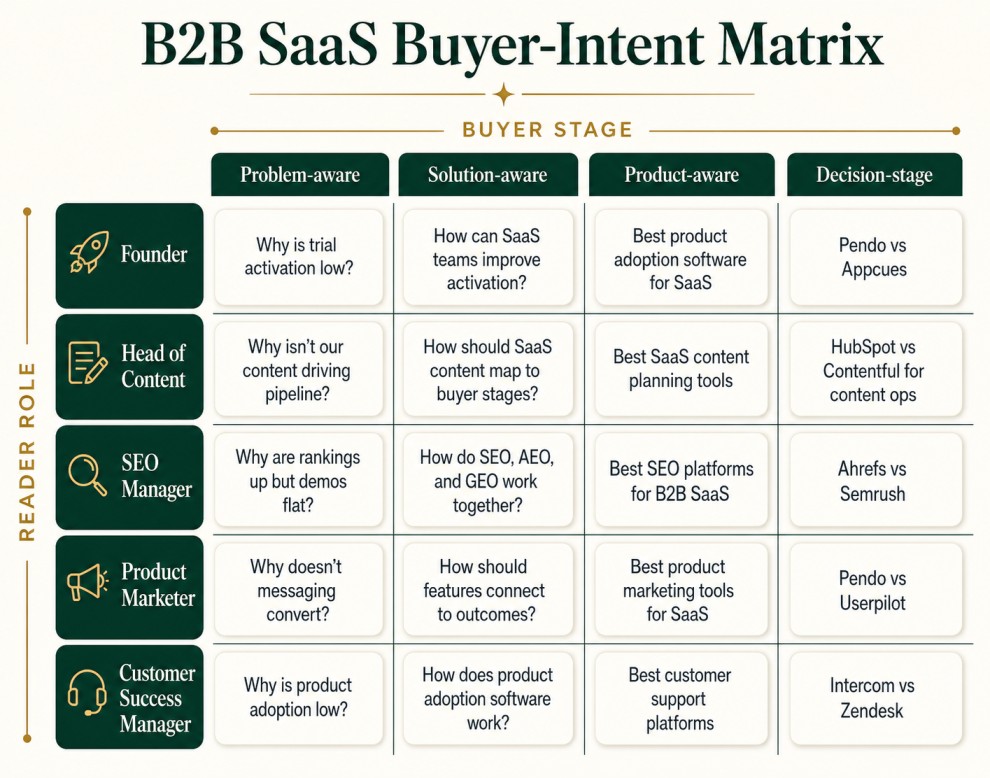
2. Confirm the Buyer’s Funnel Stage and Job
Funnel stage explains how close the reader may be to a decision. The buyer’s job explains what progress the reader wants to make.
Common stages include:
- Problem-aware: “Why is our trial activation rate low?”
- Solution-aware: “How does product adoption software work?”
- Product-aware: “Best product adoption platforms”
- Decision-stage: “Pendo vs Appcues”
Match the CTA to the stage. A problem-aware reader may need a guide or audit, while a comparison reader may be ready for pricing, a trial, or sales contact.
3. Define One Primary Question
Every article needs one main question it can answer in a sentence.
For this article, the question is:
What should a B2B SaaS team check before publishing a blog post?
Supporting questions should expand the topic without pulling the page into separate intents.
4. Match the Live Search Intent
Search intent describes what the current results suggest searchers want. Check the search results before finalizing the angle, even if the keyword looked clear during planning.
Review:
- Whether Google ranks guides, checklists, templates, tools, or service pages
- How recent the strongest pages are
- Whether the results target SaaS or a broader audience
- Which subtopics repeat
- Which useful subtopics competitors miss
Use the results to understand the page’s expected job, then add a clearer angle instead of copying the top result.
5. Check the Keyword and Topic Scope
Use one primary keyword to guide the page, then cover the connected concepts a reader needs.
For a SaaS article, useful supporting concepts may include the software category, buyer role, use case, workflow, integrations, alternatives, implementation concerns, business outcomes, and measurement terms.
Google recommends using the words people use to search in prominent places such as the title, main heading, alt text, and link text. That does not mean repeating one phrase in every section. Review Google Search Essentials.
Layer 2: Answer-First Structure and Readability
Good structure helps busy readers scan the page and helps search or AI systems identify what each section explains.
6. Build Headings Around Reader Questions
Headings should describe the answer below them.
Weak heading:
More Things to Think About
Stronger heading:
How Should a SaaS Blog Connect Features to Outcomes?
Use H2s for main topics and H3s for supporting checks. Avoid headings that repeat the same idea.
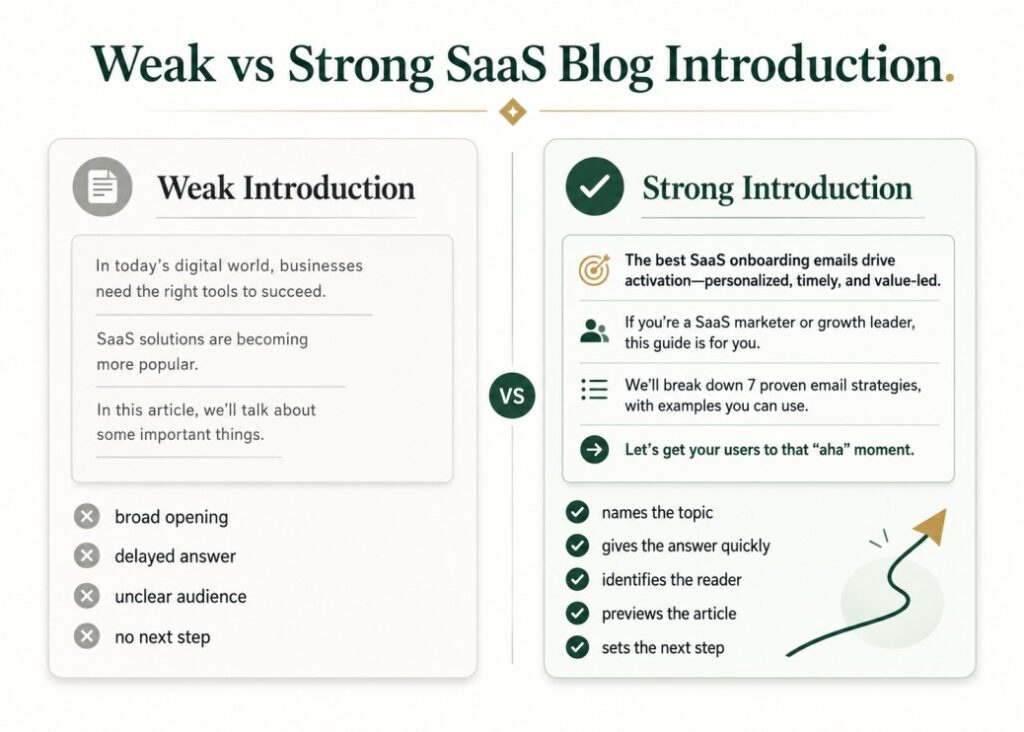
7. Answer the Main Question Near the Top
Do not make the reader pass through a broad industry introduction before reaching the answer.
An answer-first introduction should:
- Name the topic
- Give the direct answer
- Explain who the page is for
- Preview what the reader will get
For a deeper explanation, read why SaaS blogs answer too late.
Before-and-After Introduction Example
Before
Content marketing has changed over the years, and SaaS companies now face more competition than ever. Publishing valuable content can help brands build awareness and reach potential customers.
After
A SaaS content audit reviews whether your existing pages match buyer intent, answer key questions, support product understanding, and create useful paths to conversion. Start with pages that already receive impressions but fail to earn clicks or qualified actions.
The second version gives the definition, scope, and first action immediately.
8. Add Stand-Alone Answer Blocks
Important sections should often begin with a concise answer that still makes sense outside the full article.
A useful answer block names the subject, gives the answer, adds needed context, and leads into the deeper explanation.
For example:
Product-led content teaches the reader how to solve a problem while showing where a product, feature, or workflow fits. It does not turn every paragraph into a sales pitch. The product appears when it helps explain the solution or decision.
This structure supports readability, featured snippets, and accurate extraction. Learn more in What Is AEO Content?.
9. Review Readability and Scanability
Check for:
- Paragraphs of one to three sentences
- Lists for grouped items
- Tables for real comparisons
- Defined technical terms
- Examples after abstract advice
- Clear transitions between steps
- No filler before the answer
- No repeated definitions
Layer 3: SaaS Product-Positioning Checks
SaaS content should teach first, but useful product context helps the reader connect advice to a real workflow or decision.
10. Add Product Relevance Where It Helps
Product relevance means connecting the topic to the product category, use case, or workflow at the right moment.
A blog about reducing support response time could naturally discuss:
- Ticket routing
- Shared inboxes
- Service-level rules
- Knowledge bases
- AI-assisted drafting
- Reporting
Add enough product context to show how the advice works without turning every section into a pitch.
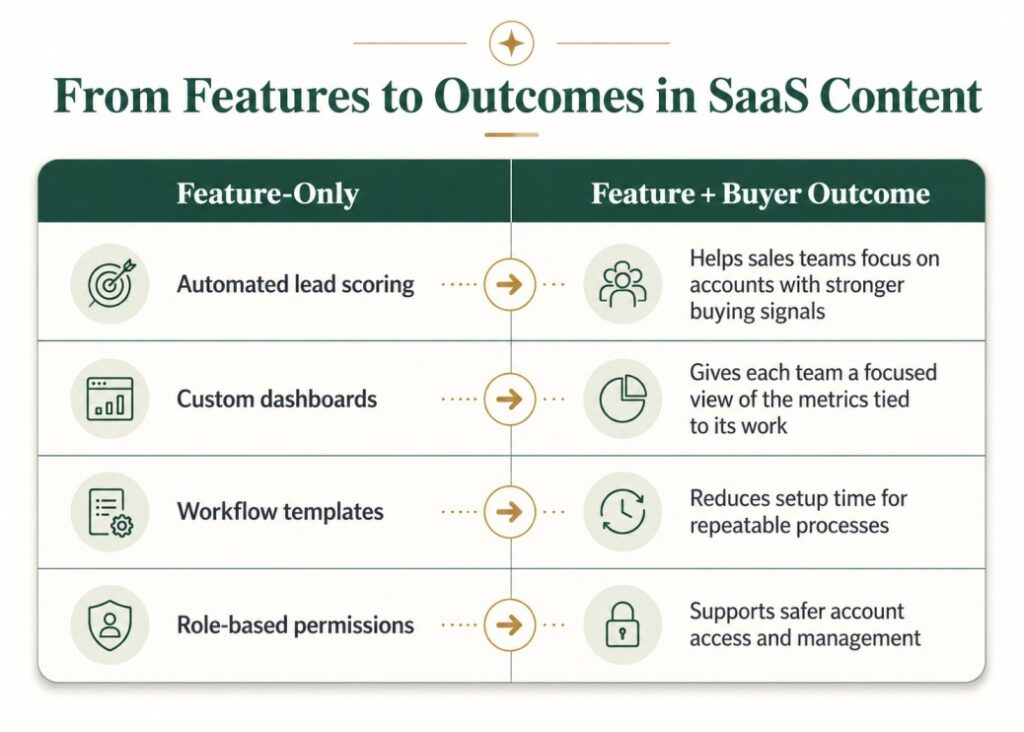
11. Connect Features to Outcomes
A feature tells the reader what the software does. An outcome explains why the capability matters in a real workflow.
| Feature-only copy | Feature connected to an outcome |
|---|---|
| Automated lead scoring | Helps sales teams focus follow-up on accounts showing stronger buying signals |
| Custom dashboards | Gives each team a focused view of the metrics tied to its decisions |
| Role-based permissions | Limits access based on responsibility and supports safer account management |
| Workflow templates | Reduces the setup work needed to launch a repeatable process |
| Conversation summaries | Helps team members review key points without replaying a full call |
Describe the mechanism and likely use without promising a guaranteed result.
12. Use Real Workflows and Product Examples
Generic examples weaken otherwise useful SaaS content.
Instead of writing “automation saves time,” show the workflow:
A customer success platform can flag an account after product usage drops, create a task for the account owner, and add the account to a recovery sequence.
Use real products only when the information is verified. Use anonymized workflows when a brand name adds no value.
You can review examples of comparison, AI visibility, and answer-first work in my SaaS content portfolio.
Layer 4: Evidence, Originality, and Trust
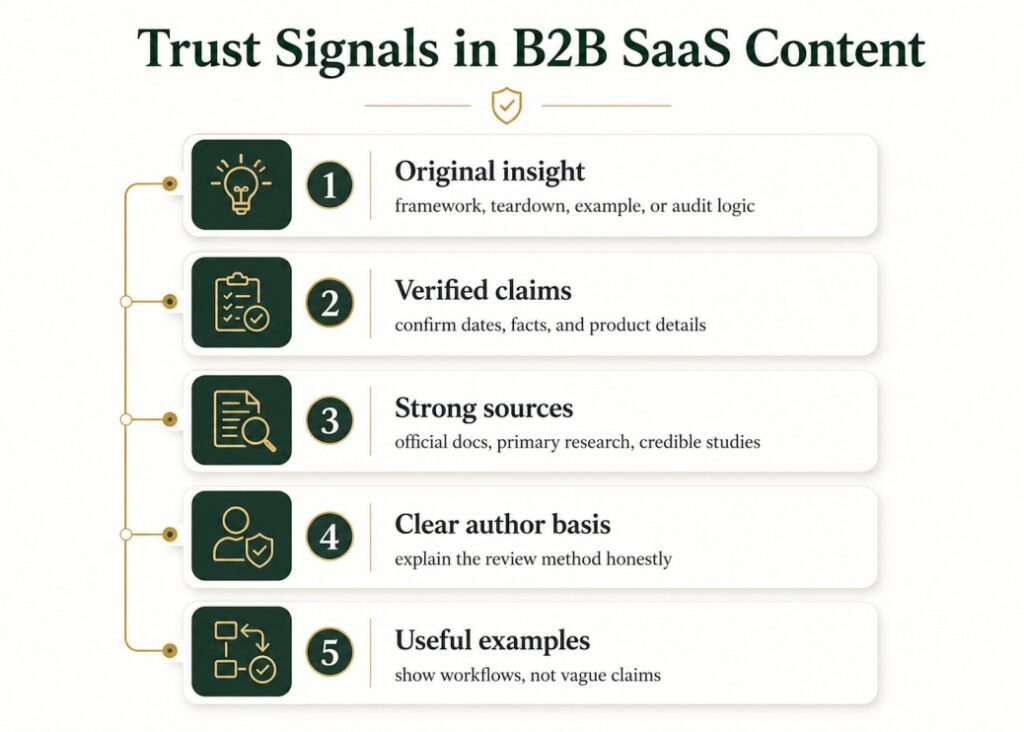
Trust comes from accurate claims, useful experience, transparent limits, and sources that support the exact point being made.
13. Add an Original Insight or Useful Framework
A page that only summarizes common advice gives readers little reason to save, cite, or link to it.
Original value can come from a framework, decision tree, checklist, teardown, before-and-after example, audit process, new comparison, or limited first-hand observation.
Google’s guidance for AI features also encourages unique viewpoints and non-commodity content that goes beyond a summary of information already available. Read Google’s AI optimization guidance.
14. Verify Every Claim and Source
Claims about research, platform behavior, technical requirements, prices, benchmarks, or product capabilities often need citations.
Before publishing, open the original source, check its date, confirm that it supports the claim, and prefer official documentation or primary research. Remove statistics that add drama but not understanding.
Attach the source to the sentence it supports. Do not place a pile of links at the end and make the reader guess.
15. Show the Author’s Basis Without Overstating It
Useful trust signals include a clear author bio, relevant samples, a stated method, transparent self-led examples, accurate first-hand notes, and a visible update date.
A line such as “In my content audits, I check the buyer stage before editing keyword use” is useful when that reflects the actual process. Avoid invented client outcomes or claims of experience you cannot prove.
Layer 5: SEO, AEO, GEO, and AI Visibility Checks
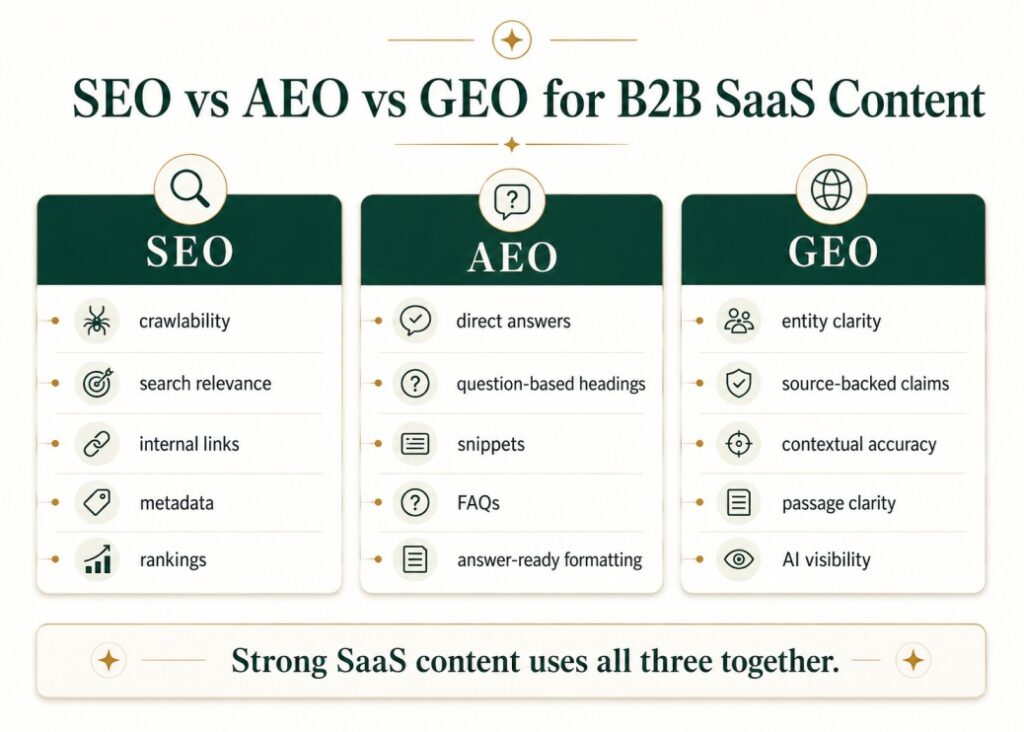
SEO, AEO, and GEO are connected, but each has a different focus.
- SEO helps pages become crawlable, understandable, and competitive in search results.
- AEO shapes content to answer direct questions clearly.
- GEO improves the context, entities, evidence, and passage clarity that generative systems may use when forming answers.
Read SEO vs AEO vs GEO for SaaS for a fuller comparison.
16. Add Useful Internal Links
Internal links should help the reader continue a logical task. Link to definitions, related guides, product or service pages, comparisons, and portfolio examples when each page supports the next question.
Use descriptive anchor text. “Read the AI visibility audit” is clearer than “click here.”
Google says internal links help people and Google understand a site and discover related pages. Review Google’s link best practices.
17. Use External Links Where They Increase Trust
External links are useful when they lead to official documentation, original research, technical standards, product documentation, or the source behind a factual claim.
Do not add weak links to make the article look researched. Prefer official or primary sources when possible.
18. Write the URL Slug and Metadata
The URL, SEO title, and meta description should describe the page clearly.
For this article:
- Suggested slug:
b2b-saas-blog-post-checklist - SEO title:
B2B SaaS Blog Post Checklist: 25 Checks - Meta description:
Use this B2B SaaS blog post checklist to review buyer intent, SEO, AEO, product relevance, trust, conversion, and publishing before launch.
Keep the title aligned with the H1. Write the description as a useful preview, not a list of repeated keywords.
19. Check Whether Each Image Teaches Something
Useful images include process diagrams, buyer-stage matrices, annotated screenshots, before-and-after examples, checklist summaries, and workflow maps.
Compress images and choose dimensions that fit the layout. Do not upload a huge file and rely on WordPress to fix it.
20. Write Accurate Alt Text and Media Details
Alt text should describe the useful content of an image for someone who cannot see it.
Good alt text:
Seven-layer B2B SaaS publishing framework from buyer intent to post-launch tracking
Weak alt text:
B2B SaaS blog post checklist SEO AEO GEO best content guide
Also check the filename, caption, width, and surrounding text. Leave alt text empty for decorative images.
21. Format the Article for Answer Engine Optimization
AEO should shape the full article, not only the FAQ.
Check for a clear definition, direct answers, useful question headings, numbered processes, comparison tables, grouped lists, concise FAQs, and consistent terms.
Better answer structure may help search and AI systems understand a passage, but it cannot guarantee a snippet or citation.
22. Improve GEO and AI Citation Clarity
Generative engine optimization should make the article easier to interpret accurately, not fill it with repeated terms.
Review each important passage for named subjects, clear definitions, category and audience context, dates where freshness matters, attached sources, stated limits, consistent terms, and sentences that remain accurate when quoted alone.
Google states that the same core SEO practices apply to its AI features, including crawlability, helpful content, internal links, page experience, and structured data that matches visible content. Read Google’s guidance for AI features.
Layer 6: Conversion Check
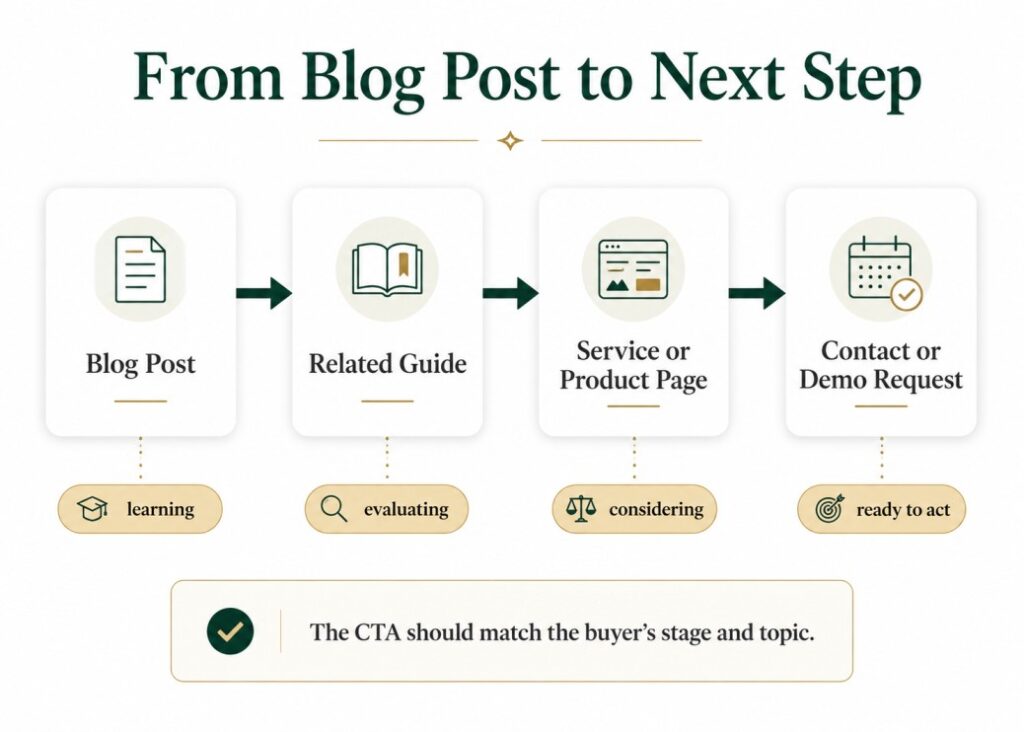
Strong SaaS content helps the reader take the next suitable step without turning the article into a long sales page.
23. Build a Clear Conversion Path and CTA
Choose the CTA based on the article’s intent and buyer stage.
Possible next steps include a related guide, product use case, comparison, template, trial, audit, or contact page.
Check that:
- The CTA matches the topic
- The offer solves the problem discussed
- The anchor text explains the next step
- The page links to one primary conversion destination
- The CTA avoids promises the service cannot guarantee
Explore my B2B SaaS content services to see how SEO, AEO, comparison content, and content audits can fit different goals.
Layer 7: Final Publishing and Learning Checks
24. Complete Technical, Mobile, and Proofreading QA
Review the final WordPress preview, not only the document.
Check:
- One H1
- Correct heading order
- Working internal and external links
- Correct metadata
- Canonical URL
- Index setting
- Article schema
- Visible FAQ content that matches any FAQ schema
- Image size and alt text
- Table display on mobile
- List numbering
- Button labels
- Author name and date
- Spelling and grammar
- Repeated paragraphs
- Extra spaces
- Broken shortcodes
- Page speed
Google uses the mobile version of a page for indexing and ranking, so mobile review is part of publishing, not an optional design check. Read Google’s mobile-first indexing guidance.
Core Web Vitals measure loading performance, responsiveness, and visual stability. Good scores support user experience, but they do not guarantee top rankings. Review Google’s Core Web Vitals guidance.
For a blog post, use Article schema that matches the visible page. Structured data gives search engines explicit information about the page, but it must describe content users can see. Review Google’s Article structured data guidance.
25. Define Post-Publishing Tracking Before Launch
Record:
- Publish date
- Primary and secondary queries
- Indexed status
- Impressions
- Clicks
- Click-through rate
- Average position
- Internal links pointing to the article
- Visits to product, service, or contact pages
- Leads connected to the article
- Backlinks and mentions
- Featured snippets
- Manually observed AI Overview or AI answer appearances
Use Google Search Console to find unexpected queries and sections earning impressions. Pages near page one may need stronger sections, better internal links, clearer titles, or a closer intent match.
Do not treat one manual ChatGPT, Gemini, or Perplexity test as stable evidence. Answers can change by prompt, user, location, model, and date.
Copyable 25-Point B2B SaaS Blog Post Checklist
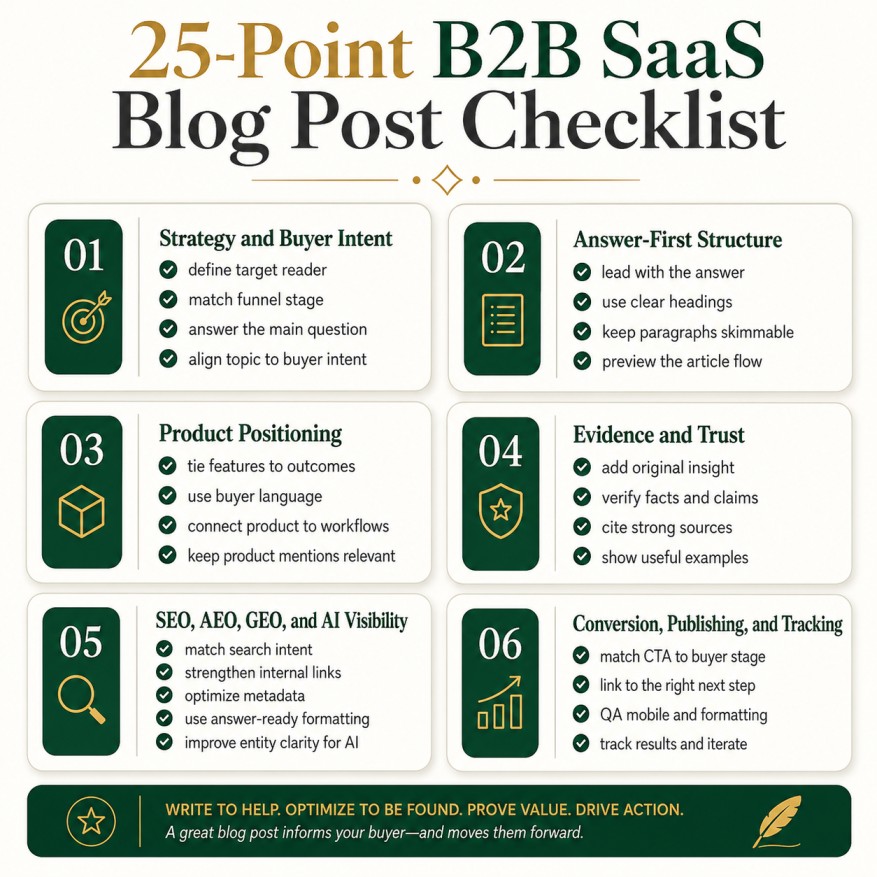
Copy this list into your brief, content document, Notion board, or WordPress workflow.
Strategy and Buyer Intent
- 1. Name the exact target reader.
- 2. Confirm the buyer’s funnel stage and job.
- 3. Define one primary question.
- 4. Match the live search intent.
- 5. Check the keyword and topic scope.
Answer-First Structure
- 6. Build headings around reader questions.
- 7. Answer the main question near the top.
- 8. Add stand-alone answer blocks.
- 9. Review readability and scanability.
Product Positioning
- 10. Add product relevance where it helps.
- 11. Connect features to outcomes.
- 12. Use real workflows and product examples.
Evidence and Trust
- 13. Add an original insight or useful framework.
- 14. Verify every claim and source.
- 15. Show the author’s basis without overstating it.
SEO, AEO, GEO, and AI Visibility
- 16. Add useful internal links.
- 17. Use external links where they increase trust.
- 18. Write the URL slug and metadata.
- 19. Check whether each image teaches something.
- 20. Write accurate alt text and media details.
- 21. Format the article for answer engine optimization.
- 22. Improve GEO and AI citation clarity.
Conversion
- 23. Build a clear conversion path and CTA.
Publishing and Tracking
- 24. Complete technical, mobile, and proofreading QA.
- 25. Define post-publishing tracking before launch.
Publish Fewer Weak Posts and More Useful SaaS Assets
A strong B2B SaaS blog post does more than pass an SEO plugin check. It answers a real buyer question, explains the product in context, supports its claims, creates useful internal paths, and gives the reader a sensible next step.
Use this checklist before every new article and content refresh. It will help your team catch weak strategy, delayed answers, generic product mentions, unsupported claims, and broken conversion paths before they reach the live site.
Need an outside review? I offer SaaS content audits and answer-first content support for teams that need clearer buyer intent, stronger SEO and AEO structure, better product relevance, and practical priorities. You can contact me about your SaaS content and share the page, keyword, or content problem you want to fix.
Frequently Asked Questions
What should a B2B SaaS blog post include?
A B2B SaaS blog post should include a clear target reader, buyer stage, primary question, direct answer, product context, supporting evidence, internal links, readable formatting, metadata, a relevant call to action, and a post-publishing tracking plan.
How is a SaaS blog checklist different from a general SEO checklist?
A SaaS blog checklist reviews buyer intent, product positioning, workflows, feature outcomes, trust, and conversion in addition to standard SEO fields. A general SEO checklist may help a page become searchable, but it may not help a software buyer understand or evaluate a solution.
How many times should the primary keyword appear?
The primary keyword should appear naturally in key places such as the H1, introduction, selected headings, metadata, and relevant body copy. No fixed keyword density guarantees rankings. Search intent, useful topic coverage, semantic relevance, and readability matter more than repeating an exact phrase.
Do AEO and GEO replace SEO?
No, AEO and GEO do not replace SEO. SEO supports crawling, indexing, relevance, internal links, and search visibility. AEO improves direct answers and content structure, while GEO improves entity context, sourcing, and clarity for generative search systems.
Can an optimized SaaS article guarantee AI citations?
No, an optimized SaaS article cannot guarantee citations in AI Overviews, ChatGPT, Perplexity, Gemini, or other answer systems. Clear structure, accurate sourcing, original value, named entities, and stand-alone answer blocks can make content easier to understand and quote accurately.
What should a SaaS team track after publishing?
A SaaS team should track indexing, impressions, clicks, click-through rate, average position, search queries, internal links, backlinks, service-page visits, contact-page visits, and attributed leads. Teams can also record featured snippets and manually observed AI-search appearances.
Need SaaS content built for SEO and AI visibility?
Work with Manal Ghamir on answer-first SaaS content that supports Google rankings, AI search visibility, buyer education, and product clarity.
View Services View Portfolio Contact Manal