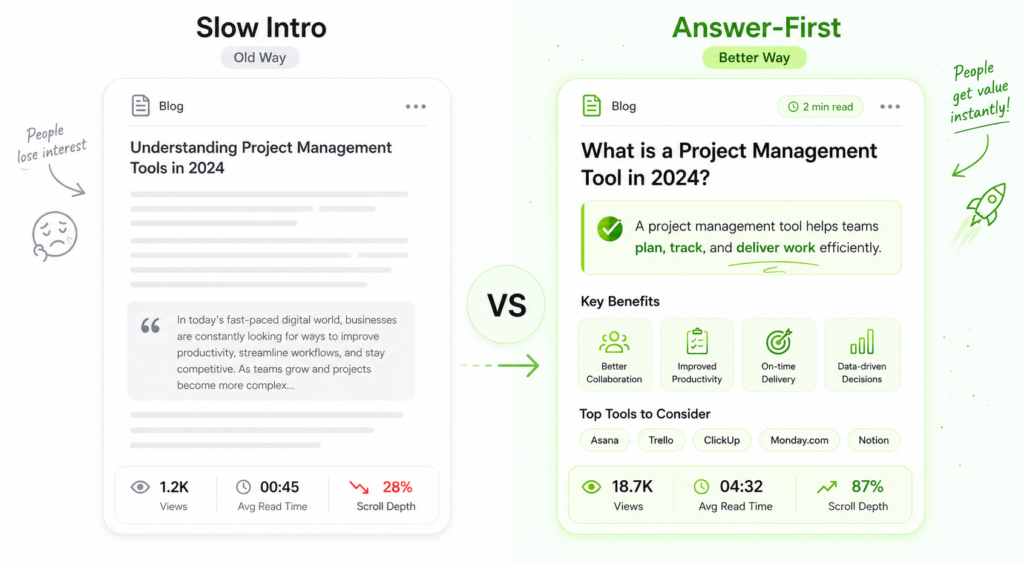
Why SaaS blogs answer too late comes down to structure: many posts delay the main answer behind broad intros, filler, and weak headings.
Most readers decide within seconds if a blog is useful. If they cannot find the answer quickly, they leave. AI search systems like ChatGPT, Perplexity, and Gemini also prefer content that explains the topic immediately.
This affects:
- SEO rankings
- Featured snippets
- Google AI Overviews
- AI visibility
- Demo conversions
- Product understanding
Modern SaaS content needs:
- direct answers
- structured formatting
- semantic entities
- scannable sections
- retrieval-friendly writing
That matters for:
- SEO
- AEO (Answer Engine Optimization)
- GEO (Generative Engine Optimization)
Today, search engines and AI systems reward clarity and speed more than long introductions.
For the full framework, read SEO vs AEO vs GEO for SaaS brands.
My pet peeve: SaaS blogs that take 300 words to answer a simple question. A busy founder wants the answer first.
Table of Contents
What Does “Answering Too Late” Mean in SaaS Content?
SaaS blogs answer too late when they delay the main answer behind filler, broad context, or generic introductions. This hurts SEO, featured snippets, AI visibility, and conversions because readers and AI systems both prefer fast answers and structured explanations.
Many SaaS blogs still spend too much time “setting the stage.”
They open with:
- industry background
- broad storytelling
- vague marketing advice
- generic AI-generated filler
The reader still has no answer.
Signs your SaaS blog answers too late
- The intro takes 300 words to explain the topic
- The main answer appears below the fold
- The article opens with generic storytelling
- Product relevance appears too late
- Headings do not match search intent
Weak intro vs answer-first intro
| Weak Intro | Answer-First Intro | SEO/AI Impact |
|---|---|---|
| “Content marketing has changed a lot over the years…” | “Most SaaS blogs lose readers because they delay the answer.” | stronger snippet extraction |
| vague context | direct answer | better search intent alignment |
| low relevance | immediate clarity | higher engagement |
| weak snippet potential | strong snippet potential | better AI retrieval |
The second version improves:
- search intent alignment
- snippet visibility
- AI answer extraction
- reader retention
AI systems from OpenAI and Anthropic often retrieve content section by section.
If the answer appears too late:
- retrieval quality drops
- citation likelihood drops
- AI visibility drops
Good SaaS content should teach quickly.
That does not mean removing depth. It means putting clarity first.
Need help turning slow SaaS blogs into answer-first content? Explore my SaaS SEO blog writing services.
Why SaaS Blogs Lose Readers Before Conversion
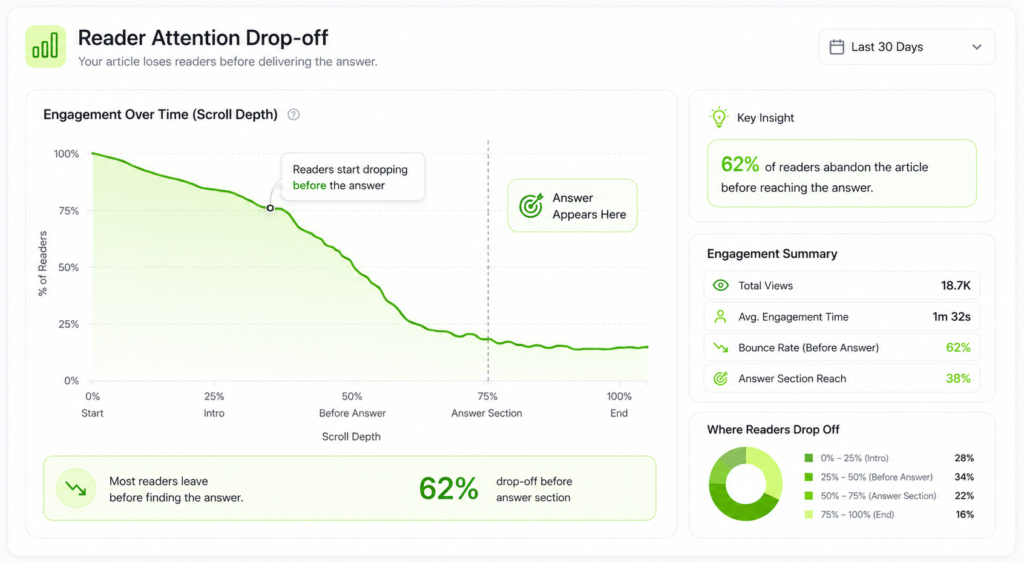
Most SaaS blog visitors scan before reading deeply. If they do not find relevance quickly, they leave.
This is one of the biggest reasons SaaS blogs that don’t convert struggle with:
- bounce rate
- demo intent
- engagement
- free trial signups
1. Long introductions reduce trust
A founder searching “best onboarding software” wants:
- fast clarity
- direct comparisons
- practical answers
They do not want:
- motivational storytelling
- generic content marketing advice
- long history lessons
When blogs delay clarity, trust drops.
2. Generic AI filler creates content fatigue
Many AI-written SaaS blogs repeat the same phrases:
- “In today’s digital landscape”
- “Businesses need innovative solutions”
- “Content is king”
Readers skip this immediately.
Strong SaaS content optimization requires:
- real examples
- product understanding
- structured formatting
- expert context
3. Weak formatting hurts readability
Walls of text increase abandonment.
Strong SaaS blog structure uses:
- question-based headings
- bullets
- comparison tables
- FAQs
- short paragraphs
This improves:
- scannability
- featured snippet visibility
- AI answer extraction
4. Delayed product relevance weakens conversion intent
Many SaaS blogs hide product relevance until the end.
That hurts conversion-focused SaaS content.
The best SaaS educational content teaches quickly, then connects naturally to product value.
Examples:
- HubSpot uses fast-answer educational structure
- Notion uses concise onboarding-style explanations
- ClickUp aligns blog structure closely with comparison intent
- Salesforce uses intent-focused educational landing pages
- Monday.com structures feature education clearly
SaaS Blogs That Don’t Convert vs SaaS Content That Ranks and Converts
| SaaS Blogs That Don’t Convert | SaaS Content That Ranks and Converts | SEO/AI Impact |
|---|---|---|
| long intros | direct answers | stronger snippet visibility |
| vague headings | question-based headings | better AI extraction |
| AI filler | expert examples | higher trust |
| hidden product relevance | fast contextual clarity | stronger conversion intent |
| poor formatting | scannable sections | better engagement |
How Delayed Answers Hurt SEO Performance
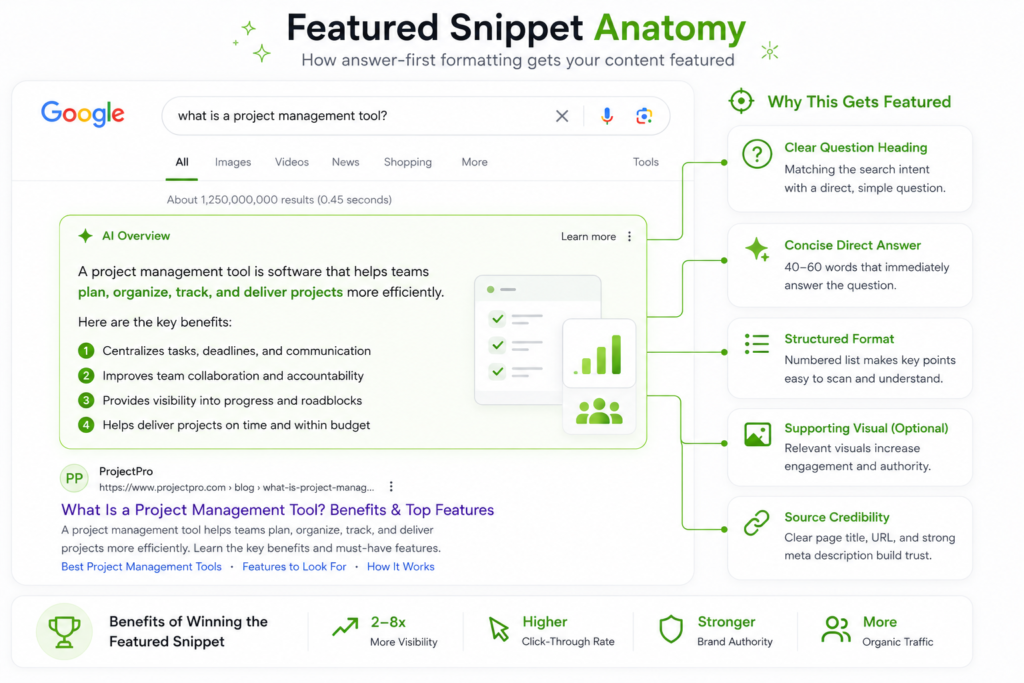
Delayed answers hurt SEO because search engines reward pages that satisfy search intent quickly.
Google prefers pages that:
- answer immediately
- match search intent
- structure information clearly
- improve user satisfaction
This affects:
- bounce behavior
- engagement signals
- featured snippets
- click satisfaction
Why answer speed affects rankings
If readers return to search results quickly, that signals weak relevance.
A slow intro creates friction.
Many SaaS content strategy mistakes come from writing for keywords instead of readers.
Example:
A post targeting “best CRM software” spends the first 500 words discussing “the importance of customer relationships.”
The reader leaves.
Good SEO content for SaaS startups answers the intent first.
Why featured snippets prefer direct answers
Featured snippets usually extract:
- concise definitions
- numbered lists
- comparison tables
- direct explanations
That is why answer-first SaaS content performs better for:
- Google AI Overviews
- featured snippets
- People Also Ask boxes
Snippet-ready structure example
What is answer-first SaaS content?
Answer-first SaaS content gives readers the core answer immediately, then expands with examples, comparisons, proof, and CTAs. This improves SEO, AEO, GEO, readability, and AI answer extraction.
| SEO Problem | Structural Cause | Fix |
|---|---|---|
| high bounce rate | delayed answer | answer within first 100 words |
| weak snippet visibility | vague formatting | use direct-answer sections |
| low engagement | long paragraphs | improve scannability |
| weak AI visibility | unclear structure | use chunked formatting |
Why Google rewards scannable content
Tools like Ahrefs and Semrush consistently show that readability impacts engagement metrics.
Scannable content improves:
- time on page
- section engagement
- CTA visibility
- content retention
AI-readable SaaS content definition
AI-readable SaaS content uses concise answers, semantic headings, structured formatting, and standalone sections that AI systems can retrieve easily.
For a deeper breakdown, read my guide on what AEO content is and how SaaS brands can use it.
Why SaaS Blogs Fail in AI Search
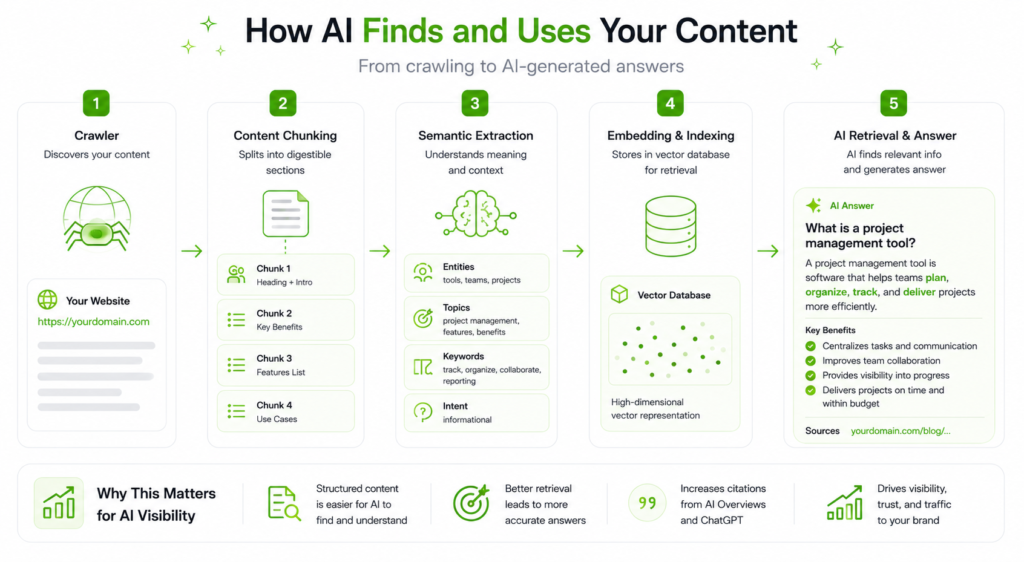
AI search systems retrieve and summarize content differently from traditional search engines. They prefer concise answers, standalone sections, semantic entities, and retrieval-friendly formatting.
AI visibility now matters for:
- Google AI Overviews
- ChatGPT
- Perplexity
- Gemini
- Claude
How AI systems extract answers
AI systems often retrieve:
- concise definitions
- numbered steps
- comparison tables
- FAQs
- standalone paragraphs
That means every section should work independently.
If an AI system must read 600 words before finding the answer, the content becomes harder to retrieve.
Why chunk-level clarity matters
Good AI-readable blog structure uses:
- question-based headings
- short paragraphs
- semantic entities
- direct answers
- concise lists
Bad structure creates weak retrieval signals.
Why entities improve AI understanding
Entities help AI systems understand context.
Mentioning companies like:
helps reinforce topical relevance.
Why AI-generated SaaS blogs feel repetitive
Many AI-written SaaS blogs:
- repeat generic advice
- avoid specifics
- use weak examples
- delay practical value
That creates low-quality retrieval patterns.
AI-friendly SaaS content still needs:
- expertise
- structure
- editorial judgment
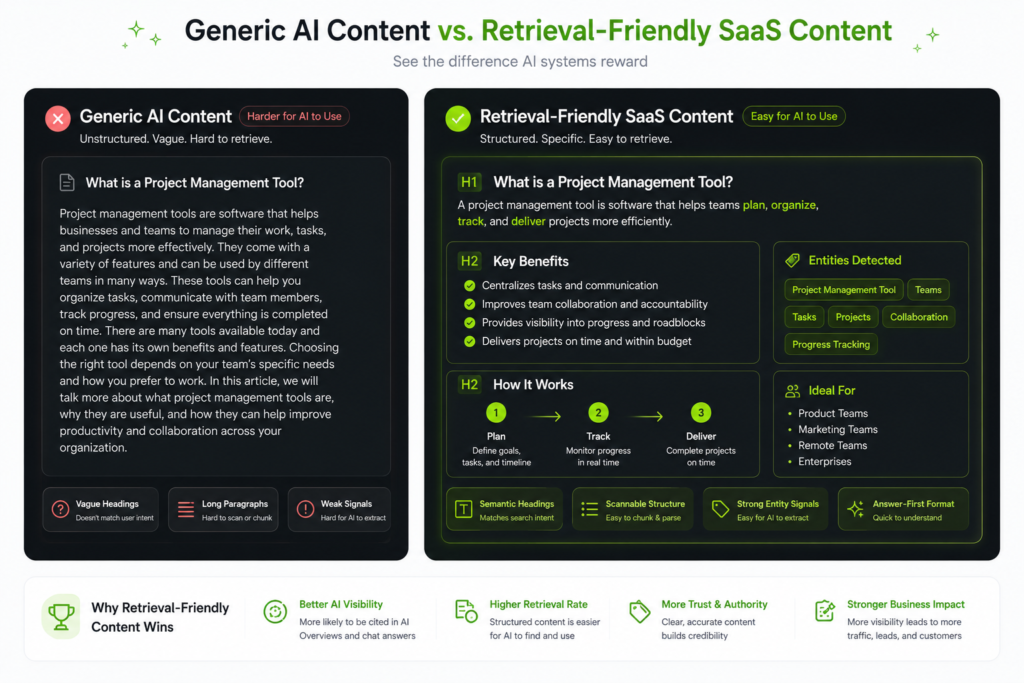
Generic AI content vs retrieval-friendly SaaS content
| Generic AI Content | Retrieval-Friendly SaaS Content | AI Visibility Impact |
|---|---|---|
| vague intros | direct answers | stronger retrieval |
| broad language | precise SaaS terminology | better semantic clarity |
| weak structure | standalone sections | better chunk extraction |
| no entities | semantic context | improved AI understanding |
| filler-heavy | snippet-friendly formatting | higher citation potential |
AI visibility checklist
To improve AI visibility:
- answer immediately
- define terms clearly
- use tables and lists
- add entity signals
- use question headings
- avoid filler intros
Answer-first SaaS blog structure improves rankings, featured snippets, AI visibility, readability, and conversions by reducing friction for both readers and AI systems.
Need SaaS content that performs better in Google AI Overviews, ChatGPT, and Perplexity?
Related guide: What Is AEO Content? A Simple Guide for SaaS Brands
What Answer-First SaaS Content Looks Like
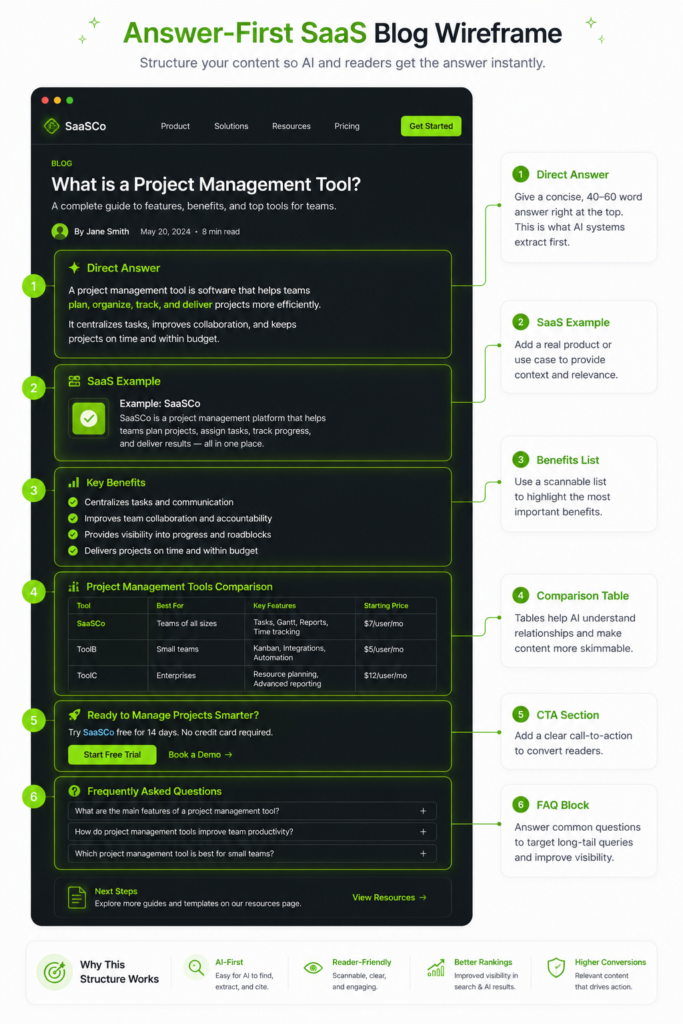
Answer-first SaaS content gives readers the answer immediately, then expands with examples, comparisons, product context, and proof.
This improves:
- SEO
- featured snippets
- Google AI Overviews
- AI visibility
- demo conversions
Structure of answer-first SaaS content
- Direct answer
- Supporting explanation
- SaaS example
- Comparison table
- CTA or internal link
Start with the answer first
Do not hide the conclusion.
Good SaaS SEO blog writing answers the core question immediately.
Use question-based headings
Question headings improve:
- scannability
- featured snippet eligibility
- AI extraction
Better heading examples
| Weak Heading | Strong Heading |
|---|---|
| Understanding engagement | Why SaaS Blogs Lose Readers Fast |
| Content optimization tips | How to Structure SaaS Blogs for AI Search |
| Improving readability | Why Short Paragraphs Improve SaaS Engagement |
Add SaaS examples early
Strong SaaS content optimization uses real examples.
- ClickUp often creates comparison-focused pages that quickly clarify use cases
- Intercom uses concise educational structure effectively
- Stripe explains technical topics with short structured sections
Keep paragraphs short
Short paragraphs improve:
- readability
- retention
- mobile UX
- AI parsing
Use comparison sections and FAQs
Tables and FAQs help:
- featured snippets
- AI Overviews
- People Also Ask visibility
| Weak Intro | Answer-First Intro | Impact |
|---|---|---|
| storytelling first | answer first | better engagement |
| generic context | direct relevance | stronger search intent alignment |
| delayed value | immediate clarity | better conversions |
Traditional SaaS Blogs vs Answer-First SaaS Blogs
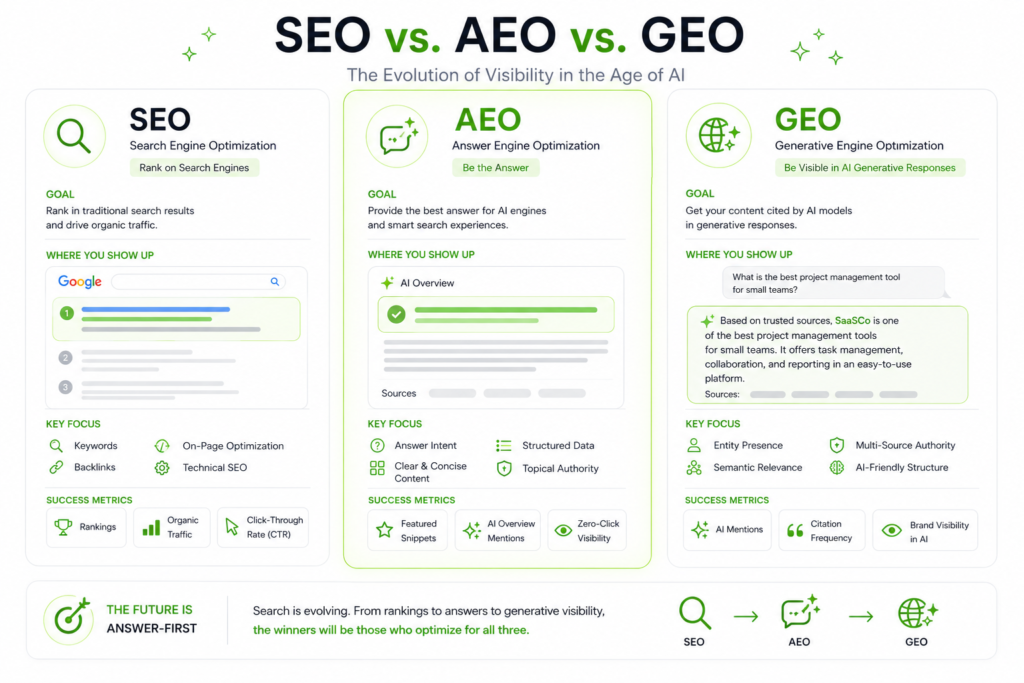
Many SaaS blogs still follow outdated SEO practices.
Modern SaaS content that ranks and converts looks different.
SEO-only writing vs SEO + AEO + GEO writing
Traditional SEO focuses heavily on keywords.
Modern SaaS content also needs:
- answer extraction
- AI readability
- snippet formatting
- retrieval structure
Human readability vs AI readability
Good SaaS content serves both:
- humans
- AI systems
That means:
- clear headings
- semantic structure
- direct answers
- concise formatting
Traffic-focused content vs conversion-focused content
Traffic alone does not create pipeline.
Conversion-focused SaaS content helps readers:
- understand the problem
- understand the solution
- understand the product category
Traffic-Focused Content vs Conversion-Focused Content
| Traditional SaaS Blog | Answer-First SaaS Blog | SEO/AI Impact |
|---|---|---|
| keyword-heavy | intent-focused | stronger relevance |
| long intros | immediate answers | better engagement |
| broad education | retrieval-friendly structure | better AI extraction |
| low product context | conversion-aware education | stronger demo intent |
| generic AI tone | expert SaaS perspective | higher trust |
How to Audit a SaaS Blog for Answer Speed
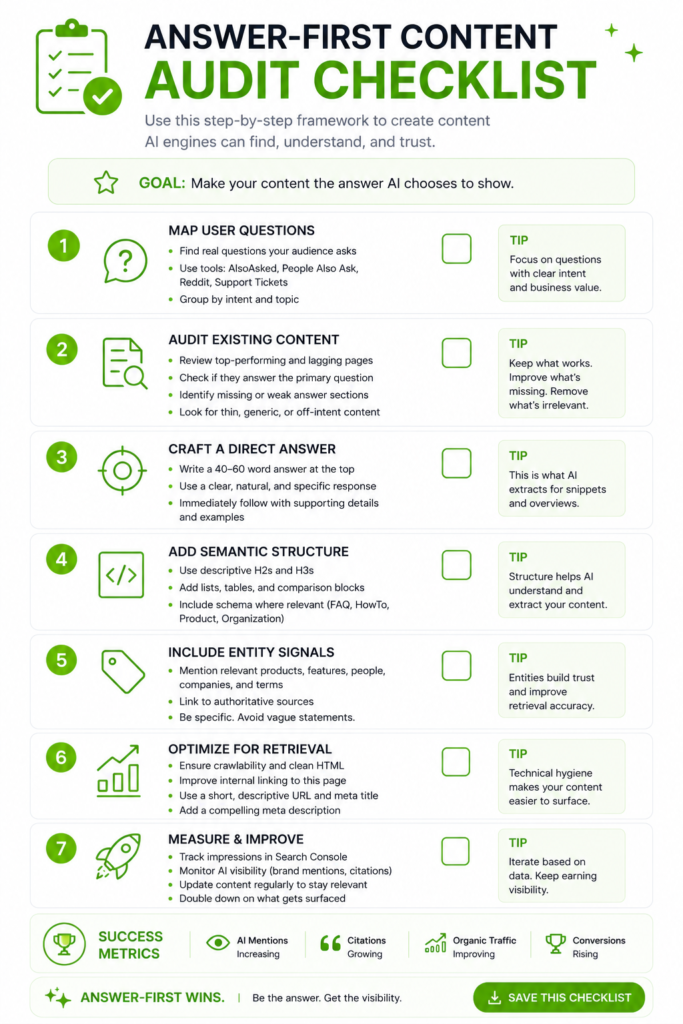
You can audit a SaaS blog for answer speed in less than 10 minutes.
Quick SaaS content audit process
- Read the first 100 words
- Check if the answer appears immediately
- Remove filler paragraphs
- Add semantic headings
- Add comparison tables
- Add FAQs
- Add SaaS examples early
- Improve scannability
Common signs of weak answer speed
- long storytelling intros
- vague headings
- walls of text
- weak formatting
- delayed product relevance
- generic AI language
Signs of strong answer-first SaaS content
- concise intros
- direct answers
- question headings
- semantic entities
- tables and lists
- standalone sections
How to Structure SaaS Blogs for SEO, AEO, and GEO
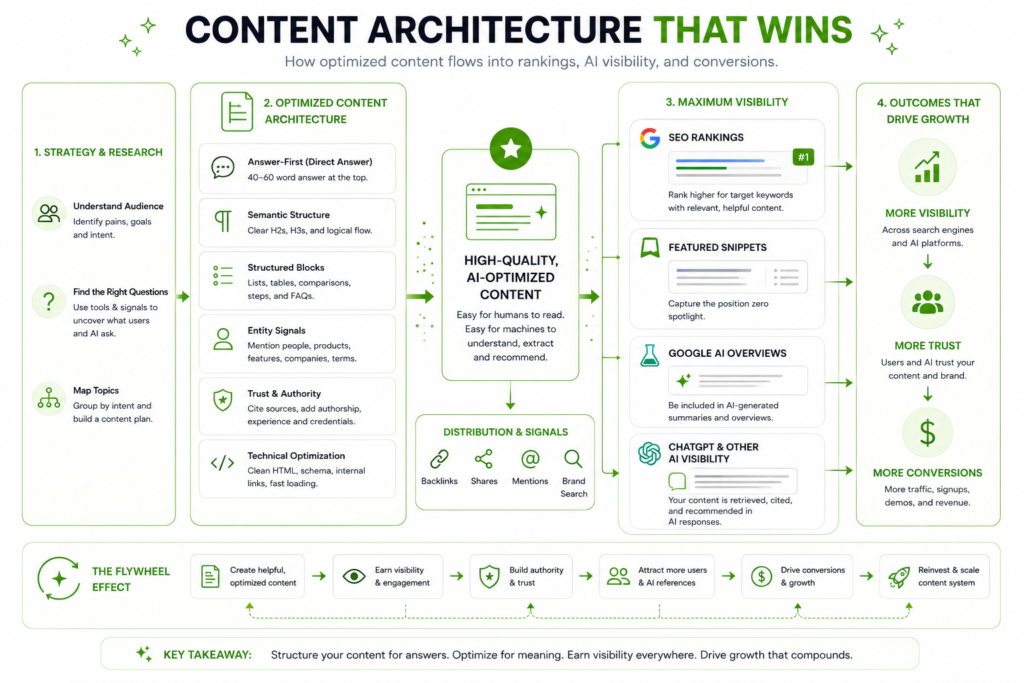
The best SaaS blog structure for conversions follows a simple rule:
Answer first. Expand second.
1. Answer the question immediately
The first 100 words should explain the main point clearly.
2. Use standalone sections
Every section should make sense independently.
That improves:
- AI extraction
- snippet potential
- reader clarity
3. Add semantic entities naturally
Mention relevant companies and tools naturally.
Examples:
- HubSpot
- Notion
- ClickUp
4. Use lists, tables, and FAQs
Structured formatting improves:
- scannability
- AI readability
- featured snippet visibility
5. Make sections scannable
Use:
- short paragraphs
- bullets
- clear H2s
- concise explanations
6. Add conversion context early
Do not wait until the end to mention:
- demos
- onboarding
- product relevance
- business outcomes
7. Use internal links strategically
Internal links help:
- topical authority
- engagement
- navigation
- conversion flow
Checklist for AI-friendly SaaS content
- answer immediately
- use question headings
- add entities naturally
- use comparison tables
- include FAQs
- keep sections concise
- avoid filler intros
SaaS Brands That Already Do This Well
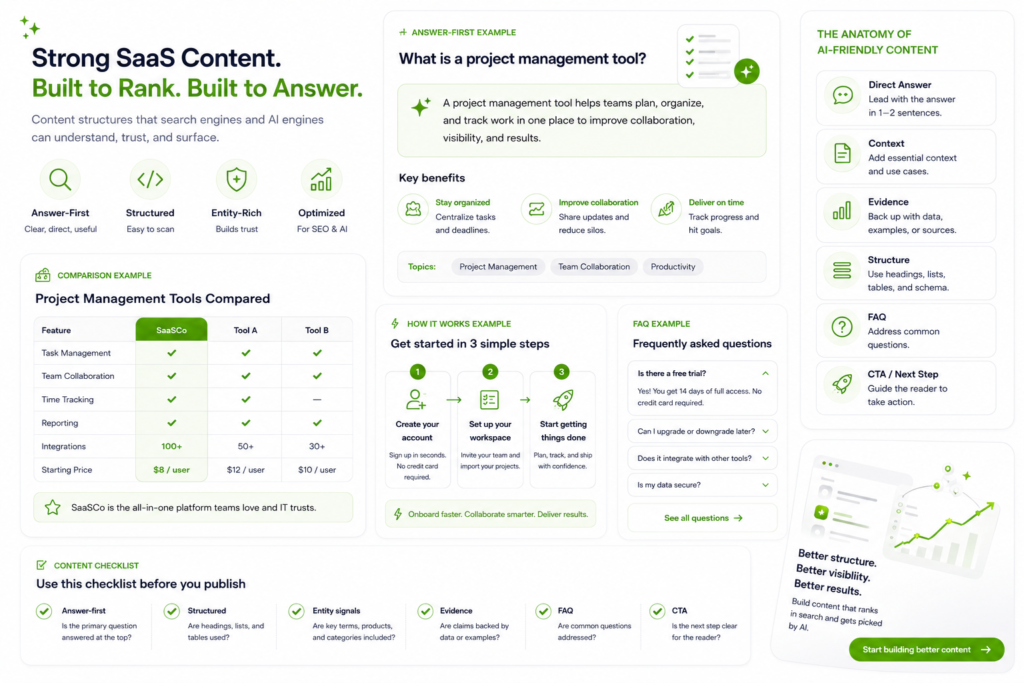
Some SaaS companies already understand answer-first content well.
What HubSpot does well
HubSpot structures content clearly and answers questions quickly.
Their blogs also use:
- snippet-ready formatting
- clear H2s
- strong educational flow
Why Notion’s structure feels faster
Notion keeps explanations simple and practical.
That improves:
- readability
- onboarding clarity
- product understanding
How ClickUp uses comparison intent
ClickUp creates comparison-focused content that aligns strongly with search intent.
This supports:
- conversion intent
- feature discovery
- self-qualification
What SaaS teams should copy
The best SaaS brands:
- answer fast
- structure clearly
- teach practically
- connect education to product value
FAQ
Why do SaaS blogs answer too late?
Many SaaS blogs still follow outdated SEO writing habits. They prioritize introductions and keyword placement instead of answering the reader’s question quickly. This hurts rankings, featured snippets, AI visibility, engagement, and conversions.
What is answer-first SaaS content?
Answer-first SaaS content gives the reader the main answer immediately, then expands with examples, proof, product context, comparisons, and FAQs. This structure improves SEO, AEO, GEO, AI answer extraction, and readability.
Why do SaaS blogs fail in AI search?
Many SaaS blogs fail in AI search because they use weak formatting, delayed answers, vague headings, and low semantic clarity. AI systems prefer concise answers, structured sections, entity signals, and retrieval-friendly formatting.
How do AI tools like ChatGPT and Perplexity read blog content?
AI systems like ChatGPT and Perplexity often retrieve blog content in chunks. They prefer standalone sections, concise definitions, comparison tables, semantic entities, and direct answers.
Why are long blog introductions bad for SEO?
Long introductions delay search intent satisfaction. Readers often leave before reaching the useful section. This increases bounce behavior and reduces engagement, snippet eligibility, and AI retrieval quality.
What makes SaaS content good for Google AI Overviews?
Google AI Overviews are more likely to surface content that is clear, structured, concise, and aligned with search intent.
- Answers quickly
- Uses structured formatting
- Includes semantic entities
- Stays concise
- Matches search intent clearly
Need SaaS content built for SEO and AI visibility?
Work with Manal Ghamir on answer-first SaaS content that supports Google rankings, AI search visibility, buyer education, and product clarity.
View Services View Portfolio Contact Manal