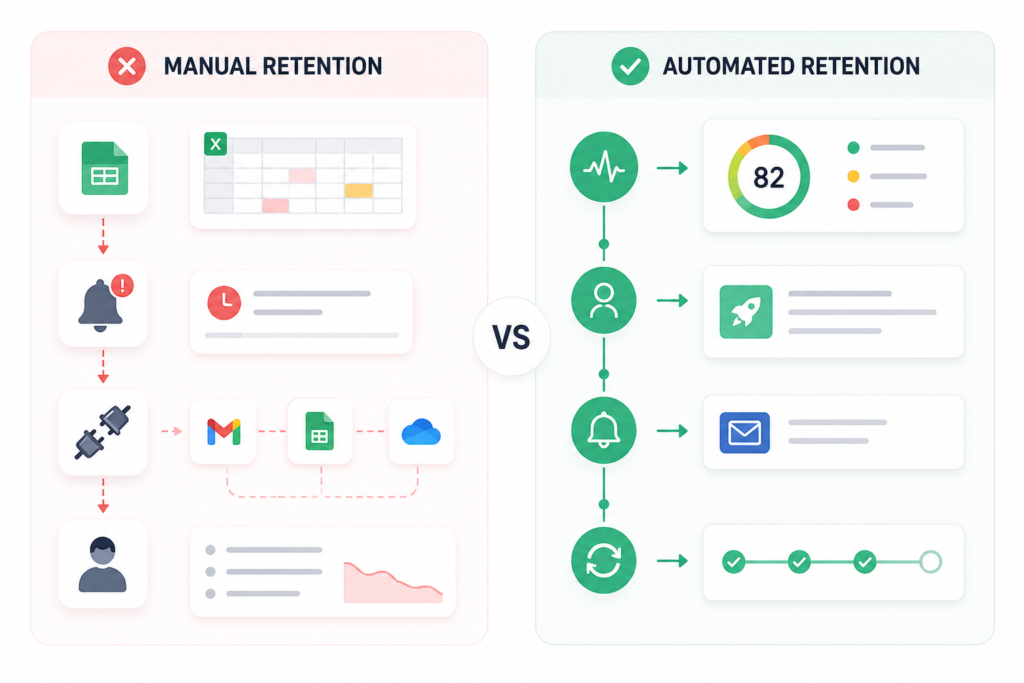
CRM automation for SaaS churn reduction can support customer success teams with health scoring, renewal alerts, and retention workflows. SaaS companies already collect large amounts of customer data, but churn still happens because teams react too late.
Customer success managers miss early warning signs. Renewal risk stays hidden. Onboarding issues go unnoticed until customers disengage.
CRM automation for SaaS churn reduction helps retention teams identify risk earlier and trigger action automatically.
Strong SaaS retention programs depend on workflows that monitor customer health, product adoption, engagement, and renewal readiness in real time.
Instead of relying on manual follow-ups, SaaS teams build operational systems that scale across the customer lifecycle.
This guide explains how SaaS companies use CRM automation to reduce churn, improve renewals, and create more proactive customer success operations.
Why SaaS Teams Struggle to Reduce Churn Manually
CRM automation for SaaS churn reduction helps teams identify risk signals early and trigger retention workflows automatically.
Without automation, customer success teams often discover churn risk too late because onboarding, product usage, and engagement data remain disconnected across systems.
Many SaaS companies still manage retention manually. Customer success managers review accounts individually, monitor spreadsheets, and rely on memory to track engagement.
Manual retention tracking becomes difficult once SaaS teams manage hundreds or thousands of accounts.
Most SaaS companies already collect product usage data, CRM records, support history, and customer communication logs. The challenge is turning those signals into action before renewal risk increases.
For example:
- A customer stops logging in regularly
- Product adoption declines
- Support tickets increase
- Executive stakeholders stop responding
Nothing happens until renewal conversations begin.
Sales automation and retention automation solve different problems.
Sales CRM workflows focus on:
- lead management
- pipeline activity
- revenue forecasting
Retention automation focuses on:
- onboarding completion
- product adoption
- customer health
- renewal risk
- engagement tracking
| Manual Retention Process | Automated Retention Workflow |
|---|---|
| CSM checks accounts manually | Health scores update automatically |
| Renewal risk discovered late | Renewal alerts trigger early |
| Static onboarding emails | Behavior-based onboarding workflows |
| Customer data scattered across tools | Customer signals centralized |
Customer success platforms like ChurnZero help SaaS teams centralize retention signals into one operational workflow.
What CRM Automation Means for SaaS Retention Teams
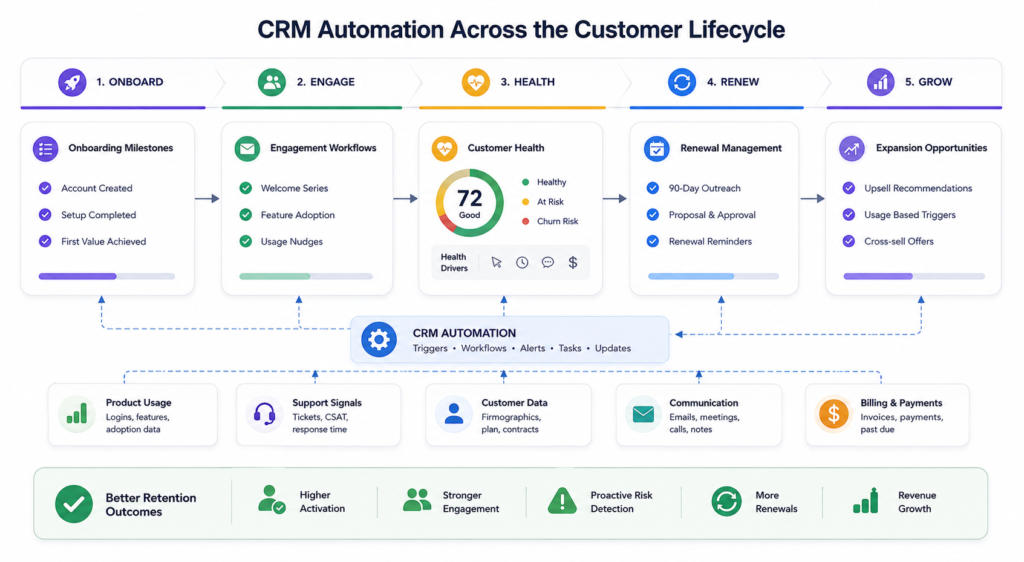
CRM automation for SaaS churn reduction uses customer behavior, product usage data, and lifecycle triggers to automate retention actions before churn happens.
SaaS teams use these workflows to monitor onboarding, customer health, engagement, and renewals automatically instead of relying on manual follow-ups.
CRM automation in SaaS retention goes beyond email automation.
It is an operational system that connects:
- CRM activity
- product usage analytics
- support interactions
- onboarding milestones
- renewal timelines
- customer health scoring
A customer health score is a weighted measurement of customer engagement and renewal risk based on behaviors like login frequency, feature adoption, onboarding completion, and support activity.
The goal is to trigger retention action before customers disengage.
Example CRM Retention Workflow
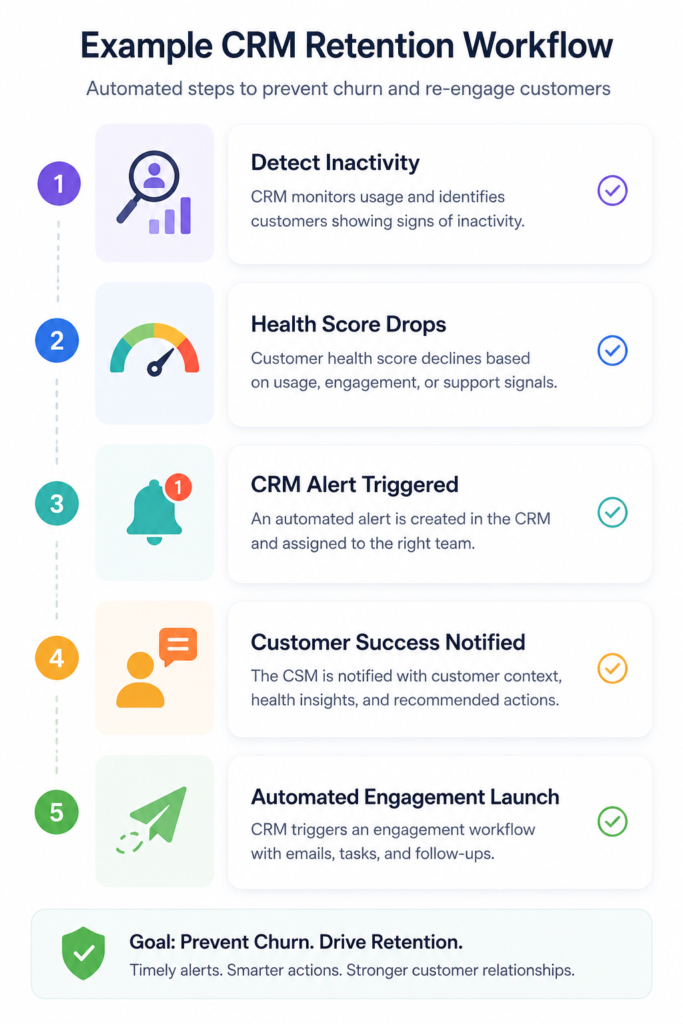
- Customer becomes inactive for 14 days
- Product usage drops below threshold
- Health score decreases automatically
- CRM creates a retention task
- CSM receives alert in Slack
- Automated engagement workflow launches
- Customer receives onboarding or education content
Core CRM automations that reduce churn include:
- automated onboarding milestones
- customer health score tracking
- product usage alerts
- renewal reminders
- stakeholder engagement monitoring
- escalation workflows
- expansion opportunity routing
Many SaaS teams connect systems like:
- Salesforce
- HubSpot
- product analytics platforms
- support systems
- customer success platforms like ChurnZero
A dedicated customer success platform for SaaS retention helps unify CRM automation, customer health monitoring, onboarding visibility, and renewal workflows into one operational system instead of spreading retention management across disconnected tools.
How SaaS Teams Identify Churn Risk Automatically
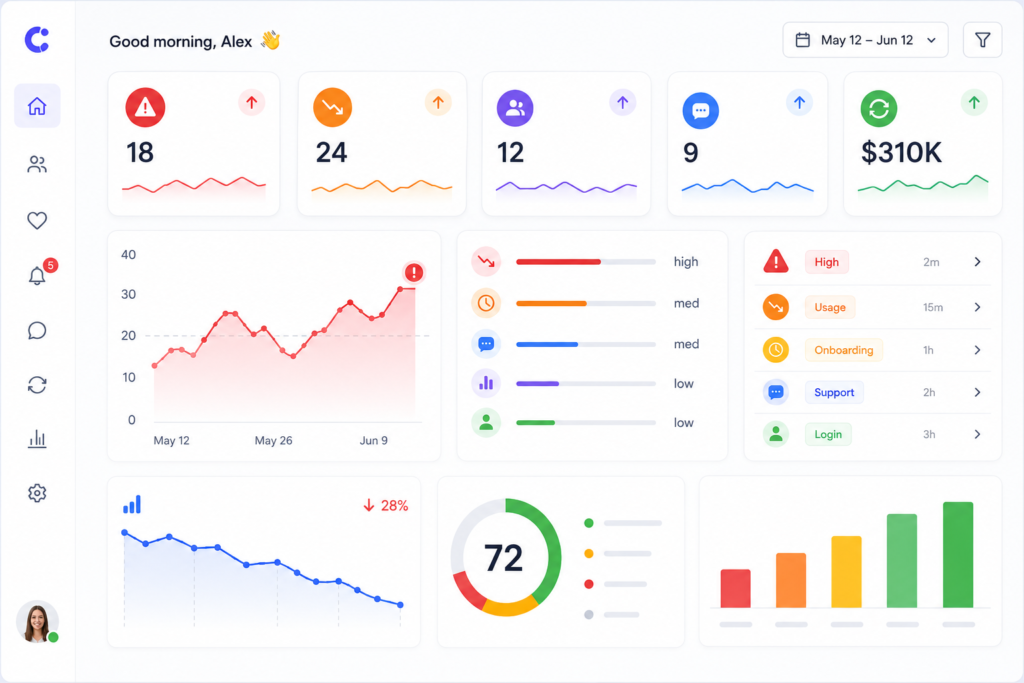
CRM automation for SaaS churn reduction improves when customer success teams automate churn-risk detection using product usage, engagement signals, onboarding progress, and renewal activity.
Automated retention workflows help teams intervene before customers become inactive or disengaged.
High-performing SaaS teams do not wait for customers to complain.
They monitor behavioral signals continuously.
Common churn indicators include:
- declining login frequency
- low feature adoption
- support frustration
- onboarding delays
- low stakeholder engagement
- poor renewal readiness
Modern customer success automation systems track these signals in real time.
| Churn Signal | Risk Meaning | Automated Action |
|---|---|---|
| Low product usage | Adoption decline | Trigger onboarding sequence |
| Support ticket spike | Frustration risk | Escalate to CSM |
| Stakeholder inactivity | Executive disengagement | Trigger executive outreach |
| Low feature adoption | Poor product fit | Launch education workflow |
This creates proactive SaaS churn reduction workflows instead of reactive customer support processes.
Example Churn Detection Workflow
- Product usage declines below benchmark
- Customer health score drops
- CRM adds account to “At Risk” segment
- Customer success manager receives alert
- Educational content workflow launches
- Executive stakeholder outreach triggers if engagement continues dropping
This also helps teams scale retention without increasing headcount.
One CSM can manage more accounts because automation handles:
- monitoring
- alerting
- workflow routing
- engagement triggers
Platforms like ChurnZero combine CRM activity, product usage data, onboarding signals, and customer health scoring into automated churn prevention workflows.
Using Customer Health Scores to Trigger Retention Workflows
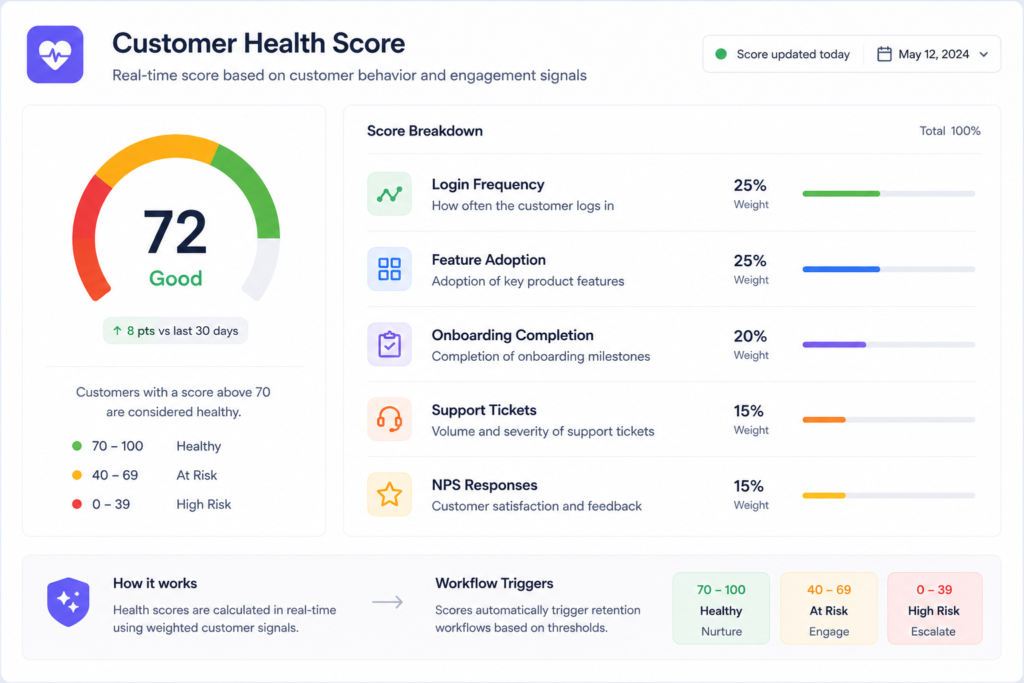
A customer health score predicts whether a SaaS customer is likely to renew, expand, or churn.
SaaS companies use health scores to automate retention workflows based on customer engagement, product adoption, onboarding progress, and support activity.
Customer health scoring is one of the most important systems in customer success automation because it helps SaaS teams identify churn risk before renewal conversations begin.
Instead of evaluating accounts manually, health scoring assigns weighted values to customer behaviors.
Example Customer Health Score Model
| Signal | Example Weight | Retention Meaning |
|---|---|---|
| Login frequency | 25% | Product engagement |
| Feature adoption | 20% | Product value realization |
| NPS responses | 15% | Customer satisfaction |
| Support tickets | 15% | Friction indicators |
| Onboarding completion | 25% | Early adoption success |
NPS (Net Promoter Score) measures customer loyalty by asking customers how likely they are to recommend a product or service.
Health scores become operational triggers.
Example Automated Retention Workflow
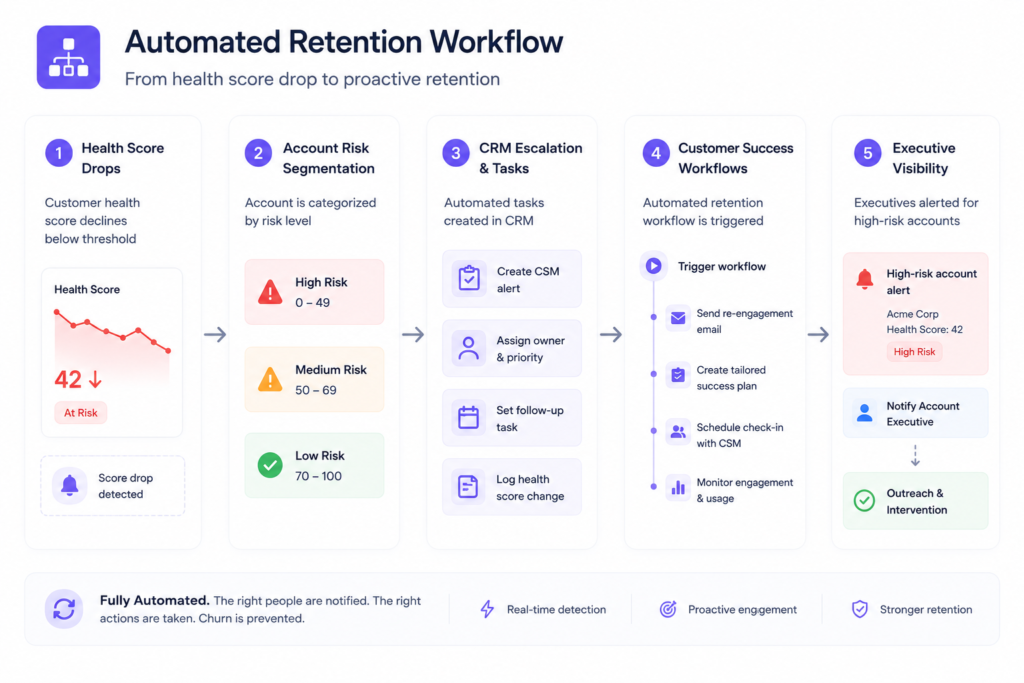
- Health score drops below threshold
- Account enters “At Risk” segment
- CRM creates escalation task
- Customer success workflow launches
- CSM receives notification automatically
- Executive stakeholder outreach triggers if risk increases
This approach improves intervention timing because teams can address problems before renewal discussions begin.
For example:
- low feature adoption triggers tutorial content
- declining executive engagement triggers outreach
- onboarding delays trigger implementation support
- support frustration triggers escalation review
Strong customer health score automation also helps RevOps teams standardize retention tracking across the business.
Platforms like ChurnZero centralize customer health monitoring, workflow automation, onboarding visibility, and retention operations inside one SaaS-focused customer success platform.
Automating SaaS Onboarding to Improve Retention
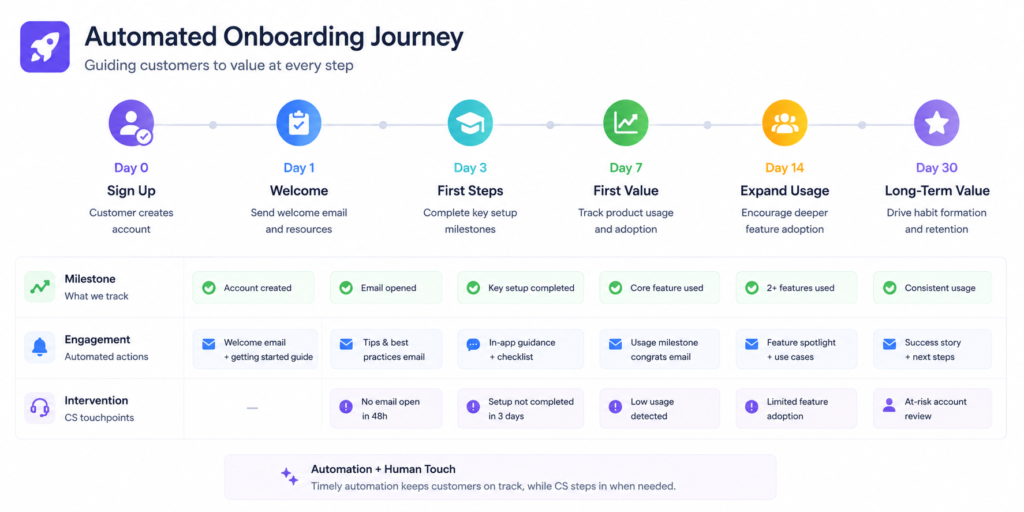
SaaS onboarding automation reduces churn by helping customers reach value faster. Automated onboarding workflows track adoption milestones, engagement levels, and implementation progress so teams can identify stalled accounts early.
Poor onboarding is one of the biggest drivers of SaaS churn.
If customers fail to adopt the product early, renewal risk increases quickly.
Many SaaS companies use CRM automation for SaaS churn reduction to monitor onboarding milestones and identify stalled accounts before adoption declines.
Automation gives SaaS teams clearer onboarding visibility and faster intervention timing.
Example SaaS Onboarding Workflow
- Customer signs contract
- CRM creates onboarding journey
- Product adoption milestones tracked automatically
- Inactive users receive reminders
- Health scores update continuously
- CSM intervention triggers if onboarding stalls
SaaS onboarding automation also supports:
- stakeholder training
- onboarding task completion
- adoption milestone tracking
- time-to-value monitoring
- customer education workflows
Time-to-value measures how quickly a customer reaches a meaningful outcome after purchasing a SaaS product.
Instead of sending the same onboarding emails to every customer, automation personalizes engagement based on customer behavior.
For example:
- low feature adoption triggers tutorial content
- inactive admins trigger outreach reminders
- incomplete implementation tasks trigger escalation
Platforms like ChurnZero help customer success teams track onboarding progress and automate engagement during early lifecycle stages.
CRM Automation Workflows for Engagement and Renewals
CRM automation for SaaS churn reduction helps customer success teams monitor engagement, renewal readiness, and account health continuously.
Automated workflows identify risk early, trigger proactive outreach, and improve renewal visibility across the customer lifecycle.
Renewal risk usually develops through declining engagement and lower product adoption.
Common signals include:
- declining product engagement
- lower feature adoption
- missing executive sponsors
- unresolved support issues
- stalled onboarding progress
CRM automation for customer retention helps SaaS teams monitor churn-risk signals continuously across onboarding, engagement, and renewals.
Example Renewal Automation Workflow
- Renewal reaches 120-day window
- Health score review triggers automatically
- CRM checks stakeholder engagement levels
- Expansion opportunities routed to account owners
- Executive escalation triggers if renewal risk increases
- Renewal playbook launches automatically
| Timeline | Automated Action |
| 120 days before renewal | Health review triggered |
| 90 days before renewal | Stakeholder engagement check |
| 60 days before renewal | Expansion opportunity review |
| 30 days before renewal | Executive escalation if risk detected |
This process gives customer success teams time to:
- improve adoption
- resolve customer friction
- strengthen executive alignment
- identify expansion opportunities
For example, a SaaS retention workflow inside ChurnZero may:
- alert CSMs when executive engagement declines
- trigger onboarding reviews for low-adoption accounts
- launch customer education campaigns automatically
- surface expansion opportunities based on usage growth
Retention teams can address churn risk earlier instead of reacting late in the renewal cycle.
How RevOps Teams Support CRM Automation for Customer Retention
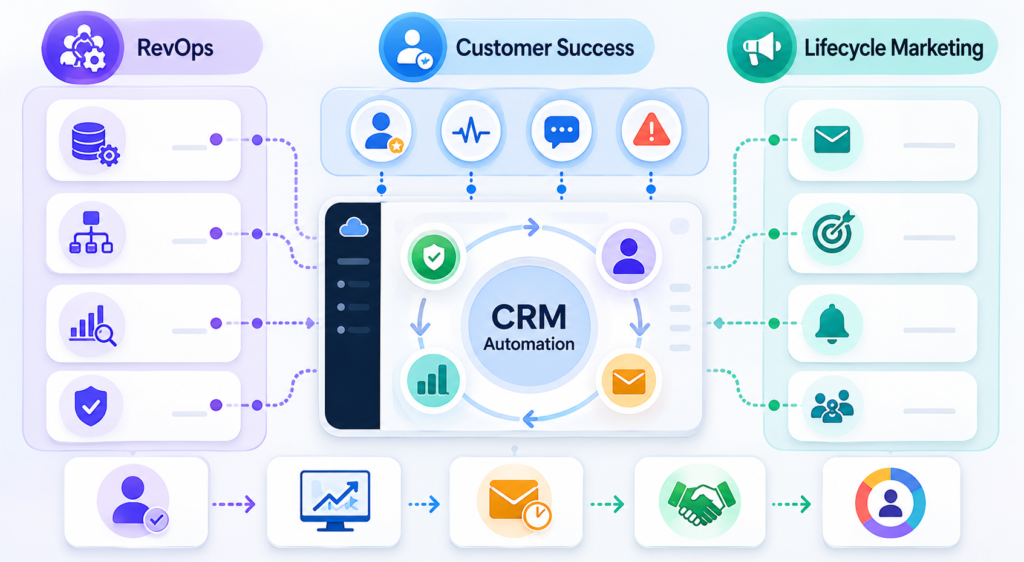
RevOps (Revenue Operations) aligns sales, marketing, customer success, and operational systems to improve revenue efficiency and reporting consistency.
RevOps teams manage:
- CRM data structure
- segmentation logic
- workflow orchestration
- reporting systems
Customer success teams manage:
- intervention playbooks
- onboarding workflows
- renewal engagement
- customer education
Lifecycle marketing teams support:
- engagement campaigns
- product education sequences
- stakeholder communication
| Team | Responsibility |
| RevOps | CRM data orchestration |
| Customer Success | Intervention playbooks |
| Lifecycle Marketing | Engagement automation |
This alignment creates a connected retention infrastructure instead of isolated customer workflows.
Strong CRM automation systems also improve:
- reporting accuracy
- customer segmentation
- churn forecasting
- operational scalability
Retention workflows should trigger the right action at the right time based on customer behavior.
What to Look for in Customer Success Software for SaaS Retention
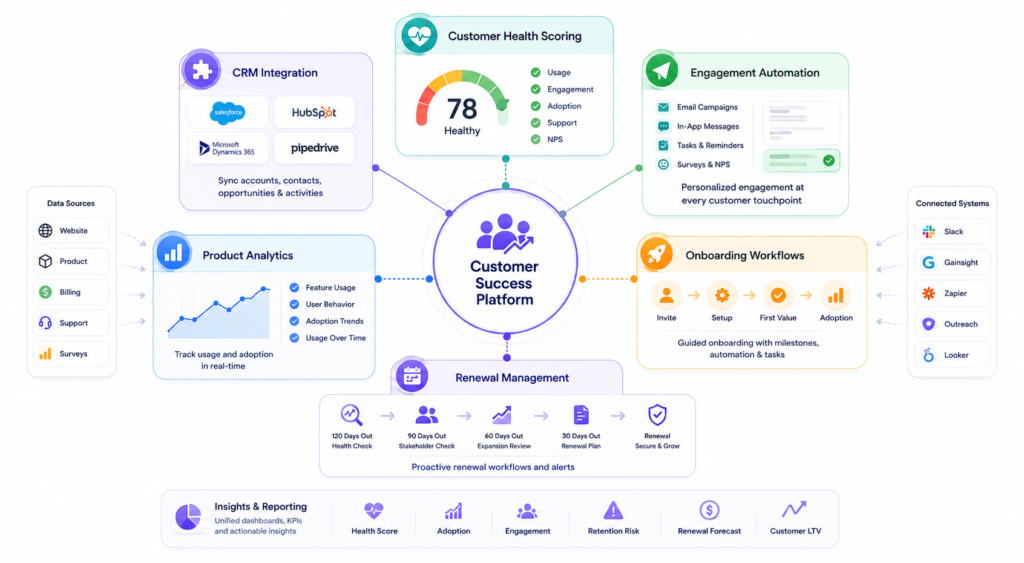
SaaS teams evaluating retention software should focus on operational visibility and workflow automation, not just dashboards.
Key capabilities include:
- CRM integrations
- customer health scoring
- onboarding automation
- renewal management
- product usage tracking
- workflow automation
- reporting and segmentation
Before selecting a platform, SaaS teams should ask:
- Does the platform connect CRM and product usage data?
- Can workflows trigger automatically from customer behavior?
- Does it support onboarding and renewals in one system?
- Can customer success teams scale account management efficiently?
- Does the platform improve proactive retention visibility?
Platforms like ChurnZero help SaaS teams operationalize customer retention across onboarding, engagement tracking, health scoring, and renewal workflows.
Competitors like Gainsight , Totango ,Vitally also support customer success operations.
But SaaS teams should evaluate which platform best fits their operational workflows, reporting structure, and retention goals.
See How SaaS Teams Reduce Churn Proactively
CRM automation for SaaS churn reduction helps customer success teams move from reactive retention management to proactive customer lifecycle operations.
By connecting CRM activity, onboarding progress, customer health scores, engagement monitoring, and renewal workflows, SaaS teams gain earlier visibility into churn risk and customer engagement trends.
ChurnZero helps SaaS teams centralize customer success operations with automated health tracking, onboarding workflows, engagement monitoring, and renewal management.
Request a demo to see how automated retention workflows work in practice.
FAQ
How does CRM automation reduce churn in SaaS?
CRM automation reduces churn by identifying customer risk signals early and triggering retention workflows automatically. SaaS teams use onboarding automation, customer health scoring, engagement tracking, and renewal alerts to intervene before customers disengage or fail to renew.
What is customer success automation?
Customer success automation is the use of workflows, customer data, and behavioral triggers to automate retention activities across the customer lifecycle. These workflows support onboarding, customer health monitoring, engagement campaigns, renewal management, and churn prevention.
How do customer health scores work?
Customer health scores work by assigning weighted values to customer behaviors such as product usage, onboarding completion, support activity, stakeholder engagement, and NPS responses. Low scores trigger proactive retention workflows that help teams address risk before churn happens.
What metrics predict SaaS churn?
The most common SaaS churn indicators include declining login frequency, low feature adoption, onboarding delays, support ticket spikes, low stakeholder engagement, reduced product usage, declining executive participation, and low customer satisfaction scores.
SaaS teams often track these metrics inside customer success platforms like ChurnZero to automate churn-risk detection.
How do SaaS companies automate renewals?
SaaS companies automate renewals by using CRM workflows tied to customer health, engagement activity, and renewal timelines.
A typical renewal automation process includes renewal timeline monitoring, health score evaluation, stakeholder engagement tracking, expansion opportunity review, automated risk escalation, and renewal playbook activation.
This helps customer success teams manage renewals proactively.
Editorial note: This is a self-led SaaS content sample created for my portfolio. It is not written for a specific CRM platform or sponsored by any brand. The goal is to show how retention-focused SaaS content can be structured around search intent, buyer clarity, workflow examples, AEO, and AI visibility.
Need SaaS content built for SEO and AI visibility?
Work with Manal Ghamir on answer-first SaaS content that supports Google rankings, AI search visibility, buyer education, and product clarity.
View Services View Portfolio Contact ManalProject Overview
This CRM automation for SaaS churn reduction sample shows how a retention-focused SaaS article can move beyond general advice and give readers practical workflows. The structure connects churn signals, customer success actions, CRM automation, lifecycle triggers, and buyer-ready examples.
The sample is part of my SaaS content portfolio, where I focus on SEO, AEO, GEO, AI visibility, answer-first structure, and clearer content for B2B SaaS buyers.
- View my SaaS SEO writing portfolio.
- Explore my SaaS content writing services.
- Read my guide on AEO content for SaaS brands.
- Learn the difference between SEO, AEO, and GEO.
- Read why SaaS blogs lose rankings when they answer too late.