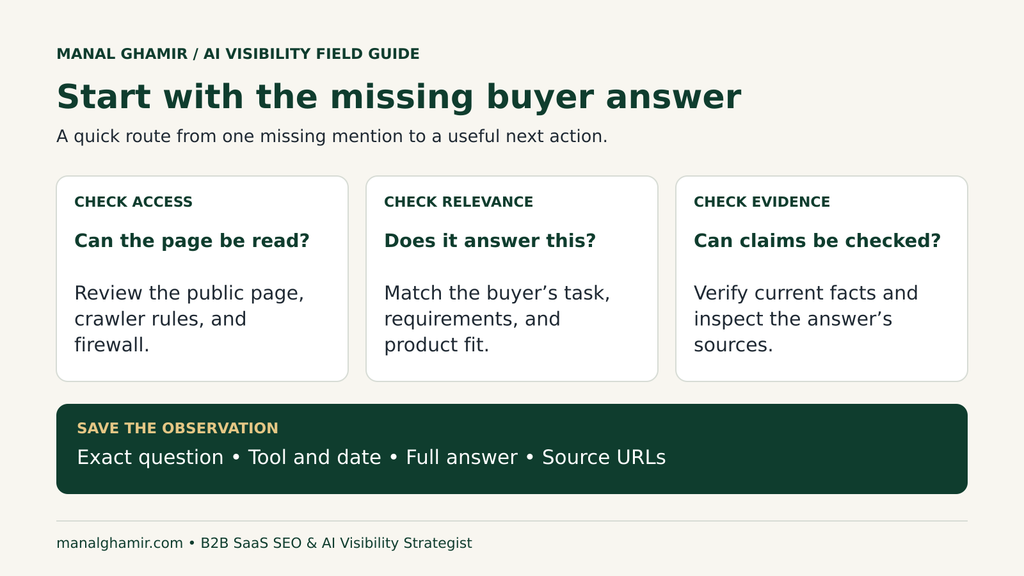
Your SaaS blog can rank in Google and still be missing from a ChatGPT answer. The tool may not have searched the web, may not have accessed your page, or may have found sources that better answer that particular question. Unclear product details and conflicting information are other issues to check.
If your SaaS is not showing up in ChatGPT, start with the exact buyer question and the sources behind the answer. Then check access, relevance, and accuracy before rewriting anything.
Table of Contents
1. Why Google rankings and AI answers can differ
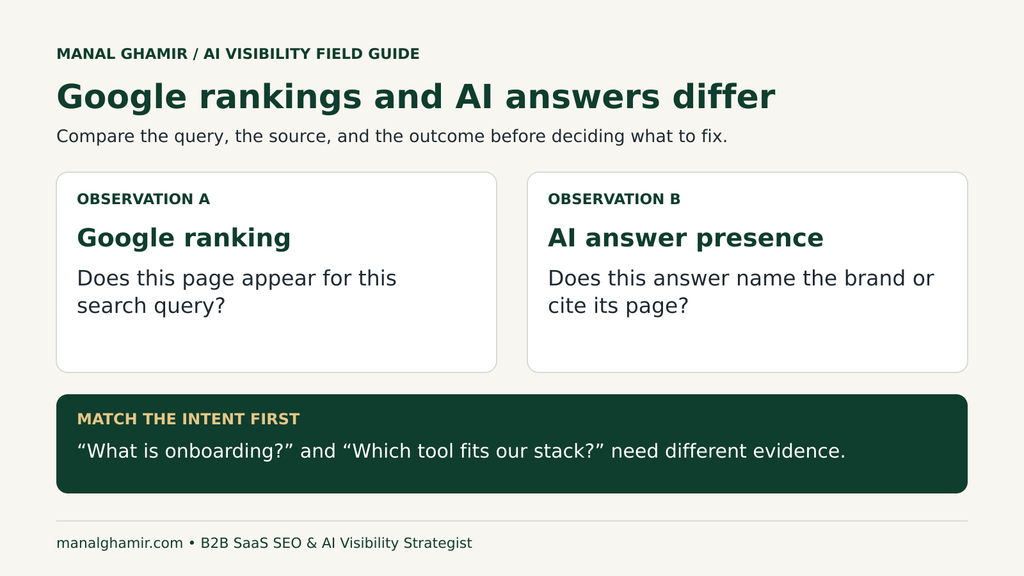
A Google ranking and a brand mention in an AI answer are different observations. Your article might answer “what is customer onboarding?” well, while a buyer asks ChatGPT for onboarding software with a specific integration and budget.
A definition alone does not establish that your product meets those requirements.
OpenAI explains that ChatGPT can search automatically, rewrite prompts into targeted searches, and use search partners. Its results are not a copy of the Google results you see.
Start by separating five possible issues:
- Test conditions: The answer did not use web search, or earlier conversation context shaped it.
- Access: The relevant page could not be retrieved.
- Relevance: Your article answers a different question.
- Clarity and proof: Product claims are vague, unsupported, or out of date.
- Other sources: The answer relies on pages elsewhere that omit or misdescribe your brand.
These are things to investigate, not a published list of ChatGPT ranking factors. One missing mention does not identify which issue applies.
Where GEO fits with SEO
GEO means generative engine optimization: work aimed at improving how content appears in generated answers. It overlaps with SEO through useful content, accessible pages, and accurate information. The measurements differ, but the work often involves the same pages.
Google’s guidance for its AI features says normal SEO practices still apply and no special AI markup is required. That guidance covers Google, not every AI tool. My SEO, AEO, and GEO guide explains the wider terms.
2. Check what the answer actually uses
When web search is used, open the sources. You may find product pages, help articles, comparisons, reviews, or other public information. These sources do not reveal a universal preference for one website type.
Ask whether each source offers clear product information, relevant evidence, and a current answer to the buyer’s question. A pricing page may answer a pricing question better than your blog.
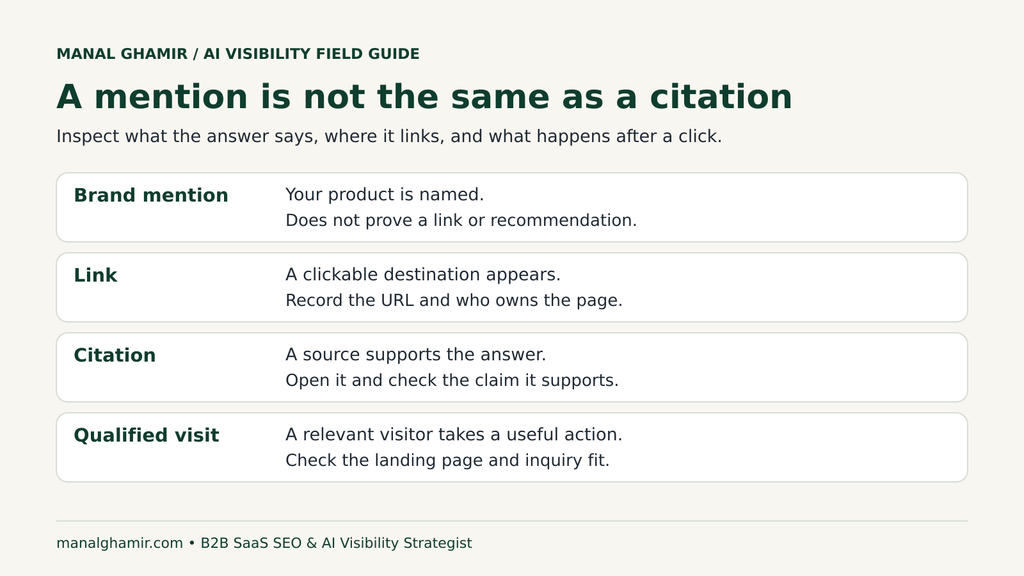
Keep these outcomes separate:
| Outcome | What to record |
|---|---|
| Brand mention | Your company or product name appears in the answer. |
| Link | A clickable URL appears. Record its destination. |
| Citation | A source is presented as support for the answer. Check what claim it supports. |
| Qualified visit | A visitor arrives and takes an action relevant to buying, such as requesting a suitable demo. |
A third-party review can support an answer that mentions your brand without linking to your website. Your article can also be cited for a definition without your product being recommended. Neither observation proves a visit or a sale.
3. Diagnose a missing or inaccurate answer
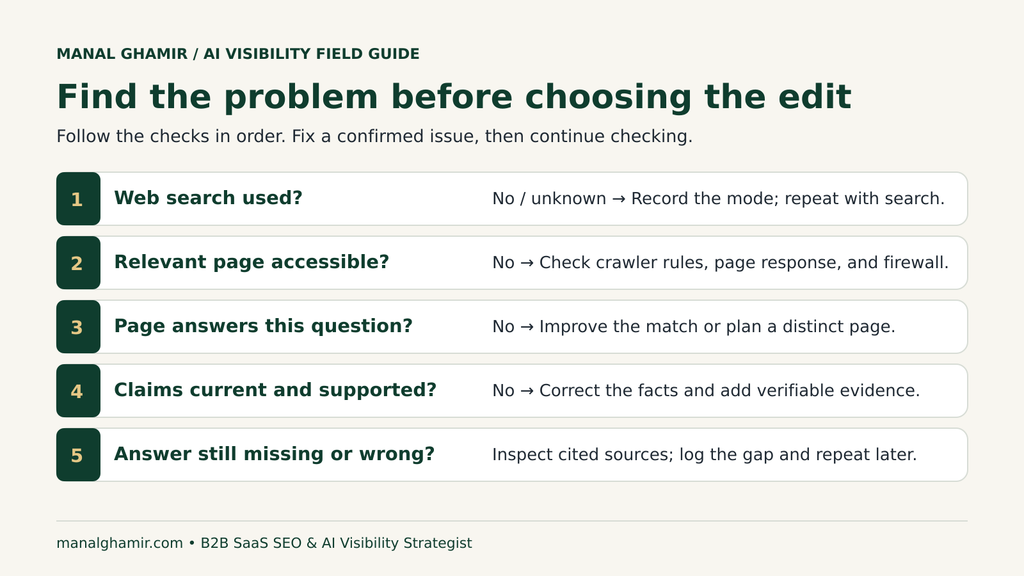
Check access before polishing paragraphs.
Check access and indexing where applicable
Ask your developer to inspect the public page response, robots.txt, and security logs. Can the relevant crawler receive the important text without a login or challenge page?
OpenAI’s crawler documentation separates OAI-SearchBot, used for search, from GPTBot, used for potential model training. Their permissions are independent. Allowing training is not a requirement for allowing search. ChatGPT-User handles certain user-requested visits and is not the control for search eligibility.
Perplexity’s documentation identifies PerplexityBot as its search crawler. Check firewall rules as well as robots.txt, using the provider’s current verification guidance. Do not disable security across the site.
For Google, use Search Console URL Inspection to review the indexed URL, canonical selection, and live-page test. Review accidental noindex settings separately from crawl blocks. Google distinguishes crawling from indexing; they are not interchangeable.
Google indexing does not confirm ChatGPT access. Likewise, a successful crawler request does not prove citation selection.
Check the content against the question
| Check | Ask your team |
|---|---|
| Product and category | Does the page name the software type, audience, and job it performs? |
| Relevance | Does it address the buyer’s actual constraints? |
| Answer quality | Is the conclusion clear, with conditions and limits? |
| Proof | Can readers verify the feature, integration, price, or result? |
| Consistency | Do current product pages and third-party descriptions agree? |
For an incorrect answer, save the exact claim and open its citation. If the source is wrong, correct your own page or request a factual correction from its publisher. If the source is accurate but the answer misreads it, record that distinction. A site rewrite may not resolve a model error.
4. Put the buyer’s answer first, then support it
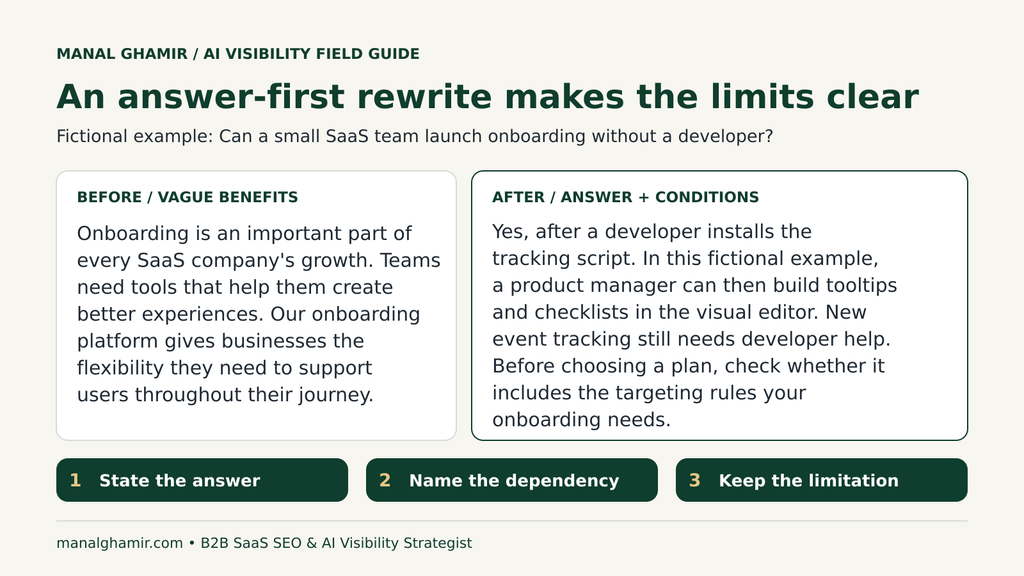
An answer-first paragraph starts with the conclusion, explains the conditions, and points to supporting detail. No paragraph length or heading format guarantees extraction or a citation.
Fictional example. Buyer question: “Can a small SaaS team launch in-app onboarding without a developer?” The product and capabilities below are invented for illustration.
Weak paragraph
Onboarding is an important part of every SaaS company’s growth. Teams need tools that help them create better experiences. Our onboarding platform gives businesses the flexibility they need to support users throughout their journey.
Stronger rewrite
Yes, after a developer installs the tracking script. In this fictional example, a product manager can then build tooltips and checklists in the visual editor. New event tracking still needs developer help. Before choosing a plan, check whether it includes the targeting rules your onboarding needs.
The rewrite gives the answer immediately. It names the setup dependency, explains what the buyer can do, and makes the limit visible. A real version should link to installation, event-tracking, and plan documentation.
Keep the implementation detail below the opening answer. Readers still need it to judge fit. For more on delayed introductions, see why SaaS blogs answer too late.
5. Use FAQs to resolve real objections
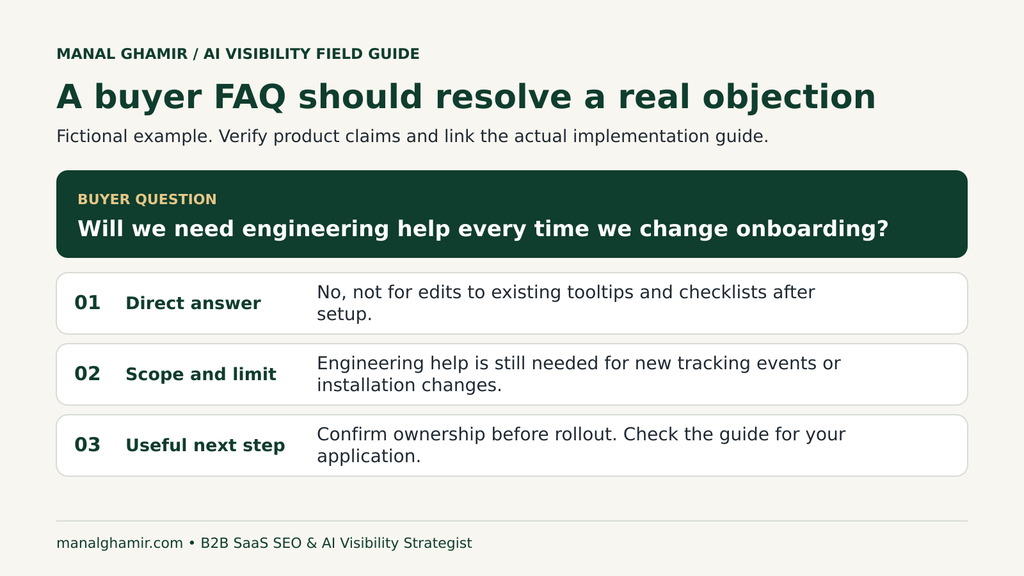
A useful FAQ resolves a purchase objection or misunderstanding. Use a plain question heading, a direct first sentence, then the conditions and evidence.
Here is another fictional example, using the same invented product:
Will we need engineering help every time we change onboarding?
No, not for edits to existing tooltips and checklists after setup. Engineering help is still needed for new tracking events or changes to installation. Confirm who owns those tasks before rollout, and check the implementation guide for your application.
This separates routine edits from technical setup. Verify claims with the product team.
Keep essential conditions in page text. Avoid repeated keywords. FAQ formatting and FAQ markup are different things; neither should be sold as a guarantee of AI inclusion. Google’s AI guidance does not require special structured data.
6. Run a five-question baseline in both tools
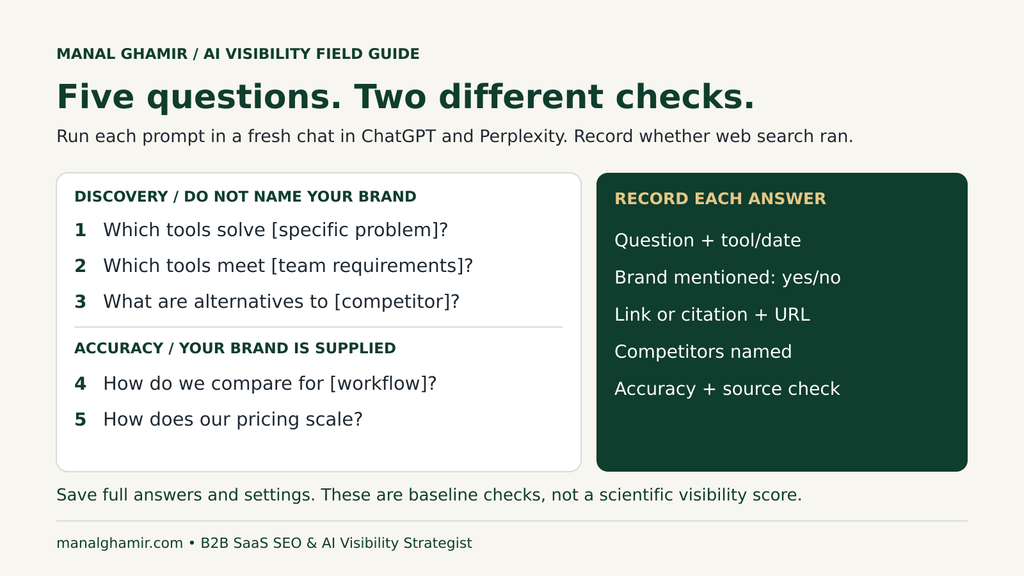
Replace the brackets below, then run each question in a separate fresh chat in ChatGPT and Perplexity. Use the same wording in both. For this baseline, use web search where available and record whether it ran.
- “Which tools help US B2B SaaS teams solve [specific problem]? Explain who each option fits.”
- “Which [category] tools suit a [team size] team that needs [must-have integration]?”
- “What are alternatives to [competitor] for [use case], and what tradeoffs should we check?”
- “How does [our product] compare with [competitor] for [specific workflow]?”
- “How is [our product] priced as [users, seats, or usage] grows, and what limits should we check?”
Questions 1–3 test discovery without naming you. Questions 4–5 test accuracy after your brand is supplied. Do not combine them into a claim about how often buyers discover you.
| Question | Tool/date | Brand mentioned | Linked or cited | Competitors named | Accuracy |
|---|---|---|---|---|---|
| Q1: Problem | Record | Yes/no | Type + URL | Names | Correct/error/unclear |
| Q2: Requirements | Record | Yes/no | Type + URL | Names | Correct/error/unclear |
| Q3: Alternatives | Record | Yes/no | Type + URL | Names | Correct/error/unclear |
| Q4: Comparison | Record | Yes/no | Type + URL | Names | Correct/error/unclear |
| Q5: Pricing | Record | Yes/no | Type + URL | Names | Correct/error/unclear |
Make one row per question per tool. Save full answers and source URLs, plus model or mode where shown, location, and personalization settings.
Results can vary with the prompt, model, date, location, available sources, conversation context, and whether web search runs. This is a useful baseline, not a scientific score or proof of a lasting change.
My Chameleon AI visibility teardown shows why those records matter. It separates broad buyer questions from brand-led questions and states limits in the supplied answers. Use it as an example of careful interpretation, not proof of a repeatable citation lift.
7. Improve the existing page before adding another
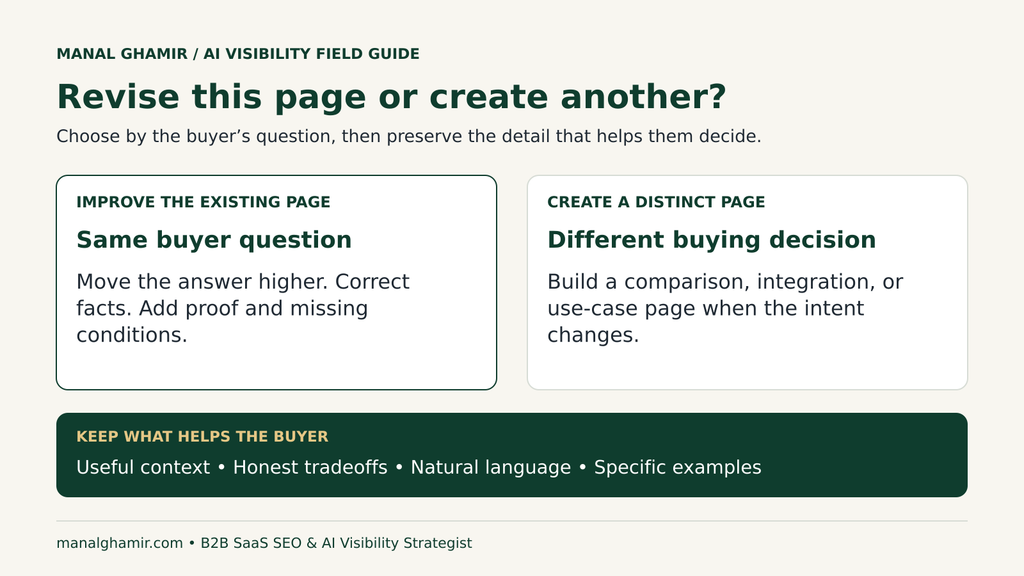
Restructure an existing article when it already serves the right question and contains reliable information. Move the answer higher, clarify the product’s role, update evidence, and connect the reader to relevant documentation.
Create a new page when the buyer needs a different decision. An article explaining onboarding metrics should not become a full comparison page simply because a comparison prompt omitted your brand.
Choose one priority page and document each edit:
- Fix confirmed access problems with technical help.
- Correct inaccurate or conflicting product information.
- Answer the chosen buyer question directly.
- Add verifiable examples and missing conditions.
- Add useful internal links and record the publication date.
Keep context, honest tradeoffs, natural language, and examples. Do not delete a valuable explanation to hit a fixed answer length. Do not rename every heading as a question or repeat the brand in every sentence.
Correct inaccurate third-party sources too. Rewriting your own introduction cannot fix every visibility problem.
8. Follow a realistic 30-day improvement plan
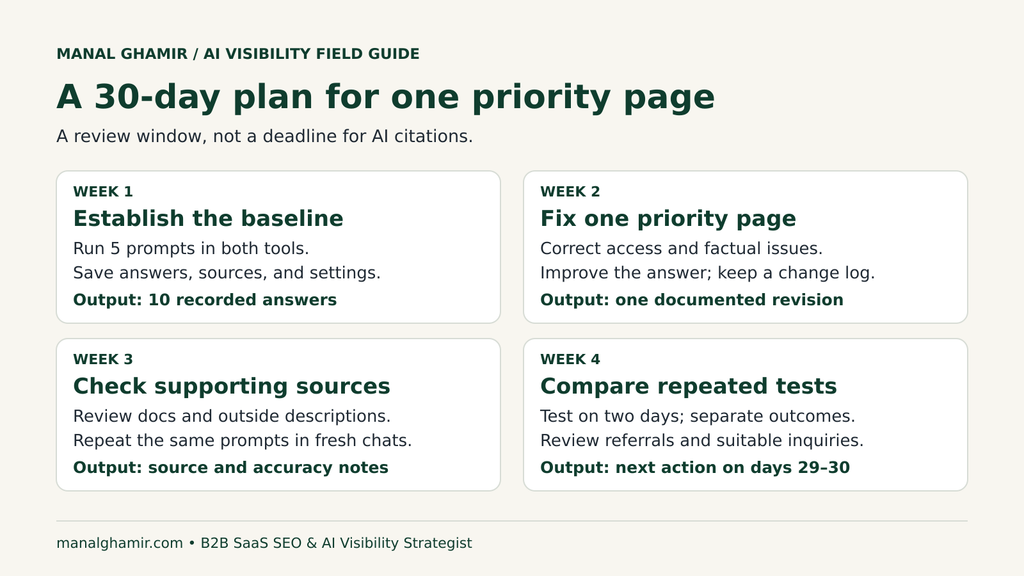
Week 1: Establish the baseline. Run the five questions in both tools. Save the ten answers, inspect their sources, and choose one page. Separate confirmed problems from guesses.
Week 2: Fix the priority page. Resolve access issues with your developer, correct factual conflicts, and revise the main answer. Keep a dated change log.
Week 3: Check supporting information. Review relevant help pages, internal links, and third-party descriptions. Repeat the same prompts in fresh chats. Record errors even when your brand is mentioned.
Week 4: Compare repeated observations. Rerun the same tests on two different days. Compare discovery mentions, links to your domain, citations to the edited page, and factual accuracy separately. Use days 29–30 to choose the next action.
Review referral visits and meaningful actions in your analytics as a separate measure. OpenAI documents a ChatGPT referral parameter that can help identify traffic. Check actual landing pages and completed inquiries; do not equate a mention with a qualified visit.
Treat attribution as incomplete: copied links, missing referrers, and later return visits can complicate the picture. Thirty days is a review window, not a promised deadline for citations.
FAQ
Is GEO different from SEO?
Yes, GEO focuses on visibility in AI-generated answers, while SEO focuses on visibility in search results. The work overlaps: accessible pages, relevant answers, accurate product details, and useful evidence support both. Keep them in one content plan, but measure search rankings and AI mentions separately.
Do I need new content, or can I improve an existing article?
Improve the existing article when it already matches the buyer’s question. Clarify the main answer, update product facts, and add missing evidence or conditions. Create a new page when the buyer needs a different answer, such as a comparison or integration decision your article does not cover.
Why does ChatGPT mention a competitor instead of my SaaS?
The competitor may fit that particular question better or appear in the sources used for the answer. Check those sources, the buyer’s requirements, and whether web search ran. Then review your own page’s access, relevance, and accuracy. A competitor mention alone does not prove that its product is better.
How can I measure whether changes are helping?
Repeat a fixed set of buyer questions in fresh chats and record brand mentions, links, citations, and factual accuracy separately. Track relevant referral visits and inquiries in your analytics too. Keep questions that name your brand separate from discovery questions. Repeated improvement is useful evidence, but it does not prove your edit caused it.
Can I guarantee that ChatGPT will cite my page?
No. OpenAI states that placement is not guaranteed. Clear answers, accurate information, and crawler access can address avoidable problems, but no heading format, FAQ markup, or content rewrite can ensure a citation. Results can change with the prompt, model, available sources, and whether the tool searches the web.
Want help choosing the first edit?
Start with a free Answer-First Page Check for one existing SaaS page. Send me the page URL and the buyer question it should answer.
This is a focused check of your page’s main answer, not a full audit.
Request My Free Page CheckNeed the page written or revised? Explore my AI Visibility Content service for the paid next step.